

The Amount Of Shots In A Handle Of Liquor
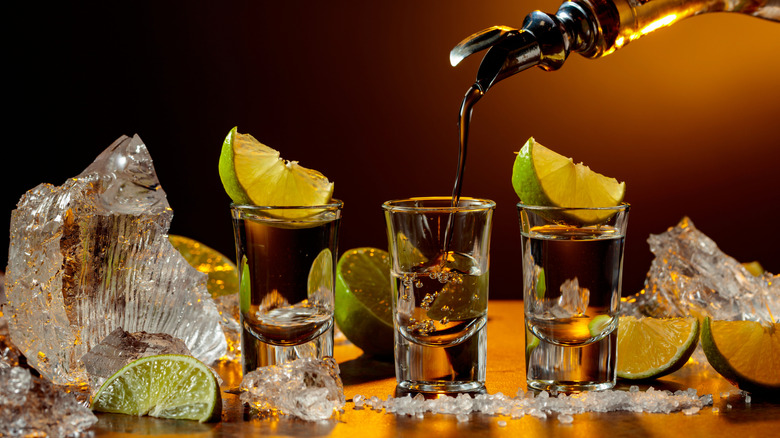
The math of maintaining a home bar is not always as simple as it seems. There is a lot of jargon in the world of booze from different bottle sizes like "fifths" and "handles" to different measures like "jiggers," "shots," and "fingers." Then there's the trouble of bottles being sold in liters, and measured for drinks in ounces. Figuring out these various numbers is always good, so that you can better judge the value of a bottle of liquor, but it is especially paramount when it comes to party planning.
A "handle" of liquor is the largest bottle size that's typically available, measuring in at 1.75 liters. Because of economies of scale, this is the size that usually offers the best value, so it's perfect for large events. To figure out just how many shots are in there, though, we'll have to convert those liters to ounces. Based on our calculations, 1.75 liters equates to just over 59 ounces. According to both industry standard and what the CDC considers one liquor drink, a shot is 1.5 ounces. So, from those 59 ounces, one can pour a total of 39 shots — with about half of an ounce to spare.
Plugged into a rule for determining how many drinks one needs for a party, that number is very useful for putting together a shopping list. There is, however, more nuance to the math of bar prep than just determining how many drinks make up a handle.
There's more to liquor than the number of shots in a bottle
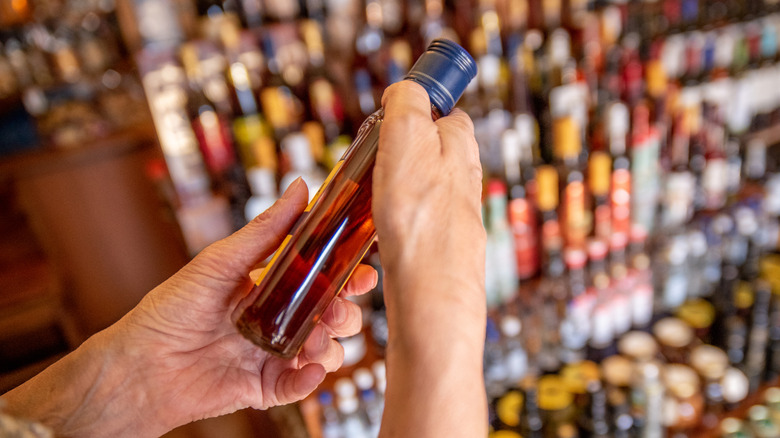
Another important factor to consider is the strength of the liquor being poured. There is something of a standard across the world of booze, with the grand majority of liquors bottled at 80 proof, or 40% alcohol by volume. This is also the benchmark used by the CDC for determining what qualifies as a single liquor drink. There are, however, plenty of bottles that stray from this norm in both directions. Cask strength bourbon, for example, is not diluted when it comes out of the aging barrel, so it may be much stronger, measuring around 50% to 75% ABV. Things like liqueurs, on the other hand, are generally lower in alcohol, often in the 15% to 30% ABV range. These factors don't affect the size of the shot, but strength is just as important to consider as size.
Throwing a wrench into the works, the definition of a "standard" alcoholic drink is not universal. In the U.S., those 1.5 ounces of 80-proof liquor — or 12 ounces of beer or five ounces of wine — have 0.6 ounces (or 14 grams) of pure ethanol. Elsewhere, that differs. In Austria, for instance, the standard is closer to 20 grams, while in Canada it's 13.5 grams. According to the World Health Organization, it is just 10 grams per drink, which is closer to one ounce of standard-strength liquor.
In the end, though, we're going to have to stick with the U.S. numbers and the local industry standard. The expected size and strength of a drink might vary around the world, but in the States, with all our jargon for liquor — also called spirits — that handle of booze contains just over 39 shots.