

Reese's Peanut Butter Cups Vs Snickers: Which Classic Candy Is Actually Healthier?

Nobody is peeling open a Snickers or Reese's Peanut Butter Cup thinking they're doing something great for their body, but not all indulgences are created equal either. And with growing concern over the added sugar in our food, it's not unreasonable to ask which one is healthier. There's nothing wrong with treating yourself to a candy bar occasionally, and there's nothing inherently unhealthy about sugar. Consumed in moderation, even some added sugar isn't too bad. But the moderation part can be tough. The average American adult consumes a lot of added sugar: 77 grams a day, which is about 20 teaspoons. That's more than double the daily recommended maximum intake. Taking those concerns into account, a two-pack of Reese's Cups is a little healthier than a Snickers bar.
Sugar isn't the only aspect of health here, but for a candy bar, it's the biggest concern, and beyond that there's not a huge difference between Reese's and Snickers. Neither option is going to blow up your sugar intake by itself, but they have enough that they should stay a treat. One pack of Reese's has 21 grams of added sugar, while Snickers has 25. That's 42% and 50% of the top recommended limit, respectively. That's not a huge difference, and it probably mostly comes from Snickers' slightly larger size, at 1.86 ounces compared to Reese's 1.5. But it's not meaningless either, as it amounts to about a teaspoon of sugar.
For most people, that's probably not enough to make anything other than taste the reason you pick one over the other. But if you're really trying to limit added sugar, that might mean skipping it in your coffee or other places.
Reese's and Snickers are both very similar in nutrition overall
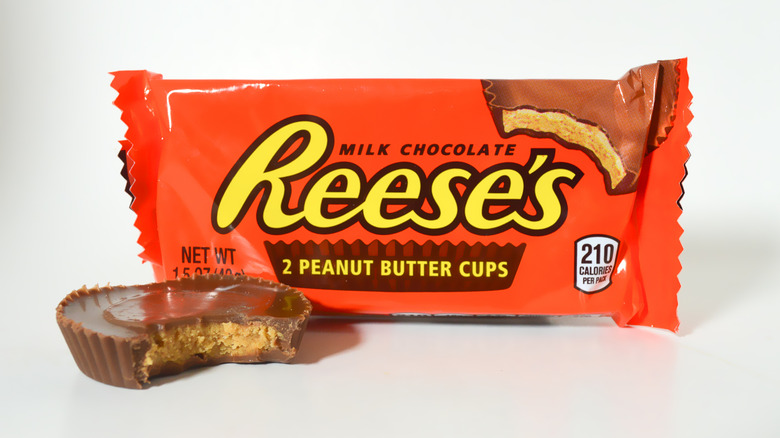
Outside of sugar, these two candies are nearly identical. The U.S. Food and Drug Administration lists saturated fat, trans fat, and sodium as the other things to limit or avoid in your diet besides added sugar, and both Reese's Peanut Butter Cups and the classic-flavored Snickers bar are fine here. Both snacks have 4.5 grams of saturated fat, no trans fat, and Reese's only has 135 milligrams of sodium, just 5 milligrams more than Snickers. For a small snack, that's a decent amount of saturated fat, but still only 23% of your daily total, and it's only 6% of your sodium limit.
The one other area where they slightly diverge is calories. Counting calories is not a great way of measuring overall health, however, as nutrition is more important, and it's really only helpful to some people trying to manage their weight. Even here the difference isn't huge, as Snickers has 250 calories compared to 210 for Reese's.
Unfortunately, neither is doing much for you nutritionally either. Snickers has 5 grams of protein, and Reese's has 4. That's not nothing, but it's less than 10% of even the minimum needs for the average adult. There is even less fiber: 2 grams in a Reese's pack, and 1 in a Snickers bar, which won't get you much closer to the 28 grams recommended each day for an average 2,000-calorie diet. But that's fine for what Reese's and Snickers are: a treat. And as long as you know what you're eating and don't get too much sugar in your other meals that day, eat what you want.