

Everything You Need To Know About Carolina Whole Hog BBQ
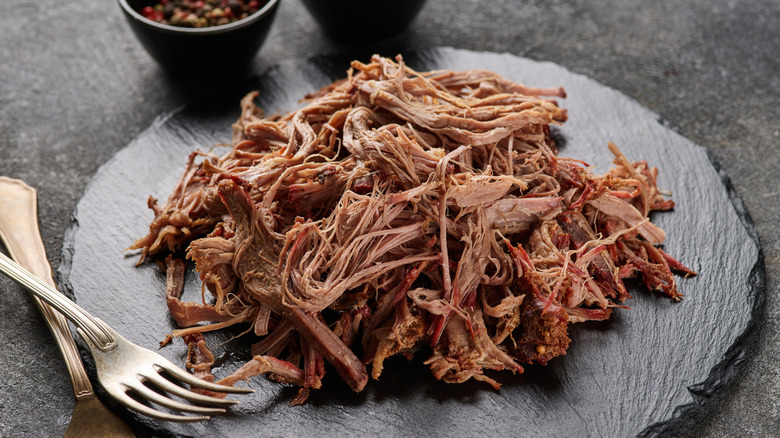
Different regions of the United States have distinct barbecue traditions. The grills, smokers, and pits may be fired up from California to the East Coast, but the proteins, sauces, and techniques vary greatly. In North and South Carolina, whole hog barbecue is the name of the game. The word barbecue is simply synonymous with pulled or chopped pork in this part of the country, and the details of how the hog gets from a farm to your plate are plentiful.
We've interviewed three experts from the world of Carolina barbecue to share their insider insights on all things whole-hog. Based in West Columbia, South Carolina, Robbie Robinson is the owner and pitmaster at City Limits Barbeque. Michael Letchworth, co-owner of Sam Jones BBQ, brings a North Carolina perspective. Adding historical context, David S. Shields is a Carolina Distinguished Professor Emeritus at the University of South Carolina.
The basics of whole hog barbecue are easy to understand. A hog is hoisted onto a smoker and, many hours later, a feast is served. But the process is far from simple. Choosing the hog, selecting the smoker, and deciding which wood to use all influence the final product and contribute to the tradition's enduring reputation.
The history of Carolina barbecue
Let's start at the very beginning. Pigs are not native to the United States and didn't arrive here until the Spanish did in the 1500s. There are two predominant theories for how the tradition of barbecuing pigs began. The first supposes that European colonists witnessed Indigenous peoples smoking their meats and began utilizing the same methods to cook larger animals. And the second theorizes that enslaved people learned this style of barbecue in the Caribbean and introduced it to the Carolinas. David S. Shields expressed that the exact origins are a bit murky, although "It's evident that it's a colonial-era thing, but the documentation really begins around the 1800s."
As time progressed, it was enslaved cooks who did the bulk of the work barbecuing meats. Shields explains, "In the early 19th century, barbecues were enormous events with thousands of people attending. They were performed over open pits, usually with enslaved cooks [barbecuing] in the open air."
After the Civil War, barbecue became increasingly commercialized. The end of slavery meant that businesses could no longer rely on the coerced use of enslaved labor, and barbecuers had to seek out the most economical source of meat. Whereas the original large-scale barbecue events tended to feature a vast array of meats, pork was becoming the defining protein of commercial Carolina barbecue. Shields explains, "Barbecue managers depended on the one livestock animal which existed in greatest profusion — the hog. And thus, whole hog barbecue becomes fixed."
The differences between North and South Carolina
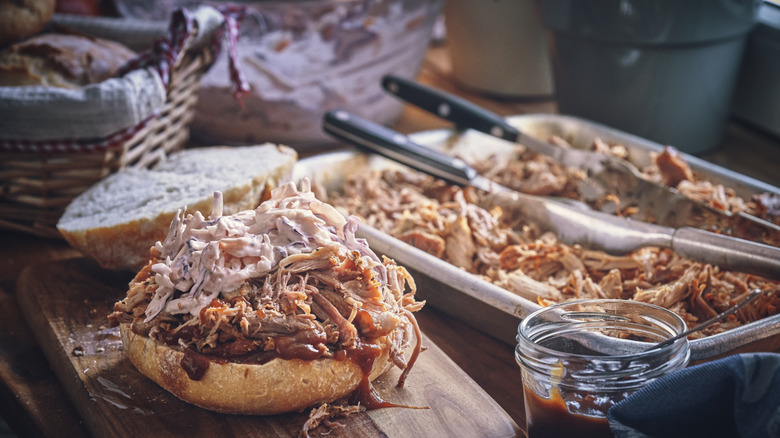
A discussion of Carolina barbecue must account for the differences between North and South Carolina. While the two states' barbecue styles may look quite similar, they take pride in their individual traditions. One of the clearest distinctions is the sauce served alongside the meat. North Carolina is known for two different variations of barbecue sauce, an eastern vinegar-and-pepper sauce and a western tomato-vinegar sauce. South Carolina, on the other hand, has four recognized regional barbecue sauces. These include the vinegar-based and tomato-based sauces, along with a heavier tomato sauce and a mustard-based barbecue sauce.
The whole-hog cooking process doesn't seem to vary much across state lines (although every pitmaster will have their own individualized technique), but the way the pork is served is an important distinction. Robbie Robinson explains, "The primary difference [between the two states is that] in South Carolina the hog is pulled, but [in North Carolina] it's chopped."
The pig
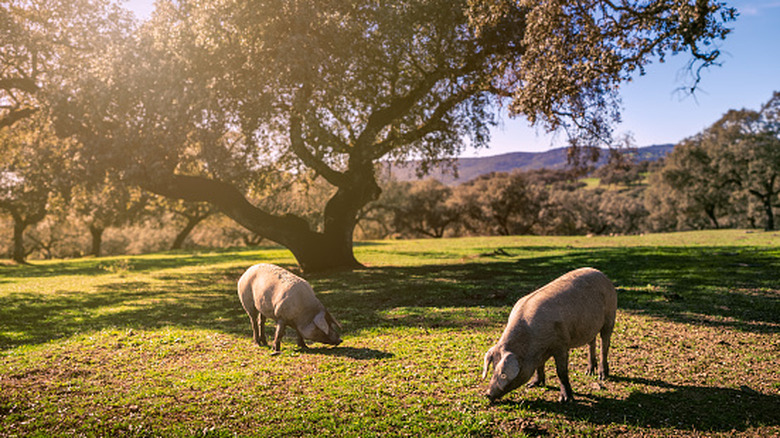
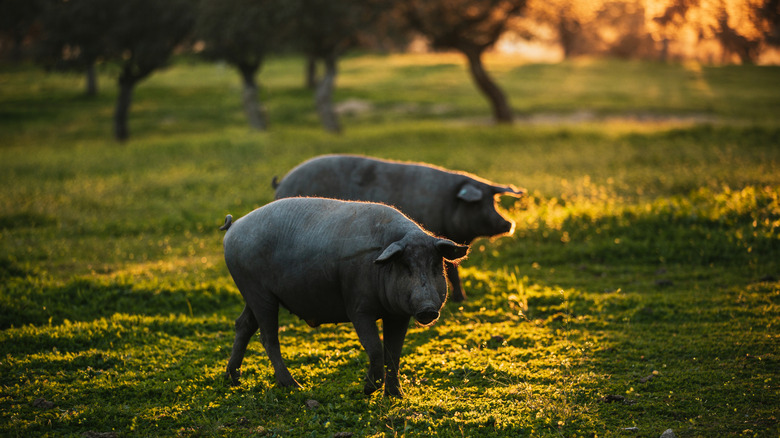
The first step in smoking a hog is choosing the right pig. The breed, size, and fat content all affect the flavor and quality of the finished barbecue. Historically, several heritage hog breeds have been common to the Carolinas, including the guinea hog, which is valued for its ability to forage for food and survive with minimal human intervention. David S. Shields explains, "Pigs have always run on the free side in the South; the penning of hogs is a rather late development in the grand scheme of things."
Some farms continue to raise heritage hogs today. The farm from which Robbie Robinson sources his pigs, Holy City Hogs, raises its heritage herds outdoors, "wild and free." Robinson says of the pigs, "They have a tremendous amount of marbling in them. That's what makes them so good."
While marbling is vital for flavor, it's also important to choose a hog that has a moderate overall fat content, as excessive fat will render out and reduce the amount of usable pork produced. Michael Letchworth says, "Breeds of hogs that have a large fat cap tend to not be great for what we do. From the business side, you don't get a good yield ... the product is just too fatty and not what we're looking for." A balance between marbled and meaty is ideal.
The pit
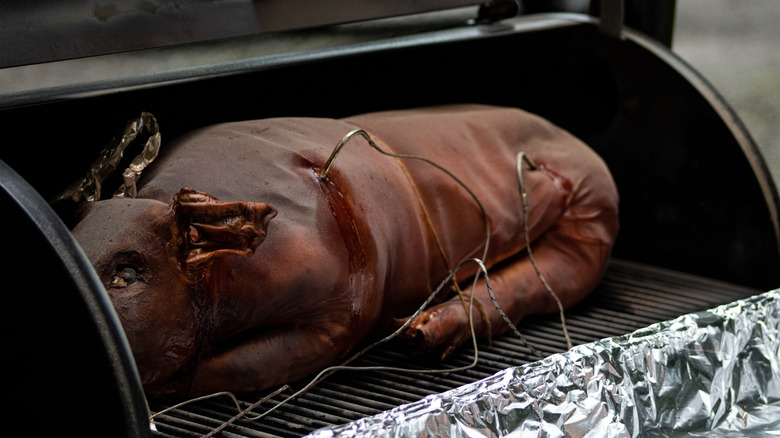
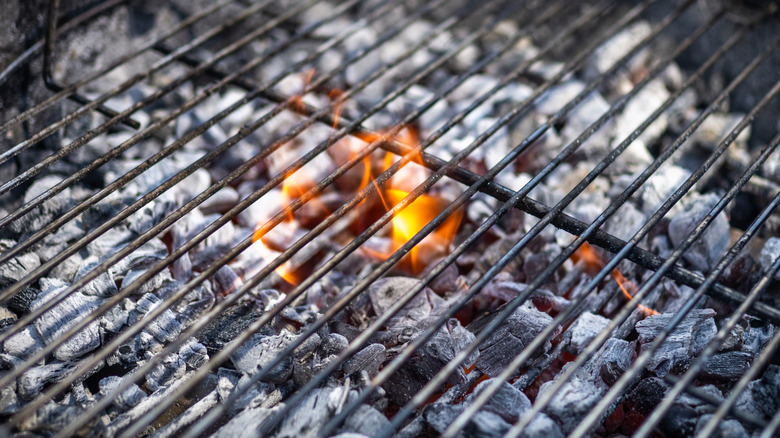
Grills, smokers, pits — the equipment used to cook meat varies from region to region. In the Carolinas, the name of the game is direct heat. Michael Letchworth explains, "Pits evolved from being holes in the ground to masonry pits, to now the steel pits of today. We just need a [rectangular] box with some airflow and a place to put some coals." Unlike Texas-style barbecue, which often uses offset smokers that burn wood in a separate firebox, the Carolina style of pit burns wood down to coals and cooks the meat directly over them.
The shift from earthen pits to masonry and steel designs reflects changes in transportation, regulation, and cooking practices. David S. Shields says, "The construction of state roads and the popularization of motoring gives rise to the roadside barbecue stand, and this brings about the end of the pit tradition. What you have is the construction of these above-ground brick barbecue [pits]." It's unclear why, exactly, the construction of roadside stands led to the building of brick pits, although it's possible it was simply a matter of usability.
Letchworth adds that while he enjoys using a masonry pit, there's a reason more pitmasters opt for steel. "The health department prefers to see something that can mitigate fires, that's cleanable, mobile, and checks the boxes for modern permitting processes." At City Limits Barbeque, Robbie Robinson loves using his modern steel pit, saying, "It's better engineered to help manage the highs and the lows and to deliver a more consistent product."
The wood
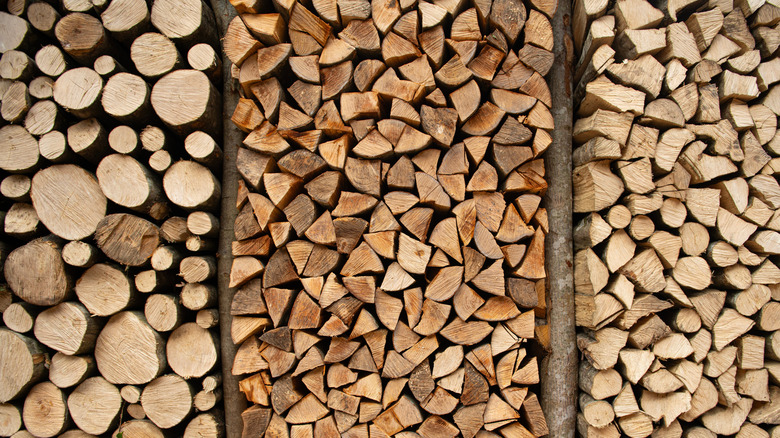
Choosing the right wood for smoking and grilling is important, not just for flavor but for the quality of the coals it produces. Michael Letchworth of Sam Jones BBQ in North Carolina explains, "In our style, we are burning the wood to create charcoal, and we're using those wood coals to fire our pit. Smoke is a byproduct of that, and using a hardwood will generate better coal quality." Certain hardwoods are particularly well-suited to Carolina-style barbecue because they produce hot-burning coals while still contributing flavor.
David S. Shields notes, "For South Carolina, hickory is really the most historically common." Today, pitmasters often use blends of hardwoods to fuel box pits. Robbie Robinson says, "For direct cooking over coals, we use a blend of hardwood. Oak, hickory, pecan — whatever I can get. We burn a lot of it to create the coals we put under the pig." Wood choices are broadly similar between North and South Carolina. Letchworth says, "We use oak and hickory" because they are readily available in the region.
The seasoning
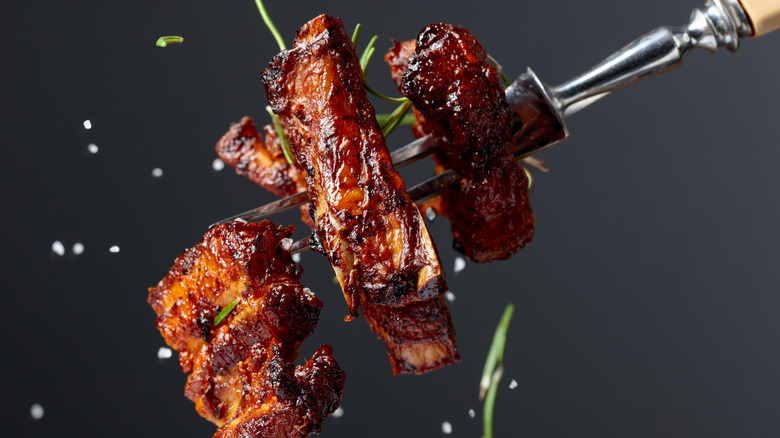
Seasoning blends around the world help define the flavors of regional cuisines. Changing one spice can transform any dish's character. In the Carolinas, the seasoning for barbecue is typically minimal. Robbie Robinson describes the traditional approach simply: "In North or South Carolina, you should only be using salt when you're cooking the pig." Some Carolinians take this minimalist approach further, waiting until the end of the cooking process to season the meat. Michael Letchworth says, "We do nothing to our pigs before they are actually chopped. [After chopping] the salt, pepper, vinegar, and hot sauce are added, and they are added in a modest amount to complement the pork."
Although some pitmasters season the hog only with salt during cooking, others apply their regional barbecue sauces while the hog cooks. David S. Shields explains, "[Some pitmasters] apply [their sauce] periodically during the cooking of the meat. They have a mop that they use to wet down the sides while they're cooking."
The sauce is applied with a literal mop, and the mixture can vary by subregion. Robinson adds, "You get into these subregional styles dealing with the pig once it's on the pit. In the Pee Dee style, they're mopping it with that vinegar, pepper flake, lemon, Texas Pete sauce."
The timing
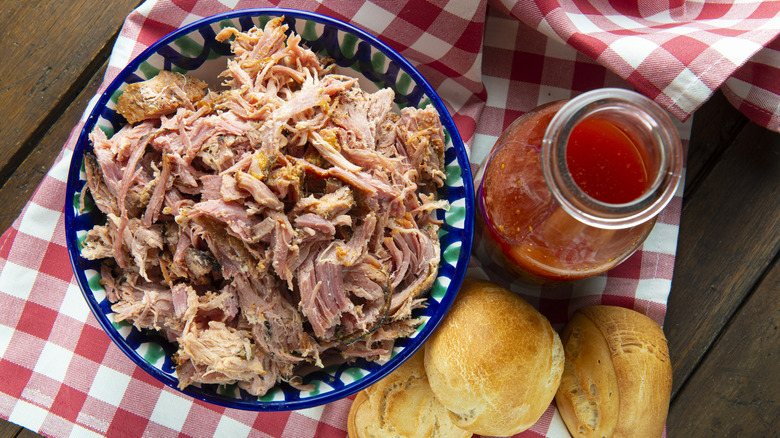
As you can imagine, cooking a whole animal is neither quick nor simple. Carolina whole-hog barbecue requires hours of cooking and close attention. Robbie Robinson says, "Our average pig size is about 140 pounds and takes about 12 hours to cook. We cook them during the day, not overnight, and at the end of [the night] I'm pulling the primals off, and we're throwing them into pans [in a hot-hold cabinet]."
Experienced pitmasters develop a precise sense of timing, but even with experience, cooking times may vary with hog size and temperature. Michael Letchworth says, "A pig in the size range that we cook, which is 165 to 185 pounds, can be cooked in 11 to 13 hours. [Although] temperature can have a pretty big impact on the timing of that."
Pitmasters must plan their cooking schedule around the temperature of the pig, its size, and the need to monitor doneness. Letchworth adds, "Once it's done, we're just maintaining the temperature of the pit so it's held at a safe temperature until we're ready to use it."
The biggest challenge
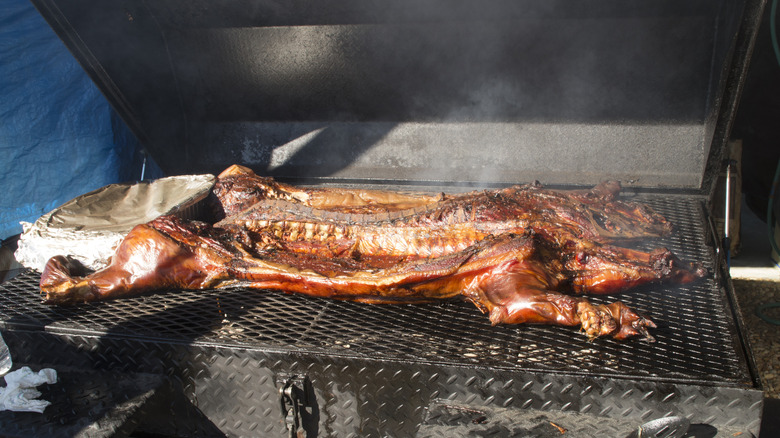
Cooking a whole hog presents several challenges, from selecting the wood and pig to managing the fire and timing. The biggest hurdle, however, is cooking the animal evenly. The animal is composed of well-marbled shoulders, thick hams, ultra-fatty bellies, and lean loins. The lean loin is especially prone to drying out when overcooked. Even pan-cooking a pork chop — a single cut of the loin — can be tricky. Cooking the entire hog evenly, with all these cuts still attached, is far more challenging. Robbie Robinson says, "If you've ever had bad whole hog, more than likely it's because the loin was [overcooked]."
To produce moist, tender Carolina barbecue, you have to be able to pay attention to how each part of the pig cooks. Robinson adds, "We really look at each of the individual primals as different components of the pig. If one of them is done, it's time for us to pull it. When that pig is on the pit, I will just rip that piece of the pig off and throw it in a pan."
The evolution of Carolina barbecue
Since its inception, Carolina barbecue has changed in response to political, commercial, and economic forces. From the size of gatherings and the design of pits to the sourcing of hogs, the tradition continues to evolve. The two pitmasters we interviewed see distinct challenges and changes ahead for whole hog barbecue.
Michael Letchworth discusses how people moving between regions are influencing the barbecue being served. He says, "What I think is getting blurred a little bit (and this is not a bad thing) is that regional boundaries don't mean as much. You have people opening restaurants in [one place] that are representative of another place. As new people enter and want to put their own spin on barbecue, blurring those regional lines helps give them identity in their restaurants and what they do."
Robbie Robinson sees the financial side of things as a hurdle in the future of whole-hog barbecue. He says, "The biggest threat to whole hog barbecue is the cost. What I've said for years is that there are more whole hog places closing than opening, and the reason is because of the economics of doing this." Regional traditions may be changing and costs rising, but that is all the more reason to explore the states' barbecue restaurants now. It's still a prime time to hit the road and go see what both North and South Carolina have to offer in the way of barbecue.