

The Charming Antique Lenox Pattern Collectors Are Always Looking For Secondhand
We may receive a commission on purchases made from links.
The Lenox brand has made waves on social media in the last couple of years, as the 1980s Spice Village sent TikTok into a thrifting frenzy. But true collectors of the brand know that its most valuable pieces predate the viral spice jars by some 60 years. The Fountain pattern, first released in 1926, is the Lenox design that's worth learning to recognize.
As the name suggests, this pattern features a fountain at the center of the design, with two long-tailed birds drinking from the water. A turquoise band around the outside contains fruits, flowers, and smaller versions of the fountain. The bright colors and charming design alone might make these plates worth something today, but the fact that the design was discontinued in 1948 has no doubt helped to push up the monetary value.
Dinner settings featuring the Fountain pattern, even with missing pieces, can fetch thousands of dollars on online auction sites, and there's a good market for replacement pieces, with individual plates going for up to $100 each. It's not just standard place settings you should be keeping an eye out for either. The pattern was applied to serving dishes, teapots and coffee pots, bon bon jars, and even multi-tiered trays.
Identifying the Fountain pattern
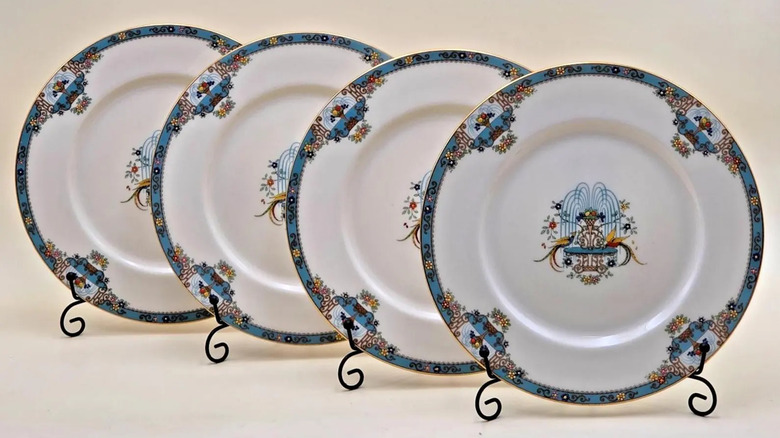
The Fountain pattern is one of the earlier dinnerware designs from Lenox. Although the company has been around since 1898 (originally under the name Lenox's Ceramic Art Company), it wasn't until 1917 that it had the technology to produce full-color designs at scale. Overseeing the company's transition from custom pieces to mass production was chief designer Frank Graham Holmes, who also personally designed the Fountain pattern. It's said he was inspired by wrought iron gates at the 1925 Paris World Fair, which he imbued with the bright colors and geometric shapes of the Art Deco movement.
The official Fountain design features a white background with the central motif and a turquoise band, but there is also a Fountain Ivory variant. This follows the same layout, but with a cream-colored band inside the turquoise, rimmed in gold. At the time of production, Lenox was still making some custom pieces. You can find examples of plates with the Fountain pattern's central motif, but missing the decorative border, instead with outer sections in bold flat colors such as pink or aqua.
When shopping for vintage Lenox, the backstamp can help you identify a genuine piece, and tell you if you have an ultimate thrift store treasure. From 1906 until 1953 the logo consisted of an uppercase L enclosed in a wreath, printed in green. From 1930 onwards, Made in U.S.A. was printed directly beneath this. In some cases, the full pattern name will be printed on the piece, but in other cases a string of letters and numbers will identify the shape, pattern, and year of release. Custom colorways will have a different number from the official Fountain design.