

Always Look For 2 Words On Vintage CorningWare Before Cooking With It On Your Stovetop
We may receive a commission on purchases made from links.
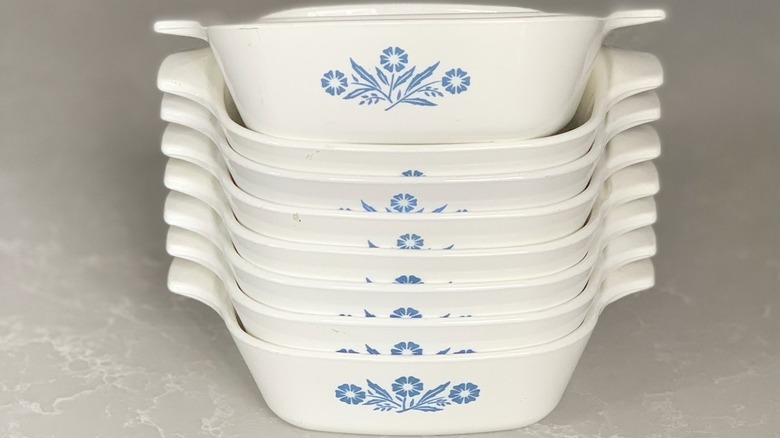
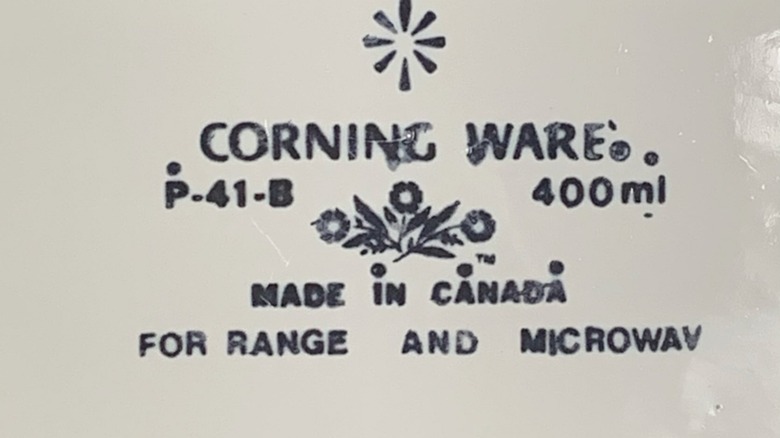
Vintage CorningWare pieces are often discussed in terms of how rare, collectable, and therefore how valuable they are. But it's important to consider how these items were designed to be used, and some CorningWare wasn't just designed for the oven — but for the stovetop too. The clue to whether your dish is stovetop-safe lies on the backstamp, where you should find the words "range" or "stovetop" safe. Later pieces might be labeled "for range and microwave," or "range-oven-microwave."
This versatility was one of CorningWare's biggest selling points during the late '60s, with advertisements promoting the fact that food could go from the freezer, to the stovetop, and to the tabletop with the one dish. Customers could buy a detachable handle that fit all dishes, allowing them to be used like a saucepan on the stove. Owners of these vintage CorningWare pieces say that they can safely be used on gas or electric stovetops.
When taken directly from the freezer, it's recommended to use low or medium heat. This is not so much to prevent damage to the dish itself, but because the ceramic retains heat so well, you run the risk of burning your food. If you're cooking on a gas stove, you might consider a heat diffuser like the Heat Equalizer Store Cast Iron Heat Diffuser. It's also worth noting that the glass lids don't have the same tolerance for extreme changes in temperature as the dish itself.
Vintage vs modern CorningWare for stovetop use
What ultimately determines whether a CorningWare piece is suitable for the stovetop is the material that it's made of. The original dishes were made of Pyroceram, a synthetic glass ceramic that was invented entirely by accident by S. Donald Stookey. This new material was durable, non-reactive to acidic foods, and most impressively, can withstand sudden temperature changes of up to 840 degrees Fahrenheit.
In the 1990s, the company switched to using ceramic stoneware for its oven dishes. Although this provided more flexibility with designs and colors, stoneware doesn't have the same resistance to the two-word problem every vintage cookware owner should know: thermal shock. It's therefore not suitable for the direct heat of the stovetop or broiler. Due to popular demand, CorningWare released a new collection of Pyroceram dishes in 2009, but in 2022, they were discontinued once again.
If you don't know the date of production for your piece, there are a few other tips that can help you determine if your CorningWare dish is stovetop safe. Some are specifically labeled "no direct heat" or "no stovetop. However, anything marked as stoneware will also be unsuitable for stovetop use. Stoneware pieces can be identified by an unglazed ring around the bottom of the dish, whereas the stovetop-safe Pyroceram dishes are completely smooth on the bottom.