

5 Of The Best Regional Baked Bean Styles To Know About
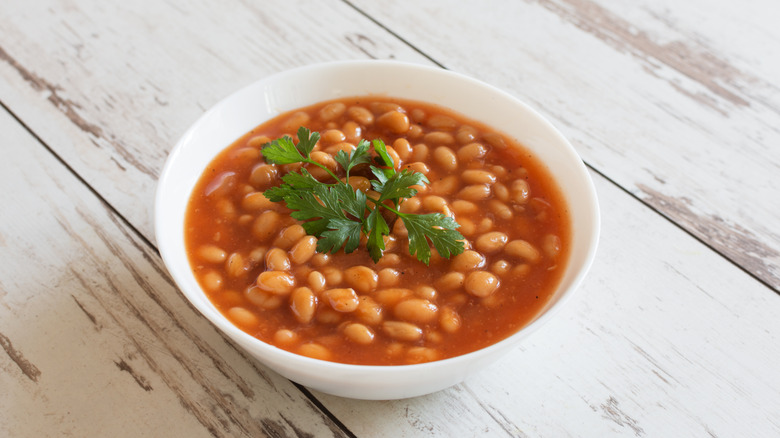
Baked beans have a history in the United States that goes back to before it even was the United States, with several Native American tribes sharing the method of slow-cooking soaked navy beans in clay pots over an open flame along with various meats and veggies. The Iroquois were said to have added the twist of including maple syrup in the stew — and thus began the long-running tradition of regional differences in how baked beans were prepared and served.
Today, there are a number of region-specific variations on the baked bean, some named after particular cities and states, and others having a more wide-reaching geographical label. In choosing the five we're spotlighting here, we tried to come up with a mix of more well-known varieties and ones that might not be as recognized outside of their specific region. We also wanted to have as eclectic of a lineup as possible, with each being fairly distinct from the others and none being just a slight twist on another.
Hopefully, you come away from this learning about at least one style of baked bean you'd never heard of before — one you are now eager to try for yourself. And as one final note, we did limit this particular list to regions within the United States. However, there are a number of delicious and unique twists on beans from all across the world.
Boston Baked Beans
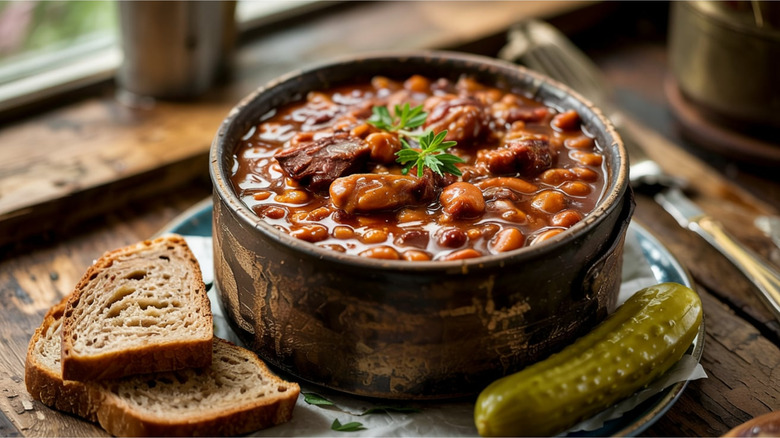
Perhaps the most well-known regional baked bean style outside of its titular region, Boston baked beans are indeed one of the most beloved varieties as well as a longtime Fourth of July favorite. It is also one of the most classic varieties, with traditional recipes using the Native American-originated approach of navy beans that are slow simmered in a sweetened stew of onions and bits of meat. But a key difference with Boston baked beans is that molasses is the sweetener instead of maple syrup — with the latter being used in another nearby region's baked beans, which we'll get to shortly.
On that point, to pinpoint the ways Boston baked beans differ from other baked beans of New England, it's not just the sweetening agent that comes up. Boston baked beans tend to be in a thicker sauce than, say, Maine baked beans, which are only cooked long enough to soften the beans. Likewise, Boston baked beans are more subtle with the meat — typically a pork of some kind — than the Maine variety, which goes a bit heavier on it.
Boston baked beans are a longtime staple of potlucks and other food-centric gatherings. They're even a popular side dish to pair with the likes of hot dogs, burgers, and ribs. They also lend themselves to plenty of tweaking based on personal taste, with some opting to add ketchup and/or brown sugar to complement the molasses for a sweeter, thicker profile.
Vermont Baked Beans
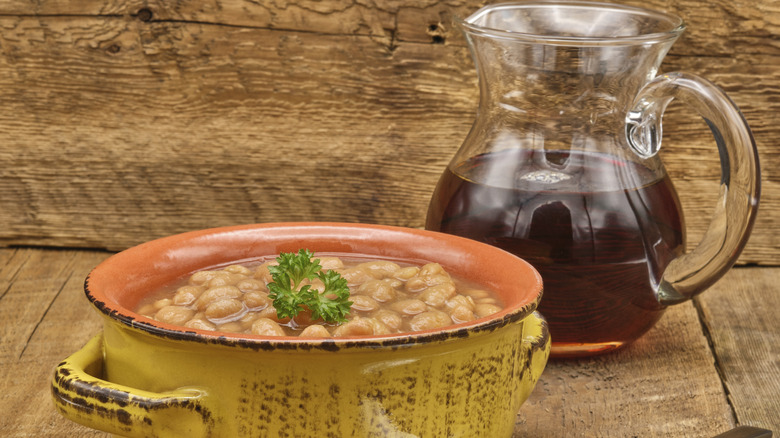
We wanted to highlight a second baked bean style from the New England region mostly just to further illustrate how different baked beans can be even among regions in such close proximity. We already discussed some of the differences between Boston and Maine baked beans, but Vermont brings its own distinctive baked bean style to the table as well. Yes, this variety also uses maple syrup for the sweetness as previously hinted it, which is a pretty notable difference from molasses. However, the variants don't end there.
As opposed to navy beans, most recipes for traditional Vermont baked beans call for using a yellow or golden variety of beans, usually either yellow-eyed beans or Marfax beans. Yellow-eyed beans are larger than navy beans, which is a key difference. But more importantly, yellow-eyed beans get quite soft and creamy when you bake them, which obviously results in a very different texture than baked navy beans.
Add in the smoked bacon that is also typical of Vermont baked beans, and you have a dish with highly juxtaposed sweet and salty extremes. This version of the dish offers an overall thinner consistency on account of the use of syrup instead of molasses. This is one New England meal you won't want to miss out on.
North Carolina Baked Beans
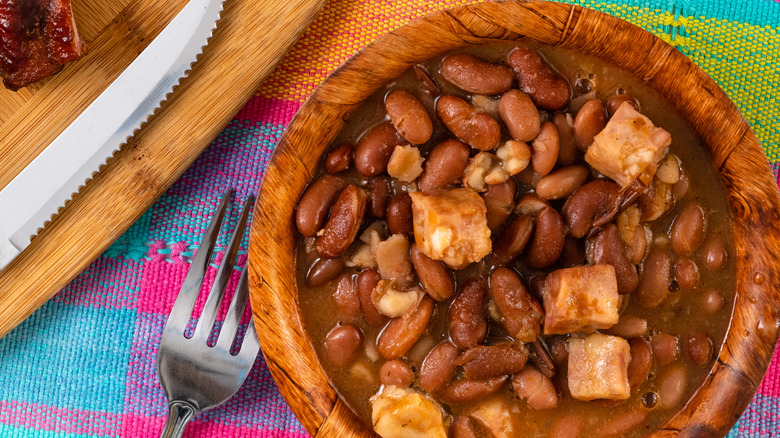
Just like New England-style baked beans represent multiple individual regions and styles, there are a number of states' varieties that fall under the umbrella of Southern baked beans. The primary difference between New England-style and Southern-style comes down, once again, to sweetness. Or in this case, lack thereof. Southern baked beans lean more on being spicy and smoky, with barbecue sauce being the primary base. With that in mind, we chose to highlight North Carolina baked beans because of the way they stand out from other Southern-style baked beans.
As with North Carolina barbecue, North Carolina baked beans (sometimes referred to as simply Carolina baked beans) have a much more vinegar-forward flavor than your average Southern-style. A common method of replicating the unique flavor profile of North Carolina barbecue (and its accompanying tang) is to make the beans with apple cider vinegar and ketchup. Of course, using actual North Carolina barbecue sauce is another option, and some recipes indeed suggest that.
As for the beans, it's typical to use a blend of several types of beans, with one of the more popular combos being black beans, pinto beans, and kidney beans. Though some use lima beans, butter beans, and even navy beans. Likewise, there's some wiggle room with the meat, though bacon is a common inclusion. Ultimately, it's the vinegary barbecue tang and going heavy on the beans that are the primary traits of North Carolina baked beans.
Hawaiian Baked Beans
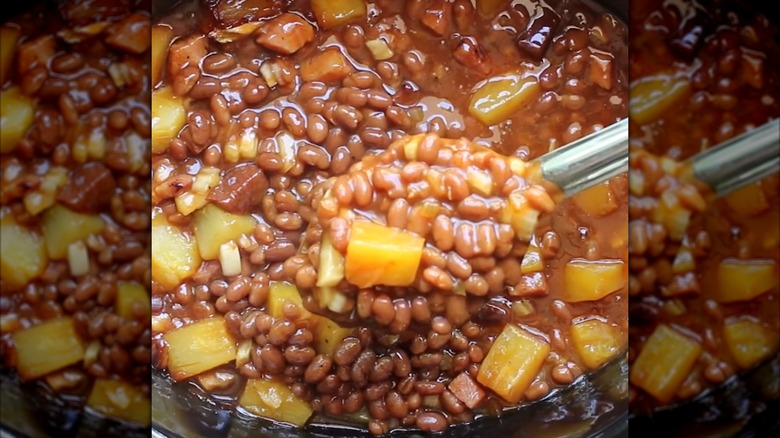
Though not actually native to the region, Americans would come to associate pineapples with Hawaii where the fruit is now an integral component of Hawaiian cuisine. So, it probably goes without saying that a telltale sign you're looking at a bowl of Hawaiian baked beans is the presence of those bright yellow chunks floating in the mix. While you probably could make Hawaiian baked beans with spam, the state's favorite utilization of ham, it's more typical of Hawaiian baked beans to be made with just regular, non-spiced cubed ham.
Unlike the baked beans we've discussed thus far, there doesn't seem to be an agreed upon type of bean (or beans) that constitute the most traditional version of Hawaiian baked beans. Some recipes just call for "baked beans" without specifying any further, while others specifically say that you can use any type of beans you want. That said, some recipes use pinto, kidney, or cannellini beans (or a combination of all three).
What seems to be most important in this dish is the pineapples and ham, and a mixture of brown sugar and ketchup being the primary base. Some recipes also include some of the juice from the pineapple if using canned pineapple. That really hammers home the tropical sweetness of the dish, which is one of the main things that sets Hawaiian baked beans apart from any other variation on baked beans.
Santa Maria Baked Beans
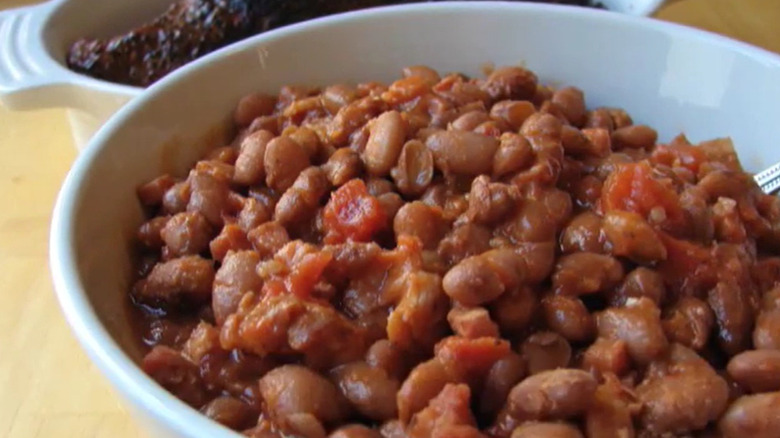
Santa Maria-style barbecue is a California tradition, and as with many regions where barbecue is king, there is likewise Santa Maria baked beans. Where these baked beans most overtly differ from other baked beans is in the type of bean typically used — in this case, pinquito beans. These are already a star ingredient in Santa Maria barbecue. What makes pinquito beans special (and perfect for cooking) is that you can cook them for a long time and have them still retain their density and texture. You don't have to worry about mushy beans when you're cooking with pinquito beans.
But here's the dirty little secret with Santa Maria baked beans: They're not actually baked. Even though they are commonly referred to as baked beans (and serve the same function as other barbecue-adjacent beans as a side dish), they are actually prepared by boiling and simmering on the stove rather than going into an oven or slow-cooker of any kind.
Santa Maria baked beans also stand out from their peers by not relying on the addition of any additional sauces. Instead, this variation lets the flavor of the beans shine through with only spices and pork (usually meat or bacon) filling out the dish. The results are still full of flavor and texture, just neither of which are quite what you get with more traditional — that is to say, actual — baked beans.