

The Clever Way Pioneers Made Butter While Traveling The Oregon Trail
Life on the Oregon Trail wasn't what we'd consider a road trip today. This was a grueling journey over a simple track that could take anywhere from four to six months, and during this time, families had to carry everything they needed on their wagons. While there were opportunities for hunting and the occasional general store along the way, these pioneers had to be smart with food in order to survive the trip. And the way they made butter is a prime example.
We are lucky enough to have access to journals from the time, where individuals describe hanging a tin full of milk to their wagon in the morning, and letting the jolting movement churn it into butter. In an entry from 1852, one Eliza McAuley explained, "We have a tin churn in which the morning's milk is put and by noon or evening we have a nice little pat of butter and some good buttermilk."
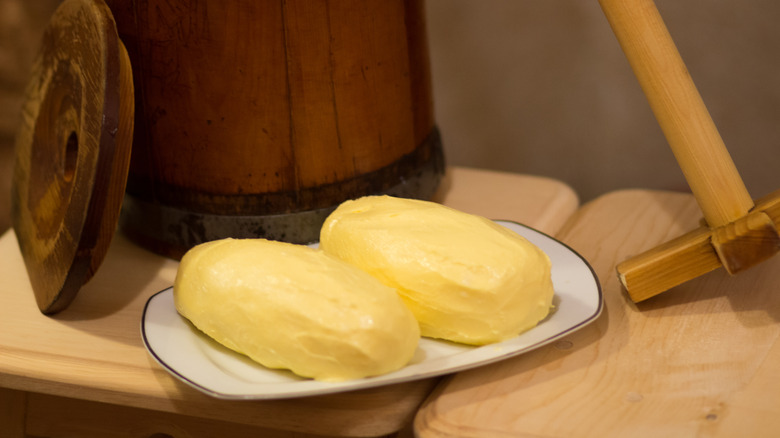
What's important to remember is that at this time, most households would have made their butter by hand anyway. Making butter the old-fashioned way meant adding cream to a wooden butter churner and agitating it with a pole or hand-cranked paddles. The method used by pioneers on the trail relied on the same principle, but allowed them to save valuable energy for their days walking.
Using and preserving butter on the trail
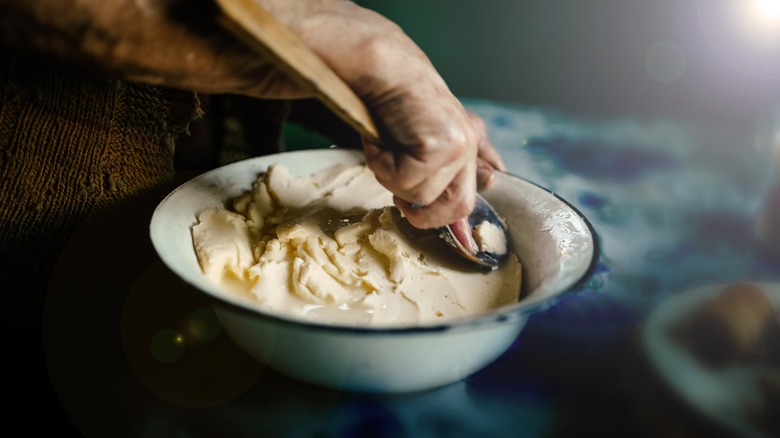
This trail-churned butter provided a welcome addition to the standard foods eaten on the Oregon Trail. One traveler mentions adding butter to a cup of coffee and cream, but it was most often simply eaten with bread as an alternative to the regular bacon grease (derived from salt pork, a cowboy staple) that featured in most meals along the trail. In her diary, Helen Carpenter complained, "One does like a change and about the only change we have from bread and bacon is bacon and bread."
This method of making butter as needed also dealt with one of the problems with living on the road: the lack of refrigeration. Although there was no electric refrigeration anywhere at the time, at home these pioneers would have root cellars or cool places to store dairy and meat for extended periods. Those on the trail who didn't have the benefit of a milk cow for daily dairy would have to purchase butter in bulk along the way, and find some way to keep it fresh.
A guidebook for overland travelers published in 1859 suggested, "Butter may be preserved by boiling it ... until it is quite clear like oil." The resulting clarified butter was then soldered into tin canisters. One family packed their supply of butter in a sack of flour, presumably to protect it from the heat, but later found that it had melted somewhat into the surrounding flour. In true pioneer style they made the most of a bad situation, and cooked shortcake from the flour and butter mix.