

Your Donut Pans Can Do More Than Just Baking: Try This Genius Soup Storage Hack
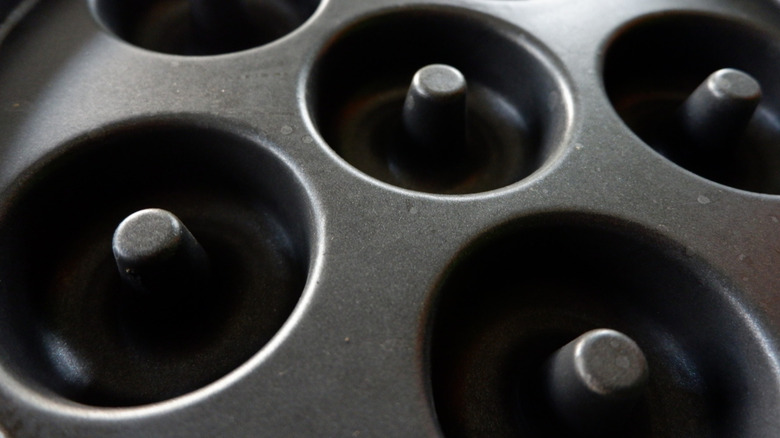
Accumulating single-purpose cooking tools is something every kitchen nerd eventually feels a little bit guilty about, so if there's a donut pan gathering dust somewhere in your cabinets, Reddit has a practical second job for it: soup storage. In a thread about creative uses for mini donut pans beyond their intended purpose, one commenter suggested using the tray of circular cavities to freeze individual portions of soup, so when it's time to microwave dinner, "there is no stubbornly frozen center." It seems like a whimsical novelty hack, but their reasoning is actually grounded in science.
Once the soup has cooled, portion it into the cavities of a donut pan and freeze until solid. Pop the frozen rings out and transfer them to a freezer bag or a sandwich bag, freeing up the pan for another batch (or perhaps for donuts, to satisfy your sweet tooth). A flexible silicone pan will make removing them especially easy, but if yours is Teflon, don't use a metal utensil to pry them out, because it could scratch the nonstick chemical coating. And if your donut pan is metal, keep it out of the microwave.
The advantage becomes clear when you picture a conventional frozen block of soup. Its center is the point farthest from every exposed surface. According to the U.S. Department of Agriculture (USDA), microwaves only penetrate about 1 to 1½ inches into the food; deeper portions are heated largely as heat conducts inward from warmer food around them. Punching a hole through the middle gives your soup an inner edge as well as an outer one, shortening the distance heat needs to travel to reach the frozen parts.
The physics of the microwave iceberg
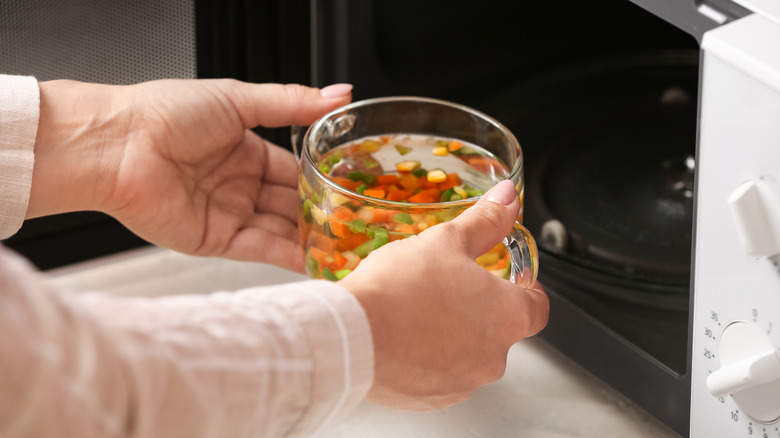
Anyone who has tried to microwave a frozen meal has encountered the maddening result — leathery, bubbling-hot edges while the middle holds out like an iceberg. This is explained by the physics of how microwaves work. Microwave energy interacts particularly strongly with water molecules, exciting them and generating heat throughout the portions of food it can penetrate, while conduction carries that heat farther inward.
Freezing complicates the process because ice and liquid water interact very differently with microwave energy. Ice is water in a crystalline structure, so the molecules can't rotate. The liquid, thawed areas absorb energy more readily and keep getting hotter, while the frozen parts trail behind. Keep blasting it at full power, and those thawed areas get too hot and can start to dehydrate before the frozen parts warm up. That's also why your microwave's defrost setting takes its sweet time. On most microwaves, lower-power settings cycle the microwave's energy on and off, creating intervals when heat can spread through the food by conduction. The donut pan hack tackles the same uneven-heating problem through geometry: instead of asking heat to work its way into the center of a thick, frozen mass, you're starting with a shape that has no center to conquer.
You can reheat soup directly from frozen, but ideally, give it a stir midway through reheating to redistribute heat and eliminate any remaining cold spots. For food safety, the USDA recommends heating leftovers to 165 degrees.