

The Pringles You Know Today Look A Little Different Than The Ones Your Grandparents Ate
We may receive a commission on purchases made from links.
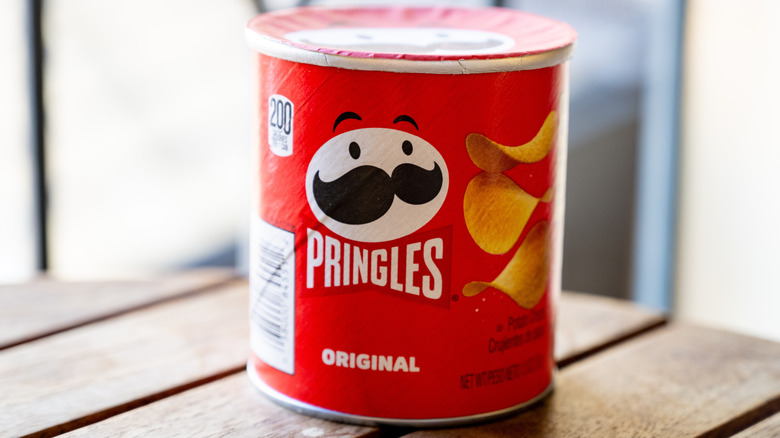
When Pringles hit the potato chip scene in 1968, its innovative food tube came with a metal pop top and the words "potato chips" plastered in big, bold letters across the front. That lingo would never work today, given the FDA's 1975 insistence that potato chips had to be sliced, whole fried potatoes. Pringles are a mash of dried potato flakes, rice flour, corn, and wheat. As a result, you'll find no mention of the word "chips" on a Pringles can in your pantry today, but you will find another word altogether.
While Pringles aren't technically potato chips, the company was given an (albeit long-winded) alternative disclaimer that the FDA thought would make everybody happy. So long as Pringles added, "potato chips made from dried potatoes" to their can (you know the same stuff that instant mashed potatoes comes from?), then Pringles could use the potato chip moniker all day. Pringles gave that a hard pass, and in the end landed on the phrase that our friends from across the pond use to describe them anyway – crisps. In rather itty bitty, innocuous black print, "potato crisps" is stamped on the lower left of every can of Pringles potato, well, crisps. That's not the only change since Pringles launched its iconic stack of crispy snacks.
Changes on the inside and outside of the can
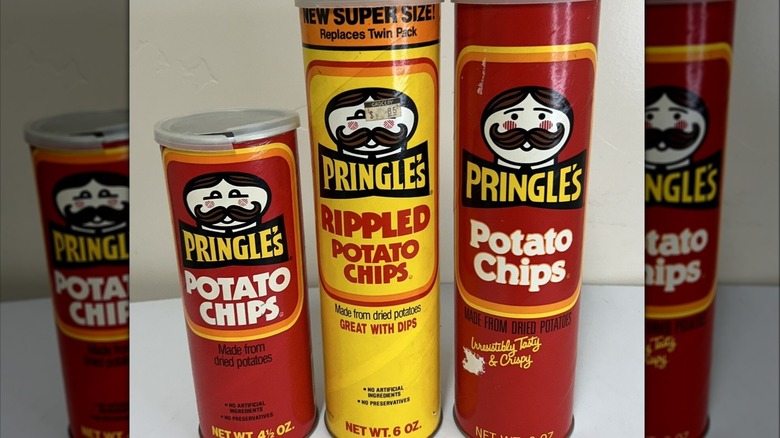
That cute little mustachioed guy on every Pringles can, Julius Pringles, or Mr. P., is the product's mascot. He used to have a tuft of slicked-back hair and today, he's completely bald. In earlier days, he also had a smirking smile and two rosy cheeks, but today, he has two happy raised eyebrows and a friendly, asymmetrical, bushy mustache. Why asymmetrical? It's meant to resemble a hyperbolic paraboloid — that's the geometric shape of Pringles crisps.
When the product launched, the structure and shape of Pringles was a big reason Pringles stood out from the competition, much like the original Lay's potato chips. Pringles' inventors set out to create a less greasy potato chip that wouldn't be a broken mess by the time consumers opened its container. The shape is an architectural engineering combo (think London Velodrome) that minimizes materials while maintaining structural integrity so the crisps can be strong but thin. That shape has stuck, though customers complain that they've become a shrinkflation level of thinner and thinner over the years. That's an issue Pringles of the future may have to address, unlike the chips vs. crisps issue. Much like the little chocolate nuggets from Nestlé Toll House bags we call chocolate chips (they're called morsels), the public will most likely continue to call Pringles "chips" and reach for another delicious stack.