

Forget Food Dye: Give Cake Mixes Rich Color With One Natural Juice

There are many ways to make food look more interesting and appetizing, and color has long helped elevate and enhance baked goods. It is, after all, incredibly easy to add a few drops of food coloring to batters and frostings and call it a day. But there are plenty of natural options for achieving bright, vivid tones without resorting to artificial dyes. And for a vibrant, ruby-red tone, few ingredients are easier to work with than beetroot juice.
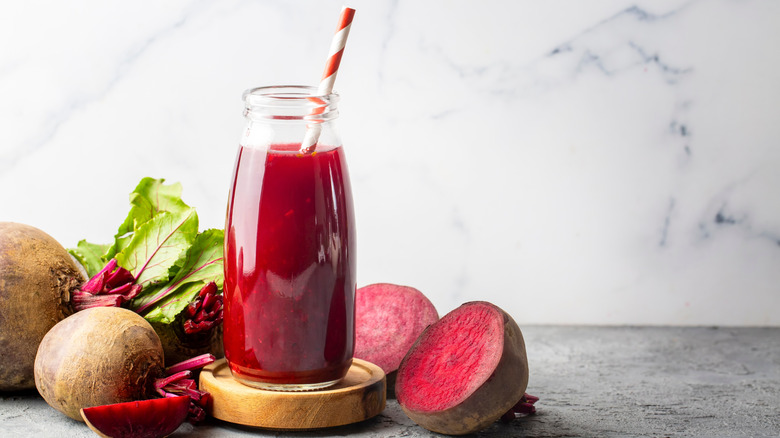
Beets are an underrated ingredient. Not only are they nutrient-dense, packed with vitamins, fiber, and antioxidants, but they are remarkably versatile. You can use them to lend an earthy, sweet touch to recipes you'll want on repeat, boost cranberry sauce, elevate smoothies, zhuzh up hummus, or make them the star of the table with an orange-balsamic glaze for a showstopping side dish. Whether you juice your own beets at home or opt for canned, beetroot juice can be repurposed in countless ways, but dyeing cake mixes might be its best applications.
A drizzle of beetroot juice can give cake batter that signature red-hued tinge, and the earthiness of beets helps balance the cloying sweetness of some baked goods. A vanilla sponge will turn a lovely magenta, while cocoa-heavy batters will go crimson, like a classic red velvet. If you are extracting your own beetroot juice by hand, grate the vegetable on the finest setting of a box grater and squeeze it firmly through paper towels to extract the colorful liquid. One beet should give you enough juice to dye a cake — it only takes a couple spoonfuls.
Before red food dyes, there were beets
As clever as this trick is, it's as old as cake itself, and rumor has it that the red velvet cake we know and love used beets before red food dye gained traction. The cake surged in popularity during times of scarcity. It was marketed (along with red food dye) by The Adams Extract Company at a time when cocoa and other ingredients that helped create a naturally reddish hue were in short supply during the Great Depression. Red food dye became the preferred alternative, but many bakers maintain that the secret to a perfect red velvet lies in beets, not only because of their hue, but also because they help keep the cake moist. In fact, New York's Waldorf Astoria Cake from the 1920s, which some credit as the original red velvet, also includes beets in the recipe.
Artificial food dyes remain a controversial subject in cooking, making beet juice a good natural alternative. Some studies have linked food coloring to hyperactivity in children, but for the most part, findings remain inconclusive. Artificial food dyes are closely regulated to comply with industry standards and are considered safe to eat. However, the FDA has said it cannot guarantee with absolute certainty that there is no risk associated with artificial food colorings, so it continually reviews scientific findings to determine whether certain formulas need to be removed from the market. In 2025, the FDA launched an initiative to limit the use of petroleum-based dyes, red or otherwise.
Whether you are opting to cook with more natural ingredients, or simply trying to reduce waste, this tip is a win-win. It's also one of the easiest and cheapest ways to bring a natural red hue to your dishes without synthetic pigments, alongside other red food coloring substitutes such as hibiscus, pomegranates, or freeze-dried fruit.