

The Most Popular Coffee Beans Make Up 61% Of The World's Production

Many who enjoy a good brew never realize that coffee beans aren't just one type, and just as varietals of grape lend wine different flavors, the breed of coffee plant profoundly affects what you get in the cup. While there are hundreds of subtle differences between subspecies, the world's coffee can broadly be split into four main types of bean, one of which is certainly more popular than the others. The Arabica bean accounts for 61.1% of global green (unroasted) bean coffee production, according to a 2026 report from the International Coffee Organization, while Robusta covers almost all of the rest. Two much smaller varieties, Liberica and Excelsa account for as little as 0.01% of global exports. Arabica's popularity comes from its superior complexity, smoothness, and nuanced flavors, such as nutty, floral, fruity, and sweet notes.
Arabica is indigenous to Ethiopia, where the bean began its worldwide journey in the 7th century. It travelled over centuries via trade routes between various empires and colonies into the ancient Middle East (where it picked up its name), through to South East Asia, and into South and Central America, as well as other parts of Africa. Today, Brazil is by far the largest producer of Arabica beans, followed by Colombia, then Ethiopia. Other key growers include Guatemala, Costa Rica, Indonesia, and Yemen, although many countries within Asia, Africa, and Central and South America export these beans. They require specific conditions to grow, and thrive in higher altitudes, between 1968 and 6561 feet above sea level, and in temperate climates between 59 and 75 degrees Fahrenheit.
Arabica's specific needs makes it more refined, and raise its price
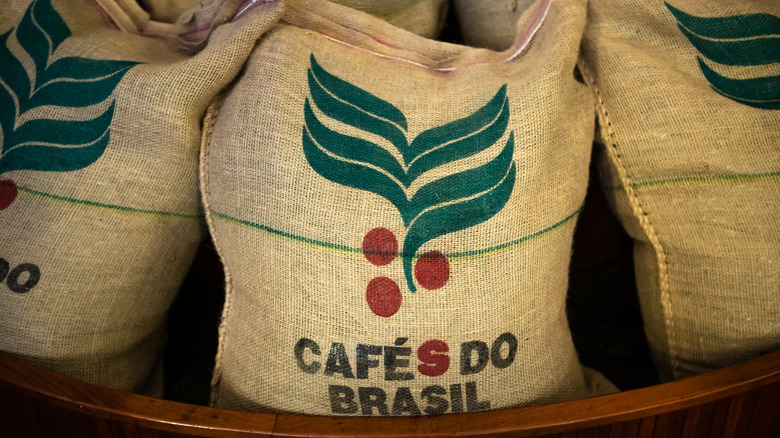
Not only does Arabica coffee require particular altitude and temperature ranges to thrive, but it's also susceptible to fungal diseases and pests, which can make growing it more challenging and more expensive. Robusta, its less-refined counterpart, is indeed more robust, able to produce crops at lower altitudes and in higher temperatures, with better resistance to pests and disease. The quality, however, is considered lower, which is why it's actually now illegal to grow Robusta in Costa Rica, in favor of Arabica production. Arabica's popularity has meant that even though it's harder and more expensive to grow, it's still the dominant bean on the global market.
Arabica's pleasant acidity and subtler, brighter flavor profiles make it the more suitable option for pour-over and drip-style coffees, which are better able to extract and present its delicate flavors. That doesn't mean that Arabica beans don't also make rich, complex, and satisfying espresso, however. To mitigate some head-scratching next time you visit a specialty coffee shop, many subvarieties of Arabica beans go by different names, including Bourbon, Caturra, Catimor, Pacamara, Pache, Catuai, and the famously elevated Geisha. These are usually derived from other sub-types and from specific regions. Kona, for example, is one of the few coffee varieties grown in the U.S., coming from Hawaii and being both sought-after and expensive.