

8 '70s Grocery Store Quirks You Won't Find Anymore
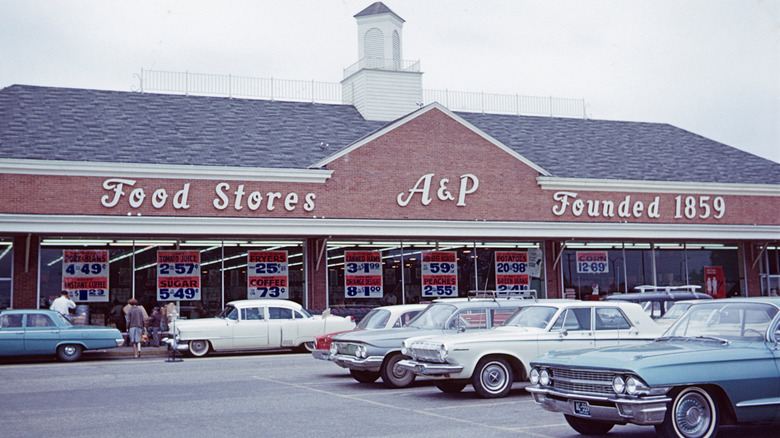
The grocery shopping experience has evolved massively since stores began popping up across the U.S. in the late 19th century. Today, shoppers are well accustomed to self-checkout scanning, online ordering, and having a vast array of products from all over the world at their fingertips, but this hasn't always been the case. In the 1970s, grocery stores looked and operated very differently, and those who frequented popular chains of the era remember a slower-paced, more hands-on approach to shopping.
Back then, many of the conveniences we take for granted today were still decades away. The services available in supermarkets were different, as was the way shoppers paid for their groceries, and countless quirks that once made a trip to the store so distinctive have since disappeared. For those who remember shopping in the 1970s, there's plenty to reminisce on, so get ready for a serious hit of nostalgia. Or, if your grocery shopping memories started a little later, you'll likely be surprised to learn just how much things have changed.
Cashiers used mechanical cash registers
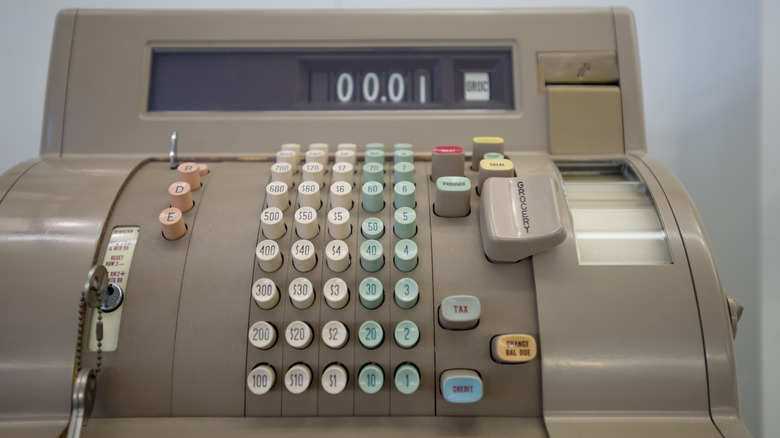
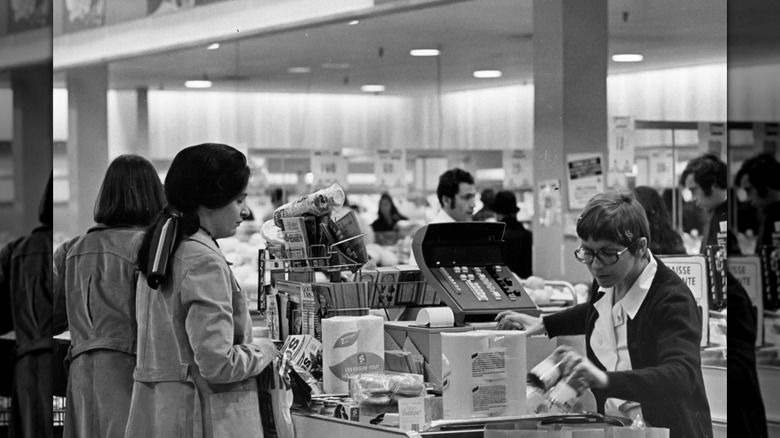
In modern-day supermarkets, scanners and touch screens make checking out a breeze, and there's often no need to even interact with a cashier at all. However, in the '70s, it was a different story. Most stores used staff-operated, mechanical cash registers, which didn't have barcode scanners. This meant the cashier had to manually input the price of each item and calculate the amount of change owed to the shopper after payment.
To keep the checkout process as streamlined as possible, it was vital that every product had a price label, as any missing labels would require shoppers to wait while a staff member went to check the price. To help the cashier ring everything up faster, customers of the era also recall deliberately placing items price-tag-up on the belt.
When it came to payment, there was no tap-and-go. Cash or check were the most common methods, since credit cards were not widely accepted in stores yet. Payment by check was a notoriously time-consuming process, as one nostalgic shopper shared in a Reddit discussion. "Everyone in line behind you groaned when you pulled out a checkbook," they wrote, explaining, "The amount of time to write the check, the cashier had to write down the driver's license info on then check, then had to get the manager to approve it. Took forever."
Meat was wrapped in paper
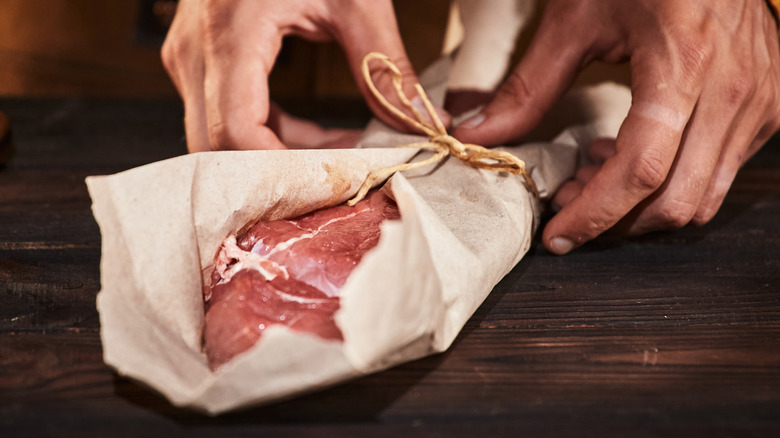
Meat packaged in plastic trays or vacuum-sealed pouches is commonplace in grocery stores today, with a vast selection of pork, beef, and chicken available to grab straight from the shelf. But '70s shoppers got a more personal experience, much like visiting your neighborhood butcher. In-store meat counters allowed you to choose how your meats were cut, with a skilled butcher preparing everything for you. The meat would then be packaged up, with no plastic in sight. Instead, it was typically wrapped in butcher paper, then secured tightly with twine.
Butcher paper is similar in appearance to parchment paper, but there are distinct differences between the two. While parchment paper offers heat resistance and non-stick properties, butcher paper, which is made from wood pulp, is much more breathable and better at absorbing moisture. Hence, it's long been a useful tool for keeping meat fresh and flavorful. There was no need for '70s shoppers to repackage their butcher-wrapped meat once they got it home, either, since the paper is an ideal solution for short-term storage in the fridge.
Shoppers collected Green Stamps
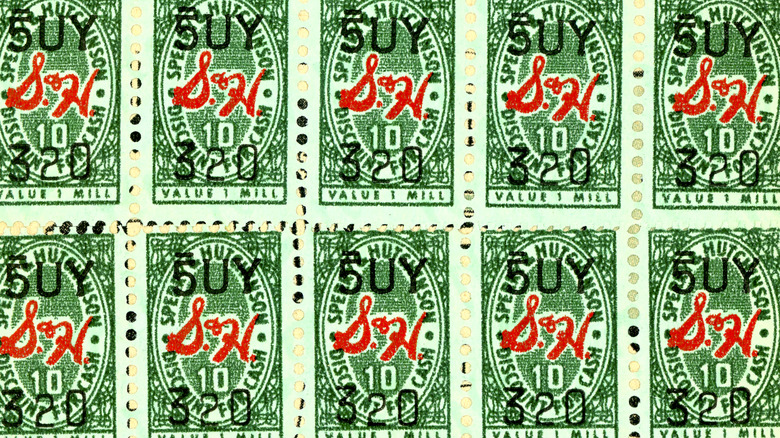
Collecting Green Stamps was one of the most memorable parts of the 1970s shopping experience for many. Produced by Sperry and Hutchinson Co. (S&H), these stamps were sold to grocery retailers, where they would then be handed out to the store's shoppers after checking out. For every dollar they spent in store, shoppers would receive 10 stamps. These could then be used to redeem various products, from bicycles to dish towels, either at a dedicated redemption center or through the S&H catalog.
Founded in 1896, S&H had already been operating for many decades before the 1970s. In fact, in the '60s, the company's stamp output was triple that of the U.S. Postal Service, with around four out of five Americans collecting Green Stamps at the height of their popularity. Towards the end of the 1970s, however, stamp collection began to dwindle as S&H failed to keep up with evolving shopping habits. Green Stamps eventually fell off the radar, until the company later relaunched as S&H Greenpoints in 1999.
And it wasn't just S&H that turned stamps into a shopping incentive. A similar scheme took off in the U.K. with Green Shield Stamps, which saw shoppers pasting their stamps into books and saving them up in much the same way, ready to trade for their choice of household goods.
There were ashtrays at the end of the aisle

Indoor smoking is now banned in the majority of U.S. states, but the rules were very different in the 1970s. Smoking in restaurants, on airplanes, and even at the doctor's office was perfectly legal, if not the norm, and the grocery store was another popular place to light one up. Back then, the dangers of smoking weren't as widely understood or taken as seriously as they are today. With smoking being so prevalent, it made sense that ashtrays were everywhere. You'd find them in pretty much every indoor public space, either in the form of small, flat-bottomed bowls or tall, free-standing bins with a hole in the top for disposing of the butts.
According to those who shopped in the '70s, it wasn't uncommon to see standup ashtrays at the end of an aisle. They weren't always used correctly, however. On Reddit, one seasoned shopper recalled their mother "looking down her nose at people stomping their cigarettes out on the floor," proving just how normalized smoking in store was at the time.
Grocery stores were much smaller
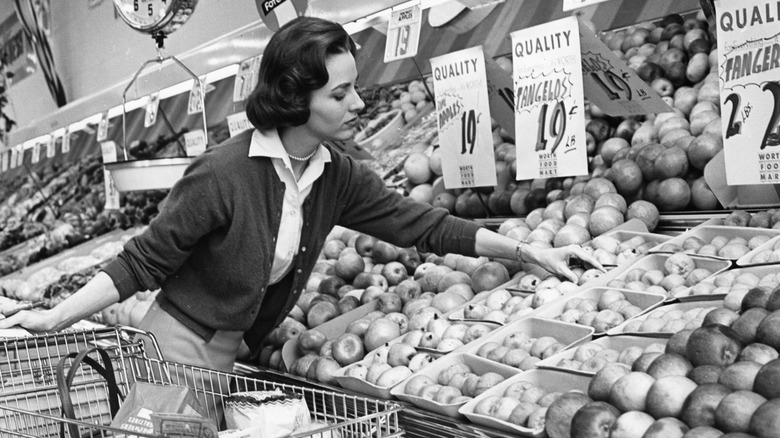
At today's supersized grocery chains like Walmart, Target, and Costco, you'll also find a wide selection of other items, such as household goods, electronics, and clothing. A visit to one of the warehouse giants can often take a good few hours, and it's easier than ever to pick up all of your essentials in one trip.
1970s grocery stores were significantly smaller in comparison. The average store was just 10,000 square feet, which is less than a quarter of the average size today. While modern stores feature shelves piled high with fresh produce, prepared meals, and foods imported from all over the world, the selection was once much more limited. Produce was less diverse, and the focus was on simple staples like dairy, eggs, canned goods, and old-school snacks.
Despite this simpler offering, the '70s were a time when processed convenience foods were on the rise, and stores saw an influx of new products throughout the decade and beyond. In 1975, grocery stores carried about 9,000 individual products on average. By 1990, this figure had risen to more than 30,000, hence stores grew larger to accommodate their broader selection. The smaller neighborhood stores of the '70s and '80s were gradually outcompeted by larger chains, who could offer more choice and lower prices, and today, these sprawling stores continue to dominate the U.S. grocery scene.
Product branding kept things simple
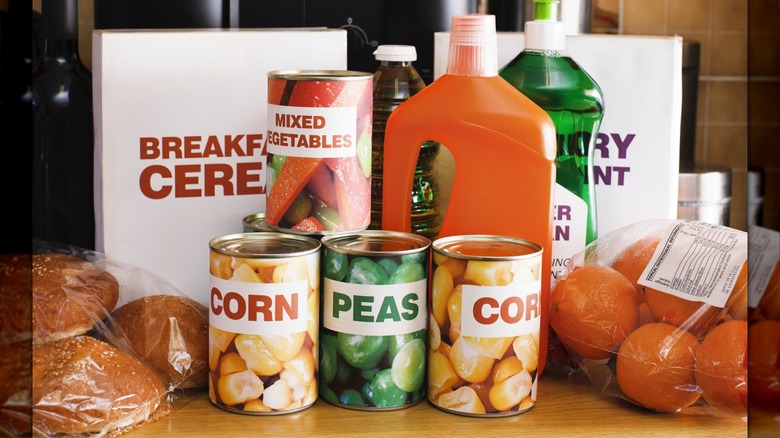
Reaching for store-brand products instead of well-known branded versions can be a nifty way to save money on your shop. As well as generally being cheaper, these dupes frequently beat their branded counterparts in terms of flavor, too, and the concept of choosing generic alternatives over name brands has been around longer than you'd think.
Many shoppers remember shelves lined with remarkably plain-looking cans, jars, and boxes back in the 1970s. These products didn't feature bright colors, eye-catching logos, or friendly mascots, just basic black-and-white packages printed with large text that clearly stated what was inside. This made it easy to identify which products were more budget friendly. From cereals and pasta to paper towels and laundry detergent, these fuss-free items delivered excellent value for money, making it easier for shoppers to make the most of every cent they spent. Plus, it wasn't uncommon for name-branded products and their generic alternatives to be produced in the same factories. So, much like today, you wouldn't always notice a huge amount of difference in quality.
Before checkout conveyor belts, there were turntables
Electric conveyor belts are now a standard feature of grocery store checkouts, but they weren't as widespread in the '70s. Instead, stores often had spinning checkouts that were operated manually. These turntable-style checkouts comprised of a large rotating deck on a raised platform. Customers would line up their groceries at one end, and the cashier would gradually move the turntable to bring the items towards them, ready for ringing up. Then, products were transferred to the bagging area.
Manual turntables served as a practical solution at a time when supermarket technology was far less advanced, but the introduction of motorized conveyor belts eventually made the checkout process much more efficient. And with most stores now providing the option to use self-checkouts, there's often no need to head to the conveyor belts at all. According to Capital One Shopping, 96% of grocery stores now offer self-checkout, and the majority of customers are ditching the cashier lines for this time-saving alternative.
At A&P, you could get your coffee ground while you waited to check out
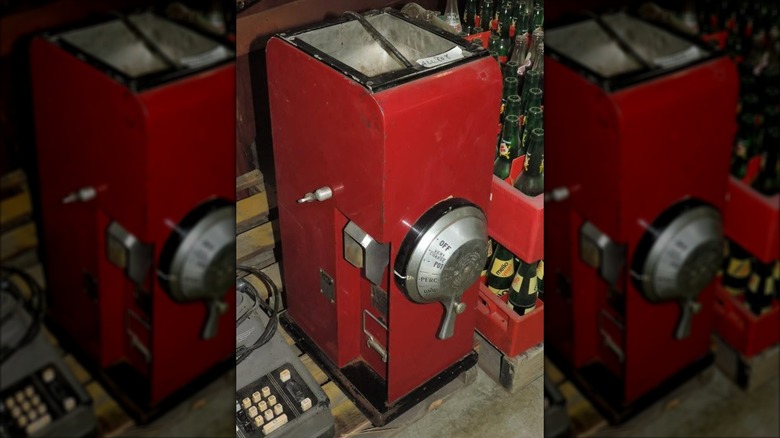
A&P was once the largest grocery chain in America. After its first store opened in 1912, the company expanded rapidly, boasting over 15,000 locations by 1930. While the chain later began to struggle and closed thousands of its stores as a result, by the 1970s, there were still around 2,000 A&P supermarkets operating in the U.S. So, it remained a familiar destination for grocery shoppers across the country, and there's one aspect of the A&P experience that many ex-customers remember fondly: the coffee grinders.
At the end of each checkout counter, there was a large, red, electric coffee grinding machine. The idea was that you could purchase whole bean coffee in store, and have it freshly ground in front of you as you checked out your other groceries. This was a clever marketing tactic for the chain, which sold its own private-label product called Eight O'Clock Coffee, and the novelty of having this ground in store likely helped to boost sales significantly. Plenty of customers remember the pleasant aroma of coffee wafting through the store — another surefire way to get shoppers reaching for a bag of beans.
Unfortunately, A&P is no longer around, and following further shrinkage, the last store closed in November 2016. You will, however, find public coffee grinders in some modern-day grocery stores, such as certain Trader Joe's locations and Whole Foods.