

Rao's Costs $5 More Than Prego: What Are You Actually Getting For The Extra Money?
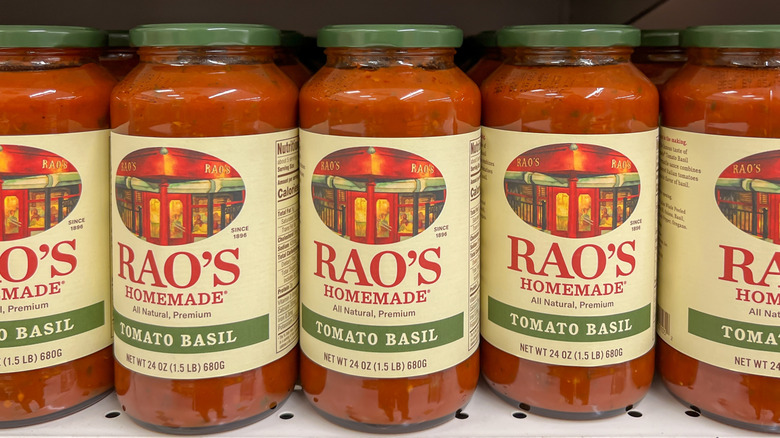
For decades, jarred tomato sauce was a cheap convenience food. You pay a few bucks for something to heat with your pasta, not expecting anything gourmet, just good enough. Rao's really changed that. The brand got its start well over a century ago, when Rao's was established as an Italian restaurant in New York City's East Harlem — but a big deal with Campbell's led to the brand being purchased, and soon after jars of Rao's pasta sauce were showing up with $9 or $10 price tags, $5 more than other classic brands like Prego. What could justify that?
The most basic explanation is that Rao's is still made as a small-batch product using premium ingredients, while Prego and other traditional jarred sauces are made on a much larger scale. Just looking at the ingredient list for each brand's marinara sauce tells you a few things. Rao's uses Italian whole peeled tomatoes, which it lets fully ripen on the vine in Southern Italy, while Prego uses tomato puree made with water and tomato paste, along with diced tomatoes in tomato juice.
Even the aromatics are different: Rao's uses fresh onions and garlic, while Prego lists dried versions of both. Rao's also uses Italian olive oil, while Prego uses canola. Prego's ingredient list isn't that bad as far as many jarred foods go. It's all recognizable, real ingredients — just usually the less expensive versions.
Rao's uses higher-quality ingredients, and lacks the preservatives in Prego
There are a few ingredients in Prego worth a closer look. The first is canola oil, which has been the subject of some debate around seed oils. However, current research does not support the idea that canola oil is inherently unhealthy. Here, the more relevant difference is flavor, because canola oil is still not going to bring the flavor that olive oil delivers.
The other key ingredient is citric acid. Prego has it, and Rao's doesn't. Citric acid can be naturally derived from citrus fruits or manufactured, and it's commonly used as a preservative. Preservatives can extend shelf life, which can help keep product costs down. Sodium, which can also act as a preservative, is also about 15% higher per serving in Prego. So, with Rao's you are paying a premium for freshness.
Of course, there is one last thing people are willing to pay $5 more for: the taste. All of those higher-quality ingredients wouldn't be worth anything if they didn't show up in how Rao's sauce tastes, but the brand consistently scores well in taste tests, including Tasting Table's ranking of popular pasta sauces. Prego, on the other hand, almost always ranks near the bottom. It may be a nostalgic flavor from your childhood, and maybe that lower price still makes it worthwhile, but there's a reason Rao's has become so successful. With the brand's continued popularity and the rise of other premium pasta sauce brands, it's clear plenty of shoppers seem willing to spend the extra $5.