

Big Mac Or Whopper: Which Fast Food Burger Is Actually Healthier?
Big, beefy, and iconically delicious, both the McDonald's Big Mac and Burger King Whopper have rightfully earned their popularity, but neither really qualifies as one of the healthiest fast food orders. This doesn't mean that you can't enjoy them while staying health-conscious, but you should know which sandwich is a better bet for your dietary needs. To help you decide, we asked Samar Kullab, a Chicago-based registered dietitian nutritionist, which burger is actually healthier.
After comparing nutrition stats, Kullab revealed that the Big Mac is marginally healthier than the Whopper. "Neither is the best pick if you're watching sodium closely, but between the two ... the Big Mac is lower in calories, fat, and sodium," she said. A Big Mac delivers 580 calories, 25 grams of protein, 45 grams of carbs, and 34 grams of fat, while a Whopper contains 710 calories, 34 grams of protein, 57 grams of carbs, and 42 grams of fat. Both burgers are indeed quite salty, but the Whopper has more sodium, at 1,250 milligrams compared with the Big Mac's 1,060 milligrams.
Kullab pointed out that the Whopper still has its merits, as it's "flame-grilled and includes fresh tomato, lettuce, and onion." That's one more fresh veggie than the Big Mac, which only uses lettuce and onion. Also, customers who value high-protein fast food items might choose the Whopper. All of that said, both burgers can be part of a balanced diet, and Kullab gave us advice on how to enjoy fast food while sticking to your nutrition goals.
It's possible to fit fast food into a healthy diet
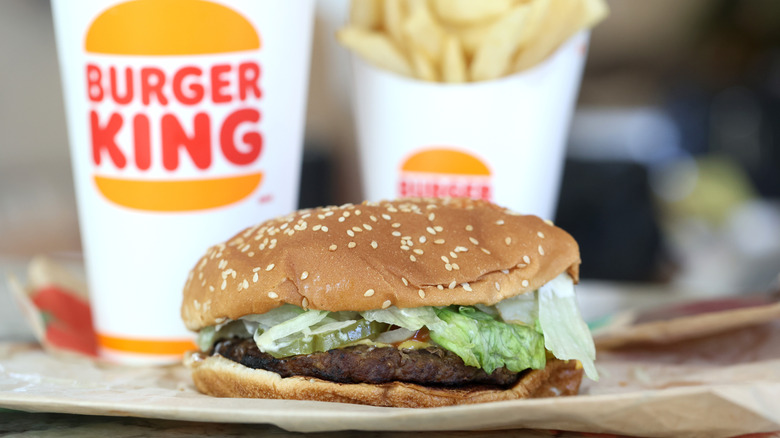
McDonald's may have the slightly healthier burger, but when we compared the Big Mac to the Whopper in terms of flavor, value, and more, we found that BK ultimately won out. This might influence which burger you order — and if you ask Samar Kullab, your choice of entree isn't the only factor that makes a meal healthier or unhealthier. To enjoy fast food while staying on track, Kullab believes, "The key really is the portion, the modifications, and your overall diet."
Kullab advised being mindful about the side dishes you order, the size of your meals, and how often you eat fast food, rather than "treating any single meal like it's going to make or break your health." To make your orders a bit healthier, she advised, "Swap the fries for a side salad, skip the soda for water, add lettuce and tomato where you can; small tweaks like that add up."
Additionally, Kullab emphasized that aiming for a balanced, nutritious diet is a better, more realistic practice than completely avoiding fast food, and you shouldn't feel guilty about relying on it sometimes. You want a diet "where convenience foods have a place, without it derailing everything else," she explained. "Are you eating a variety of foods, getting enough protein and fiber most days, giving your body a mix of nutrients over time? That's what your health is built on — not any one burger, one bad day, or one indulgent meal."