

It's Not Just About Cracks Or Exploding — Here's Why You Should Think Twice Before Thrifting Vintage Pyrex
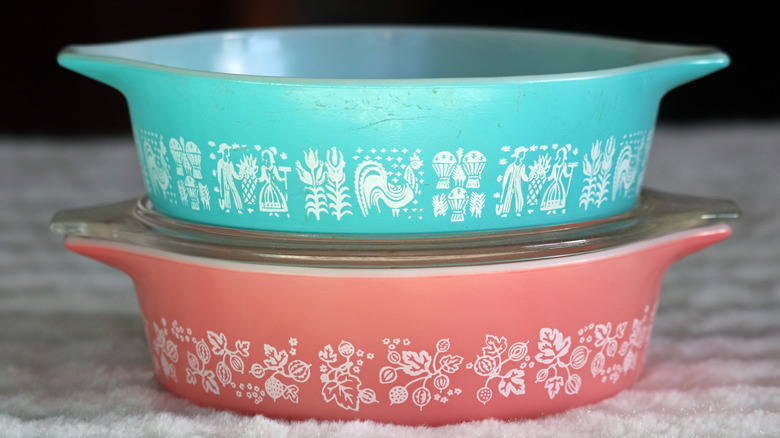
For many cooks, few secondhand kitchen finds are harder to resist than vintage Pyrex. Some patterns have become so valuable that if you spot one at the thrift store, it's definitely worth grabbing. However, the potential for cracks and the possibility that a glass dish could explode aren't the only safety considerations when you're inspecting decades-old kitchenware. Before you thrift a cool set of bowls, it's important to know that some older pieces may contain lead.
The nostalgic florals, snowflakes, geometric prints, and cheerful, saturated mid-century colors are what make vintage Pyrex beautiful enough to collect and adorn your home. The bowls were made to be workhorses, still functional for real cooking many decades later. But if you're planning to eat from your thrifted treasure, its age and decoration should be seriously considered. The U.S. Food and Drug Administration (FDA) warns that lead present in such vintage foodware can migrate into your meal.
The concern with old Pyrex is primarily that pretty paint applied to the outside of the glass — the clear glass itself doesn't inherently contain lead. Historically speaking, lead compounds were added to lower temperatures needed to melt or fuse materials and produced smooth, durable finishes and vivid colors. That said, lead is a serious neurotoxin, and exposure is toxic at any age, with children being particularly vulnerable. Per the Center for Disease Control (CDC), even low blood levels can be dangerous to kids. It's no wonder the FDA cracked down on this in the 1970s.
Test vintage Pyrex before use
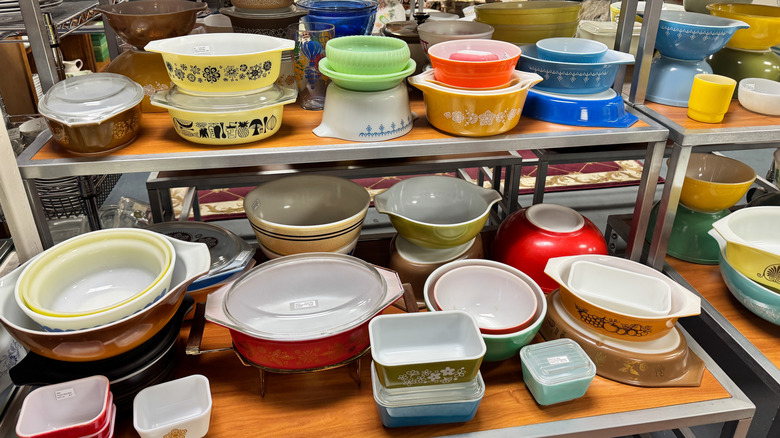
The potential for lead is primarily associated with older decorated Pyrex produced before those modern restrictions were enacted. Figuring out when a piece was made can therefore help you decide what to do with your find. The Corning Museum of Glass maintains a pattern library with production dates for vintage Pyrex, which can also help you determine whether your Pyrex is really vintage.
Consumer lead-testing swab kits are also available. These kits are affordable, provide instant results, and are overall fairly easy to store and use. If you're a regular kitchenware thrifter, a lead testing kit may be a useful tool. If the test indicates that a piece contains leachable lead, the FDA strongly advises against using it to prepare or store food. If you can't test a questionable piece or otherwise establish that it's suitable, it may be a sign that it's better to leave that particular vintage dishware at the thrift store rather than introduce an avoidable uncertainty.
A gorgeous vintage bowl may still be a legitimate treasure you can keep or bring home, but you may want to reconsider how you use it. The concern is eating from it, not being near it or looking at it. Retired Pyrex can live on a shelf as part of a displayed collection, hold non-food objects, or become an unusual cachepot for a houseplant. Just because a piece isn't safe for food service doesn't mean it isn't useful or lovable. Sometimes surviving into a new century means getting a new job.