

What Actually Makes A Big Mac So Unhealthy?
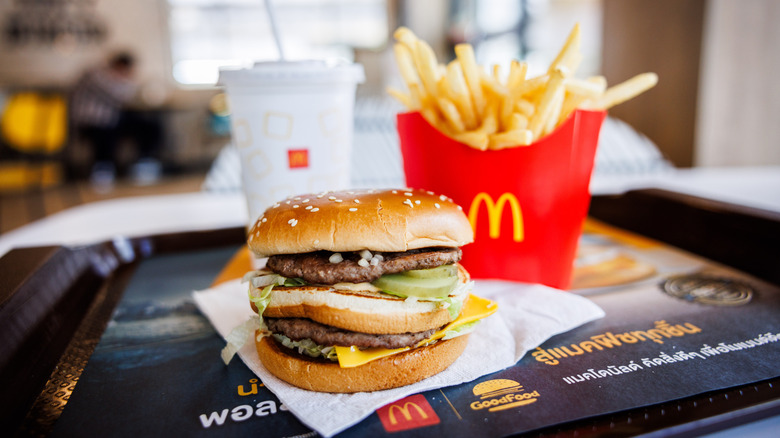
The facts about what makes a fast food burger like a Big Mac unhealthy or healthy can certainly be a bit confusing. While nobody thinks of the classic McDonald's Big Mac as health food, the recent focus on protein, and the greater understanding that not all fat is bad for you, may have some people reevaluating their opinions on fast food cheeseburgers. After all, the Big Mac's 580 calories isn't that wild for a meal, especially if you're a more active person, and 25 grams of protein is some solid nutrition. But that's not all you should be looking at. So we reached out to a registered dietitian nutritionist, the Chicago-based Samar Kullab, to find out what makes experts consider a Big Mac unhealthy.
Kullab zeroed in on one particular worry with a Big Mac: sodium. A Big Mac by itself has 1,060 mg of sodium, and she says, "the American Heart Association recommends no more than 2,300 mg/day of sodium." Kullab also explains that people with common conditions like high blood pressure, CHF, Kidney Disease, Liver Disease, Metabolic Syndrome, Type 2 Diabetes, and pregnancy-related hypertension, should be as low as 1,500mg a day, or possibly eating even less salt depending on a doctors recommendations. She tells us, "when you're eating a Big Mac in one sitting, you're consuming more than half of your daily limit, if not more." And eating too much sodium can have real negative side effects for your long-term health.
McDonald's Big Macs are loaded with sodium that can increase your blood pressure

According to Samar Kullab too much sodium is bad because of how it regulates fluid balance in your body. She tells us, "when you consume a high amount of sodium in one sitting, your body responds by holding on to more water to try to balance it out." That's why you may feel bloated, thirsty, or get puffy when eating too much sodium. Kullab explains that, "Generally, once you stop eating salty foods, your body flushes it out and it's temporary (unless you have a condition)," but if you eat that much sodium regularly your body will hold onto that extra water more often. She says that when that happens, "you're causing more pressure on your heart and blood vessels over time, which is where the damage can happen." That strain increases the risk of heart attack or stroke.
That doesn't mean you can't ever eat a big cheeseburger. Kullab says, "a Big Mac once in a while if your diet is overall balanced won't really hurt." You just don't want to be consuming high-sodium foods every day. She also notes that you can lighten some aspects of a Big Mac through simple modifications, like skipping the middle bun, or asking for a lighter spread of McDonald's Big Mac secret sauce. It just might make the famously bun-ny burger taste better anyway.