

These 9 Appetizers Were Dinner Party Staples In The '70s
If you were enjoying a typical, everyday meal in the 1970s, the chances are you would be tucking into classics like quiche Lorraine, meatloaf, and tuna casserole. You know the drill: comforting and hearty, but pretty ordinary. For a dinner party, though, you had to take things to the next level. It was important to serve something special. Chicken liver wrapped in bacon and slathered in teriyaki sauce — that kind of special.
Here, we're taking a look back at the dinner party staples of the '70s. But specifically, we're focusing on the kind of appetizers people would regularly feast on before the main event. These are the foods you might have eaten while circling the room before it was time to sit down, or the apps that were found on the buffet table before the crown roast of frankfurters made an appearance (yes, that was an actual thing). Interestingly, while some of these are no longer really a thing (ahem, pineapple Spam sliders), others are very much still around (looking at you, number two). Let's go.
Deviled eggs
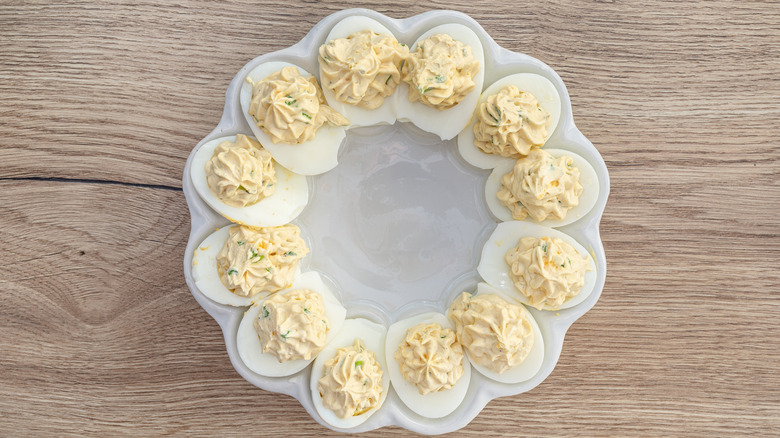
Deviled eggs weren't invented in the 1970s (the original version of stuffed eggs can actually be traced all the way back to Roman times), but they were a dinner party staple of the era — and a regular feature on buffet tables, especially. It makes sense that hosts would trot them out for big gatherings; after all, they're pretty easy to make. All you need to do is boil the eggs, scoop out the yolk, combine it with sauces and spices (like mayonnaise, mustard, and paprika), and then stuff the mixture back in the halved egg whites. Serve the eggs on a platter, and you've got an instant dinner party hit.
You could find deviled eggs being served in many households across the U.S. during the '70s, from more rural areas to busy cities. In fact, a recipe for them appears in "Farm Journal's Country Cookbook" from 1972, which according to the blurb includes "time-tested" recipes for cooks throughout America, whether they live in the city or the country. The recipe is fairly straightforward, but it does offer up ideas for unique twists, like adding chopped ham or cream cheese to the egg yolks.
This particular version of deviled eggs was such a success that, more than five decades after it was published, people are still thinking about this dish and searching social media for the recipe. "You are the real hero of this website," says one Reddit user in response to someone who had found and pasted the recipe into the r/Old_Recipes subreddit.
Guacamole
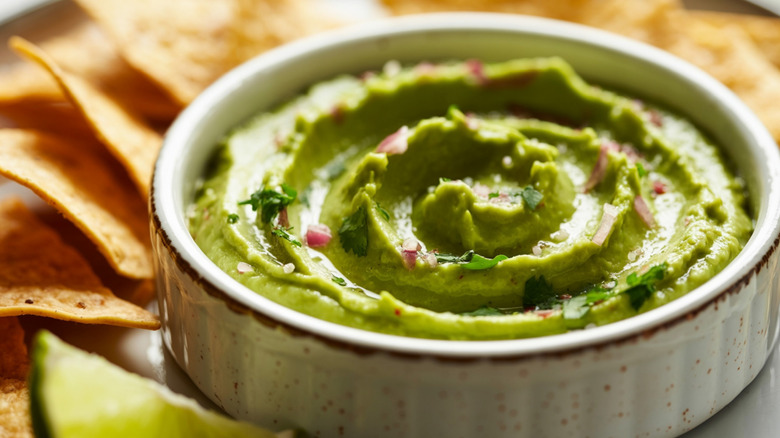
Guacamole is far from new. In fact, when Spanish colonizers arrived in the Americas in the 1500s, they came across the Aztec people making a dip called ahuacamolli by smashing avocado and combining it with tomatoes and chiles. The 1697 book "A New Voyage Around the World" features the first written, English-language guacamole recipe, which combines mashed avocado with lime juice and sugar. Centuries later, guacamole would take off in the U.S. when Mexican foods started to hit the American mainstream in the second half of the 1900s. Sure, people could head to their local Mexican restaurant for a taste, but guacamole was so simple that some decided to make it at home, too.
That's probably why, by the '70s, many party hosts loved serving guacamole to guests as an appetizer. In fact, "Betty Crocker's Dinner Parties" cookbook, published in 1970, includes a sample menu for a Mexican dinner, and guacamole dip with tacos is listed as the first course. According to the book, making it required one can of frozen avocado dip, cumin, and Tabasco, along with frozen cocktail tacos and lettuce. Another recipe appears in the 1972 cookbook "The Cuisines of Mexico" by the British-born Mexican culinary expert Diana Kennedy. This recipe is slightly more authentic than Betty Crocker's (go figure), and it involves grinding onions, chiles, coriander, and salt together with a mortar and pestle before mixing it with the avocado and chopped tomatoes.
Guacamole is, of course, still popular today. Although it's worth noting that if you want restaurant-quality guac at home, it's best to use fresh, ripe Hass avocados over canned versions (sorry, Betty).
Shrimp cocktail
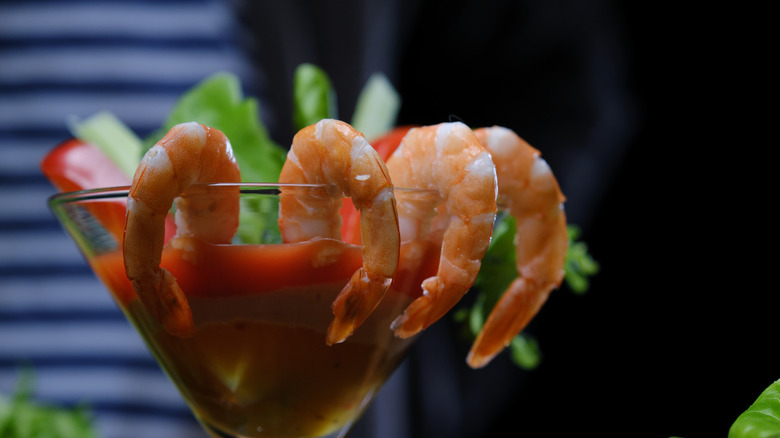
In 1926, The New York Times suggested a fun appetizer to readers: shrimp (or oysters or clams) paired with a catsup-based sauce, served in a glass dish. Shrimp cocktails weren't dreamt up by the newspaper, though; a similar recipe actually appeared several years earlier in 1901's "The Picayune's Creole Cook Book." So, we know that by the time the 1970s rolled around, at least some Americans had been eating shrimp cocktails for a while. But regardless, this popular app still went on to define the dinner parties of this decade.
If you wanted to elevate the dish and outdo your friends in the '70s, you could (once again) reach for a copy of "Betty Crocker's Dinner Parties" cookbook. The recipe book features a guide to a shrimp boil with cocktail sauce, which is basically an upgraded version of the classic shrimp cocktail. The recipe instructs readers to serve beer-boiled shrimp to their guests (with the shells still on) with a side of cocktail sauce made with catsup, horseradish, and lemon juice.
Fondue
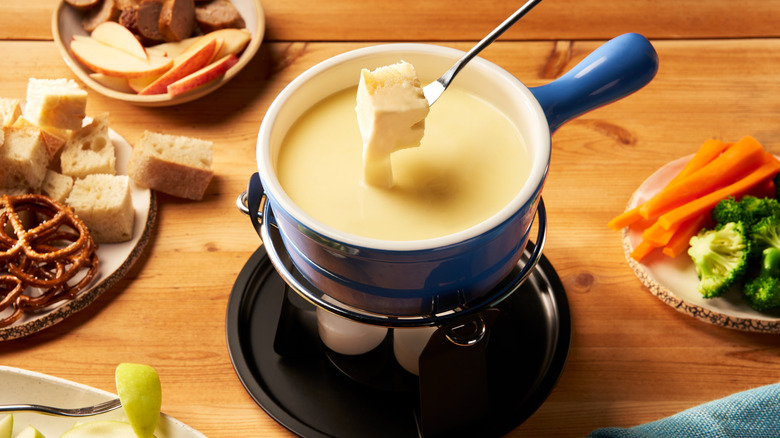
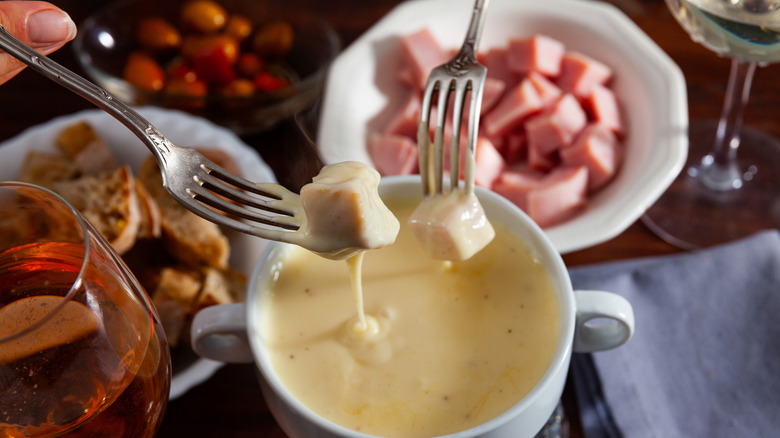
Like most of the dishes on this list, nobody invented fondue in the 1970s. The rich, gooey, bubbling pot of melted cheese and various dipping foods can actually be traced back to Switzerland in the 1600s. Many, many years later, it became popular in the U.S. after an appearance at the 1964 World's Fair held in New York City. By the following decade, the appetizer had been established as a party must-have.
In fact, many people who were children in the '70s remember the fondue pot being brought out for special occasions, like Christmas and New Year's Eve. "It is 1974 and we just bought one. Ours is green!" reads one Facebook comment in a group called We Pretend it's Still the 1970s. "All of my parents' college friends come over to our house and eat with us and enjoy fondue!" Another person adds: "I remember having fondue dinner parties with my HS circle of friends ... we thought we were so cool and sophisticated."
While many people just had classic cheese fondue, some liked to experiment. In 1972, Kraft published a few different takes on the Swiss dish in Seventeen magazine. One involves dunking pork cubes into a sweet-and-sour fondue made with Kraft Barbecue Sauce and Kraft Pure Apricot (or Peach) Preserves, while another recipe urges people to dunk pieces of meat, vegetables, and bread into a fondue made with Velveeta Pasteurized Process Cheese Spread. Interesting.
Pineapple Spam sliders
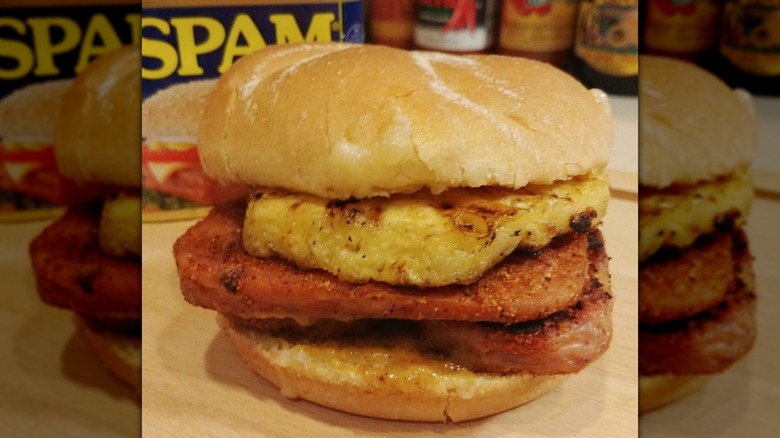
Spam hit the market in the 1930s, but it really flew off the shelves due to food rationing during WWII, when people all over the world (not least the American and Allied soldiers) needed more affordable, long-lasting, shelf-stable meat options. Spam dipped in popularity in the post-war years, but it was still a relatively common protein choice. Some remember serving Spam sliders with pineapple as an appetizer during the 1970s, for example. The pineapple element was likely influenced by Hawaii, where Spam has remained incredibly popular since the Second World War.
Not everyone paired Spam with pineapple in the '70s, though. Another recipe from the decade, published by Spam itself, combines Spam with lima beans, pimiento squares, and a Spanish-inspired tomato sauce. In fact, Spam recommended a lot of recipes during this decade, often printed in magazines and newspapers. There was the Spamburger, as well as Spam sandwiches with cream cheese and scallions, a Spam-style pizza, and even a pineapple Spam loaf (which is basically slices of Spam and slices of pineapple squashed together and topped with a dry mustard, brown sugar, and pineapple juice glaze).
Cheese balls
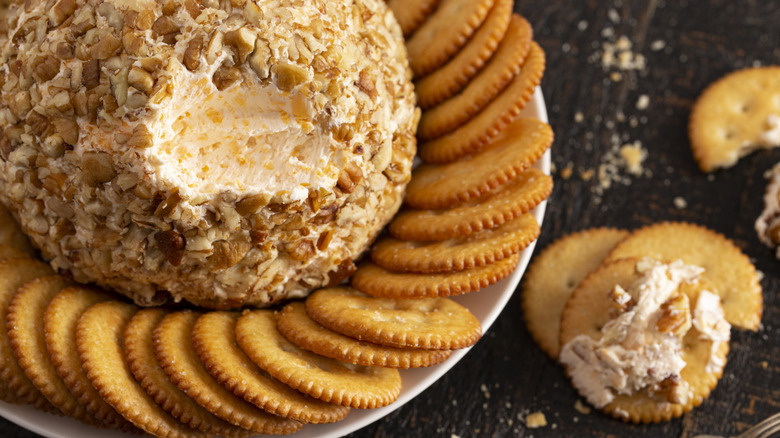
If you were attending a 1970s dinner party and you were greeted with a cheese ball, you'd probably be pretty stoked. This ultra-cheesy favorite is, quite literally, a ball of cream cheese, sometimes mixed with other soft or semi-soft cheeses, and usually seasoned with spices and covered in nuts. "Before you could buy the 3-pack of cheese balls, there [were] delicious homemade cheese balls at every party," writes one Redditor in the r/Old_Recipes subreddit. "The one I remember definitely had cheddar and was coated in pecans."
The dish has pretty interesting roots. In fact, the story goes that the first cheese ball, a gargantuan creation of more than 1,200 pounds, was created by Elder John Leland of Cheshire, Massachusetts and gifted to President Thomas Jefferson in the early 19th century. Over the years, the cheese ball got significantly smaller, and it eventually landed on dinner party tables as a beloved appetizer staple.
Many '70s hosts kept it simple, but others got a little experimental. Some remember adding a kick to their cheese balls with some jalapeños, for example, or adding in ingredients like chopped olives and dried beef or bacon. "From what I recall, everyone had their own special recipe," says another Reddit user, before adding: "My mom's version used a dash of steak seasoning and a bit of garlic powder."
Pigs in blankets
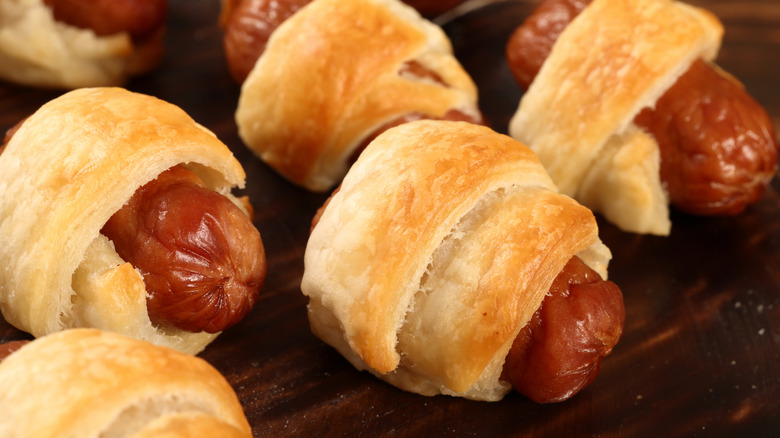
Another family-friendly dish that used to grace the tables of 1970s dinner parties? Pigs in blankets. And by that we, of course, mean sausages wrapped in pastry. Again, they're not a '70s creation. In fact, a recipe for a very similar-sounding concoction appears in the 1874 British cookbook "Mrs. Beeton's Book of Household Management," and another one turns up in an American cookbook called "The Joy of Cooking" around 60 years later.
In the '70s, people were still making pigs in blankets, and they loved serving them up to dinner party guests. Some might have followed the recipe from the 1971 "Betty Crocker's Bisquick Cookbook," for example, which encourages home cooks to wrap frankfurters in sauerkraut and Bisquick dough. Others might have followed the more kid-friendly pigs in blankets recipe from "The Betty Crocker Recipe Card Library," which was also published in 1971. This recipe is basically the same but without the sauerkraut (which, clearly, is decidedly un-kid-friendly).
Rumaki
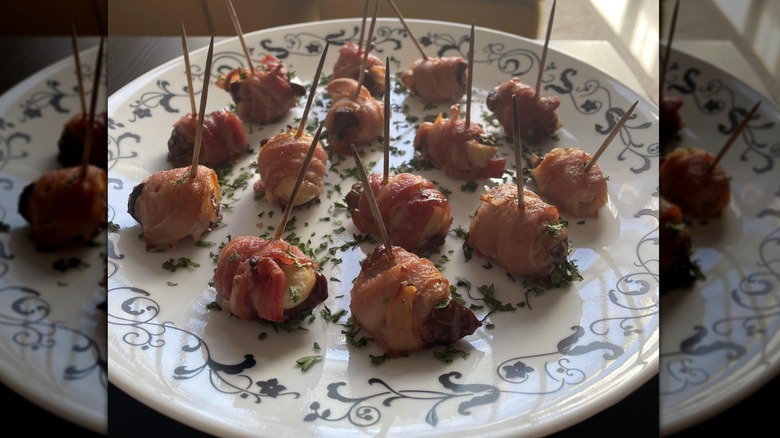
Rumaki sounds a little more glamorous than it actually is. The appetizer, which was popular in the 1960s and 1970s, consists of small pieces of chicken liver and water chestnuts that have been wrapped together with bacon and then covered in teriyaki sauce. That last ingredient is particularly significant: Teriyaki sauce first hit the American market in the 1960s, and by 1970, it was so popular that the word was entered into "Webster's New World Dictionary of the American Language."
For many, the chosen way to serve teriyaki to guests was via rumaki. Some even remember their parents offering up the bacon-wrapped pieces alongside the fondue pot, while others would bring this appetizer along to a potluck. "My mom is having a dinner party," reads one post in the previously mentioned Facebook group for people to pretend it's the '70s. "The food is kind of gross, but I kind of like the rumaki because I like bacon."
Cocktail meatballs
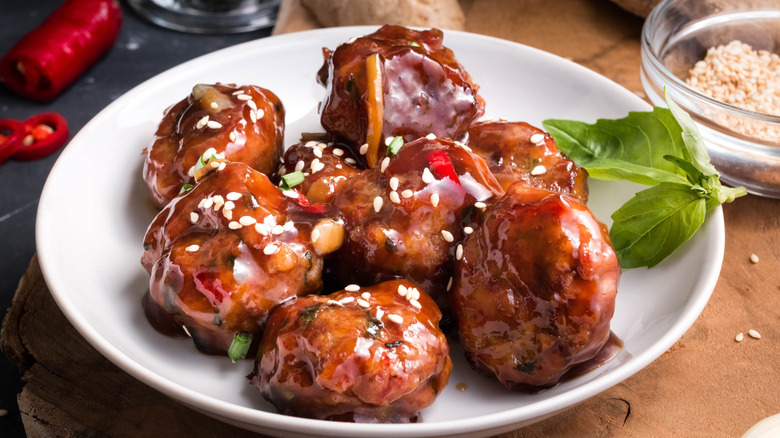
Cocktail meatballs, usually served with a sauce made from grape jelly and chili sauce, were another common sight on 1970s dinner party tables. The appetizer was also popular in the 1960s, with a recipe called chafing dish meatballs first appearing in the "Elegant but Easy" cookbook at the start of the decade. But it was clearly beloved enough to stick around for another decade or two (people seemed to enjoy it in the 1980s, too), and later editions of the same cookbook note that it's "probably the most popular hors d'oeuvres in the book."
It's easy to see why cocktail meatballs were a favorite: They're simple to make, tasty (thanks to the sweet-meets-savory tangy and fruity flavors), and easy to eat (designed to pop in your mouth, they were often served on wooden skewers). Another recipe for cocktail meatballs appears in the 1978 edition of "Betty Crocker's Cookbook," and in this version, it recommends incorporating some chopped parsley and Worcestershire sauce in the meat mixture (should you go that extra step and not use pre-made frozen meatballs), and then serving them up in that same classic sauce.
Back in the '70s, some folks preferred to make up their own recipes for cocktail meatballs, although many followed a similar format to the Betty Crocker version to wow their guests. That said, some people recall swapping the grape jelly for cranberry sauce instead.