

No, Brown Sugar And Baking Soda Are Not Going To Fertilize Your Garden — Here's Why
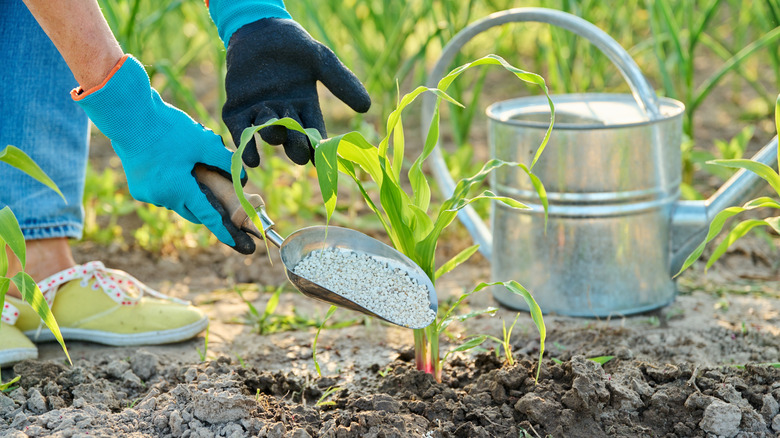
There's a seemingly AI-generated gardening tip currently making the rounds online, recommending mixing brown sugar and baking soda with water, then pouring it around your plants as fertilizer. The videos look convincing enough: Hands mixing ingredients, lush garden footage, and a confident robot-voiceover explaining what to do. Some viewers are taking the advice seriously enough to ask whether white sugar will work instead, but others are considerably more skeptical. One commenter succinctly states, "This is not good for plants. Google it." There are some good DIY gardening hacks and recipes to make your own natural fertilizer, but before adding anything from your pantry into your garden soil, it's worth exploring the simple question: What would brown sugar and baking soda actually do in the dirt?
Brown sugar and baking soda may be the beginning of many good cookie recipes, but living plants don't eat cookies, and there's basically nothing helpful or good about feeding the composition to your soil. What the ersatz fertilizer mixture would contribute to your garden is problems. Plants require a range of nutrients, with nitrogen, phosphorus, and potassium forming the familiar N-P-K trio listed on fertilizer labels. Brown sugar is primarily sucrose; baking soda is sodium bicarbonate. Neither supplies plant nutrients in meaningful amounts.
Sugar, spice and questionable advice
Baking soda would add sodium to the soil, and while a tiny bit probably won't do much, too much salt around plant roots can interfere with their ability to take up water, and degrade the soil conditions over time. Plants manufacture their own sugars through photosynthesis, so pouring table sugar into the soil isn't the equivalent of giving your tomatoes a yummy snack. Sugar can supply an easily accessible source of carbon for soil microorganisms, which can shift microbial activity and temporarily affect the availability of nutrients like nitrogen.
There's a time and a place for that; agronomists can deliberately use added carbon to manipulate the relationship between soil microbes and available nitrogen. But it's a way more complicated calculation than "more microbial activity equals happier plants." When microbes suddenly get an abundance of easy-to-eat carbon, their population can grow rapidly, increasing their demand for nitrogen and potentially gobbling up nitrogen that would otherwise be utilized by your plants. Sugar may also attract ants and other visitors, which isn't inherently bad, because bugs are part of a healthy ecosystem, but you don't need to provide them lunch, either.
The claim sounds believable because both ingredients have some real gardening associations, giving it a veneer of legitimacy. Baking soda has specific, functional uses around the garden, including strategic applications involving plant diseases and killing weeds, and sugar really can affect the rhizosphere, the biologically active zone of soil that surrounding plant roots. Brown sugar also contains molasses, which is known for being high in minerals and vitamins, lending the whole concoction a down-home, nutrient-rich aura. String those ideas together quickly enough, and it sounds plausible. A 30-second video doesn't leave much room to inspect the links in that chain of ideas.
Don't believe bot-anical counsel
There's a powerful incentive online to create advice-style content that gets a response. Generative tools make it cheap and easy to produce authoritative-sounding instructional videos, and social platforms reward posts that keep people watching, and commenting, and arguing amongst each other. A dubious DIY gardening hack video may provoke questions from people who believe it, and corrections from people who know better. Both reactions keep the engagement rolling in. It's beside the point whether anyone on the other side of the post actually believes it, and it's up to the viewer to decide what they engage with, and if the information is trustworthy enough to try out on their growing garden.
The "Google it" advice is good, but also slightly inadequate for the current internet ecosystem. Search results themselves now begin with AI-generated summaries, which harvest and synthesize information pulled from the same enormous web where bad advice is being infinitely copied, recycled, and repackaged. Keep your wits about you, don't turn your brain off just because an AI-voiceover presents a reassuringly folksy solution to a common problem. Scrutinize everything.
Ask what the source is, whether the explanation makes physical or biological sense, and do some secondary research to find out if there's a reputable expert recommending the technique. For gardening, Cooperative Extensions programs, botanical institutions, experienced growers, and master gardeners are good places to start asking for advice. You can even visit your local nursery IRL and just ask a knowledgeable staff member for tips. Plants are complicated living ecosystems, and if you're going to go to the trouble of coaxing them to life, don't dump a slurry of random pantry ingredients on them if it doesn't pass the smell test.