

For Bigger Container-Garden Tomatoes, Use This Natural Fertilizer
We may receive a commission on purchases made from links.
Gardeners know that tomatoes are exuberant but ravenous plants. They'll put out a heavy bounty come late summer, but require plenty of water, fertilizer and fussing throughout the season. Nowhere is that more obvious, or tricky, than in a container garden. If you want to grow the biggest, juiciest tomatoes from a patio pot or balcony planter, one of the best natural soil boosters out there is fertilizer made from ... fish! Fish fertilizer is excellent for container gardens because it helps a few gallons of nutritionally paltry potting mix feed the plant through the season. The microbial community surrounding the roots also enjoys being fed by the compounds that the fish fertilizer provides.
In the productive part of their life cycle, tomatoes are doing it all, simultaneously building roots, vines, leaves, flowers and eventually, hopefully, pounds and pounds of juicy fruit. All of that requires a steady supply of nutrients. In an in-ground garden bed, roots can continue exploring fresh pockets of soil as nearby microbes and fungi, while worms and decaying organic matter slowly recycle nutrients back into the ground. A pot is a much smaller world. Once those nutrients have been absorbed by the plant, there's nowhere else for the roots to go looking for dinner.
Frequent watering exacerbates the problem because every time excess water drains out of the bottom of the container, it carries away a small amount of crucial soil nutrients — the dissolved nitrogen, potassium and other minerals — a process called nutrient leaching. Potted plants also tend to get hotter and dry out faster than those in the ground, so over weeks of summer maintenance watering, those losses accumulate, leaving tomatoes with progressively less and less nutrients to work with.
Dilute, don't pollute
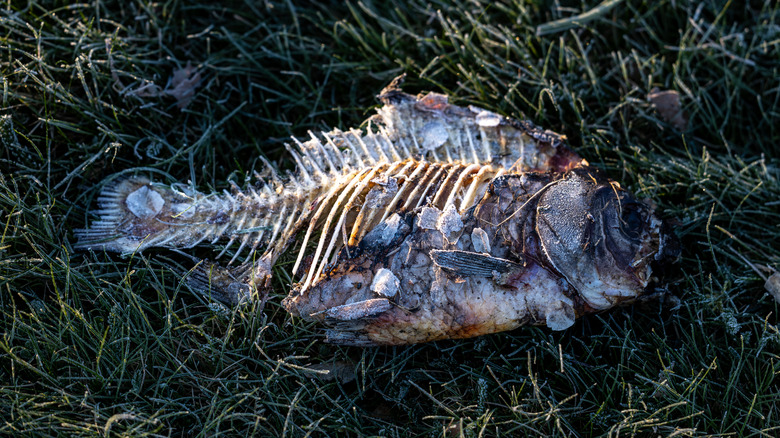
Commercial fish fertilizers can be made from whole fish or the bones and skin and scales left over from commercial fish operations. In the case of fish emulsion, the fish is pulverized into a slurry, then processed into separate products like fish oil and fish meal — the remaining goop can be strained, preserved, and sold as plant food. It's gill-to-tail, uses parts that might otherwise just be wasted, and it returns nutrients accumulated in an aquatic food web to the soil, where another food crop can use them.
The fertilizer bottle will tell you the proportion of nitrogen, phosphorus, and potassium, or N-P-K, it contains. You don't have to go running for your high school chemistry textbook, but the balance is worth understanding and paying attention to. Alaska Fish Fertilizer, for example, has an N-P-K ratio of 5-1-1, which tells you it has a lot of nitrogen. Nitrogen supports the vigorous growth of stems and leaves that a young plant needs to build before it can support a heavy, productive crop later in the summer. Phosphorus plays an important role in root growth and fruit production, while potassium is involved with everything from water regulation to fruit development.
The plant's nutritional needs change as the season progresses; a high nitrogen fertilizer is good for the early, leafing out stage, for example, but for thriving tomato plants, you'll want a slightly different nutrient cocktail with a higher ratio of phosphorus and/or potassium, once the plant is putting out flowers and developing fruit. Fish fertilizers will also require dilution in certain ratios; Alaska's 5-1-1 formula, for example, recommends mixing 1 to 2 tablespoons into a gallon of water. Others may have different concentrations, so read and follow the directions on your particular bottle.
Something fishy...
You can make your own fish fertilizer, but it's a project that requires a certain tolerance for the timeline, and fragrance, of the decomposition process. Home preparations take upwards of three weeks to ferment and break down, and need to be covered against flies and curious animals, while still allowing gases to escape. You can probably imagine what sort of ... bold aromas ... will emanate from a well-aerated bucket of rotting fish slop, and if you're growing tomatoes in containers because you don't have a lot of outdoor gardening space, you may not want to devote your limited real estate to a gurgling, unctuous chum bucket.
If you're set on DIY, recipes vary, but the basic process harnesses microorganisms to dismantle the fish tissue and release its nutrients. Some brave gardeners combine a slurry of fish scraps with a carbon-rich material such as sawdust, add molasses or brown sugar to feed the microbes, and periodically mix the contents as the solid material gradually breaks down. Once it stops stinking, and you've created what is essentially a wood-pulpy fish sauce, it will still need to be strained and diluted before it goes anywhere near your potted tomato plants. Unlike the store-bought bottle, however, your backyard concoction hasn't been chemically analyzed, so you won't know the precise N-P-K ratio.
Theoretically, you could apply your marine home-brew in different dilutions on several different tomato plant containers, and observe which grows best. You might end up with lush foliage and not a lot of fruit, or lose some plants in the experiment, because too much nitrogen can mess with the salts in the soil and cause fertilizer burn. Either way, homemade or over-the-counter, fish fertilizer can help a container of sterile potting mix produce a fruitful bounty.