

Why You Should Be Cooking Eggs On Your Blackstone Grill (And How To Do It Right)
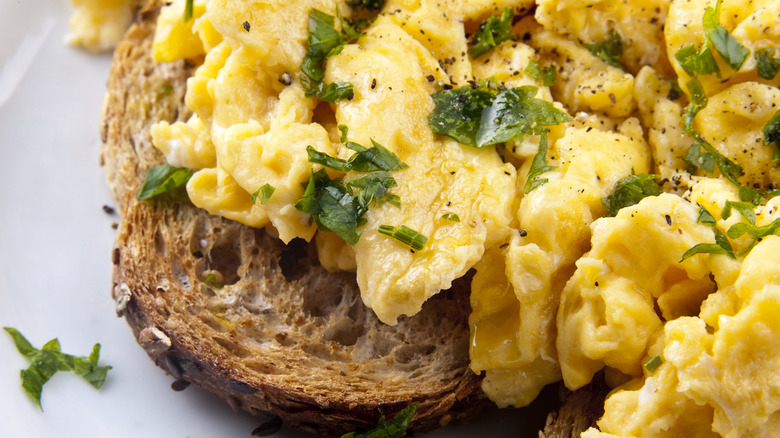
Since releasing its outdoor flat-surface grills in 2008, Blackstone Products has made good on its mission to create a grill that allows users to cook virtually anything outside. Gone are the days where outdoor grilling is reserved only for burgers and barbecue. Folks are making everything from homemade biscuits to canned cinnamon rolls on a Blackstone, and you really should be cooking your eggs on it, too.
The flat, expansive griddle space on the Blackstone grill is the perfect surface area for eggs. You can easily slide a spatula where it needs to go, cook larger quantities of eggs without crowding out multiple pans, and cleanup is simple. Best of all? The Blackstone is a versatile tool that allows you to cook every style of egg you can imagine, with only a few simple rules that need to be followed.
Matthew Hussey, on his YouTube channel The Hungry Hussey, details the right way to cook eggs on a Blackstone, and temperature is the key. Just as with an indoor stovetop, eggs should be cooked on a lower temperature (anywhere between 300 to 325 degrees Fahrenheit). Blackstone recommends keeping the setting on a 3, but if your griddle seems too hot anytime during the cooking process, don't be afraid to turn off the middle burners. You can use an infrared thermometer to check temperatures, or simply gauge the level of heat on the surface by looking for any smoke. If your butter or oil begins to slightly smoke, turn off the middle burners, place some water on the grill, and wipe the surface with a cloth to cool it.
Blackstone eggs like low temperatures and good timing
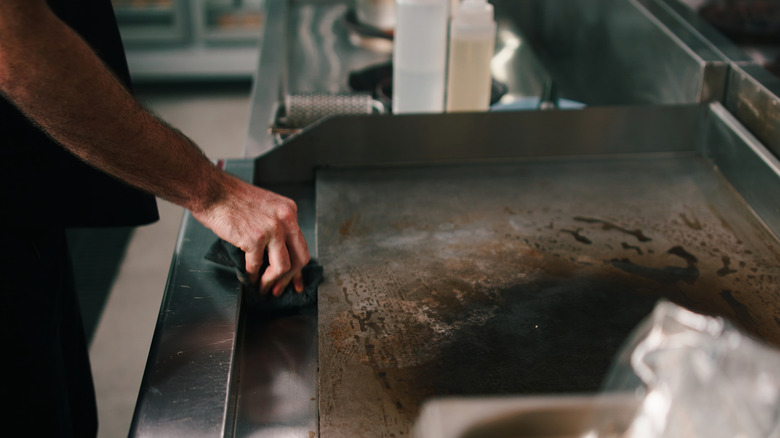
The best tip for cooking eggs on a Blackstone, in addition to low temps, is timing. For sunny-side up, set your Blackstone to a 3 (turning off burners or reducing heat if you notice smoke), use your choice of fat (we think butter is the absolute best fat to cook your eggs in), and cook for about five minutes until the white sets. For over-easy, flip the egg when the white sets and cook for another minute. Increase by a minute for over medium and to three minutes for well. The low temperatures combined with the large surface area will help ensure your eggs have a consistent texture that's not rubbery.
If scrambled is your jam, use the same process (medium heat on the middle burners, then lower or turn off the burners if it's too hot). Here, you'll want to be sure to move the spatula frequently and quickly to break up the eggs. For finer scrambled curds, stir the eggs frequently. For larger curds, let the eggs set slightly before stirring.
If you're an omelet person, but find yourself intimidated by the process of folding omelets in a limited space, fear not. Amanda Freitag's best tips for cooking a fluffy omelet are easily achieved on a Blackstone. You can also cook the filling of your choice on the sides of the Blackstone while cooking your eggs. Just remember to keep those eggs moving.