

The Old-School Pizza Chain That Wanted To Laser Its Logo Onto The Moon
For as long as humans have watched the night sky, we have looked at the moon to mark time, navigate, tell stories, and contemplate our place in the universe. At the close of the last millennium, Pizza Hut gazed into the final frontier and boldly asked, "If we can put a man on the moon, why not an advertisement for the Meat Lover's Stuffed Crust Special?" In 1999, the old-school pizza chain investigated using lasers to project a newly redesigned red-roof logo onto the lunar surface. The idea was that Earth's most visible nightlight (owned by none and belonging to all) might have some untapped marketing potential.
Pizza Hut reportedly spent two months dead-seriously consulting real astronomers and physicists, but under technical scrutiny, the extraterrestrial billboard-surface presented some big issues. After running calculations, the scientists came back with a disappointing answer: For a logo on the moon to be visible to the people on Earth, it would need to be roughly the size of Texas. Estimates put the project in the hundreds of millions of dollars category. After an era defined by increasingly unusual menu items and larger, more complicated pies, Pizza Hut finally encountered a scale problem it couldn't solve with extra cheese.
Having established that the moon is really big (and really far away), Pizza Hut scaled back its ambitions. Instead, the brand put its logo on a Russian space rocket. In 2000, the chain paid about $1 million to emblazon a roughly 30-foot logo on the Proton-K rocket carrying the Zvezda service module to the International Space Station (ISS). Compared with altering humanity's view of the heavens above, branding a real spacecraft qualified as the practical option.
When the moon hits your eye...
Pizza Hut's lunar ambitions weren't without precedent. The moon scheme makes a little more sense when you look at the company's maximalist '90s menu and advertising aesthetics built around audacious cross-cultural references. In 1993, the chain went toe-to-toe with Little Caesars by introducing the Bigfoot, a rectangular, two square foot pizza. The game-changing Stuffed Crust followed in 1995 and, in 1999, the 16-inch Big New Yorker arrived. Pizza Hut spent $80 million to market that last one. The theory of scale was expansive, and soon, there wasn't enough room on planet Earth.
Hitching its red roof to the Russian rocket might seem like a random geopolitical collision, but the company had already made Russia part of its global brand mythology even before the Cold War was over. Pizza Hut opened its first Moscow restaurants in 1990, and by 1997, the brand recruited former Soviet leader Mikhail Gorbachev for a commercial that turned the arrival of Pizza Hut into a punchline about his complex legacy. Diners argue over whether Gorbachev brought chaos or opportunity before all rejoice that they have Pizza Hut because of him. The surreal commercial casts imported American fast food as a symbol of a transformed Russia, and a heroic instrument of cultural diplomacy.
During the Cold War, the Unites States and the Soviet Union spent decades competing for space, literally — a rivalry that ultimately put Americans on the moon in 1969. Over 30 years later, Pizza Hut's abandoned plan to advertise on that same floating rock found a consolation prize in the former rival's space program. The Space Race had been a contest of national prestige and technological supremacy, but Pizza Hut was just getting into the game.
Special delivery to the International Space Station
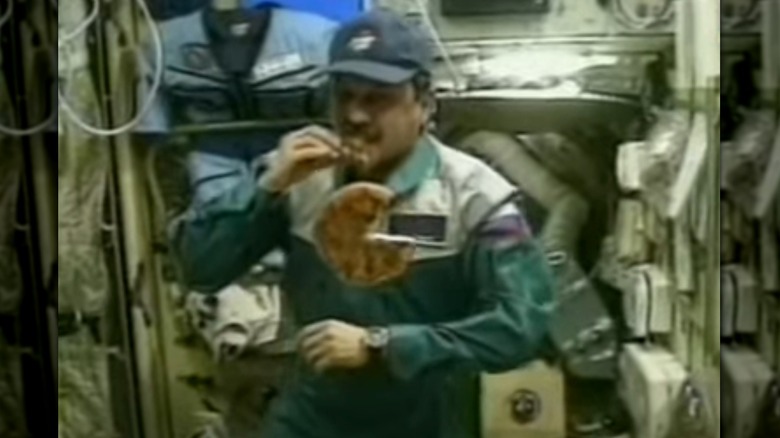
Having failed to engineer the moon around Pizza Hut, the company turned to engineering its pizza around space. In 2001, the chain worked on sending an actual pizza to the stars for Russian cosmonaut Yuri Usachov. However, getting takeout into orbit presented its own peculiar set of problems. Pizza Hut worked with Russian food scientists to develop a six-inch pizza specifically for the trip, topping it with salami after pepperoni reportedly failed to measure up. The pizza was also more aggressively seasoned since taste and aroma can feel muted in microgravity.
The space pizza travelled to the ISS aboard a Russian resupply mission. There, Usachov heated the pie up and enjoyed it on camera. Pizza Hut billed the stunt as the first pizza delivery to space, reportedly spending around $1 million on the promotion.
Projecting its logo for the entire population of Earth may have been out of reach, but getting dinner to one hungry guy in low Earth orbit was something Pizza Hut could deliver, despite the unprecedented address. For a marketing campaign conceived at a literally astronomical scale, getting both a logo and pizza off planet is a respectable accomplishment. For now, the moon remains unbranded.