

How To Figure Out Your Go-To Drink Order, According To A Bartender

The world of cocktails is vast and wondrous, and it can be an adventure for your palate to try new things. But there's also something intrinsically cool (and comforting) about being able to walk up to any bar and order the exact drink you know you love. How does one reach such a confident point, especially considering that vastness of options? We asked an expert how anyone can figure out their ideal go-to drink order.
"Start by paying attention to the drinks you already enjoy and asking yourself why you like them," suggests Justin Lavenue, the Austin, Texas-based master mixologist and co-owner of The Roosevelt Room and owner/operator of The Eleanor and RoadHaus Mobile Cocktails. "Are they tart, bitter, sweet, refreshing, boozy, dry, fruity, herbal, spicy, carbonated, creamy, or spirit-forward? Then try cocktails in a few major families: a sour, a highball, a stirred spirit-forward drink, a spritz, a tropical drink, and something bitter or aperitif-driven."
If you love sour flavors, for example, you'll likely love the sour cocktails that belong to the daisy family — consisting of a spirit, citrus juice, and sweetener, these include margaritas. If you like lighter, more effervescent drinks, highballs are a good match. Likewise, fruity-flavor fans may love tropical drinks, while bitter, botanical enthusiasts might appreciate spritzes. As you try cocktail families based on the flavors you prefer, Lavenue advises, "Keep notes in your phone of what you liked and what you didn't. After a while, patterns emerge."
Think less about one specific drink, more about the flavor experience you want

A "go-to" order may shift depending on where you are and what you're in the mood for, Lavenue says. The best approach isn't one specific cocktail with no wiggle room, but instead confidence in your preferences. "The most confident drink order is not necessarily, 'I always drink a Negroni,'" he says. "It might be, 'I like refreshing tequila drinks with citrus and a little bitterness, but not too sweet.' That gives a bartender much more to work with, and it keeps you from becoming the person who orders the same drink everywhere even when the bar clearly makes something else better."
This puts you in a zone where you can trust you'll get something you like, but leaves some flexibility so you can try new things within that zone. If you want to explore, the way to ask your bartender for a surprise drink is not, in fact, to just say, "surprise me." Give the bartender a general direction. "For example: 'I usually love margaritas, but I'd like to try something with tequila that is a little more herbal and savory,'" Lavenue recommends. "Or, 'I love bourbon and citrus, but I want something more unique than a standard whiskey sour.'"
Use an ingredient or drink as a frame of reference, and tell the bartender why you like it — it's citrusy or floral or refreshing or bitter, etc. "The best version is something like, 'I love a Daiquiri because it's bright and clean, but I want to try that same idea with a different spirit or flavor,'" Lavenue says.
Dial into your preferred spirit, but remember other factors matter, too
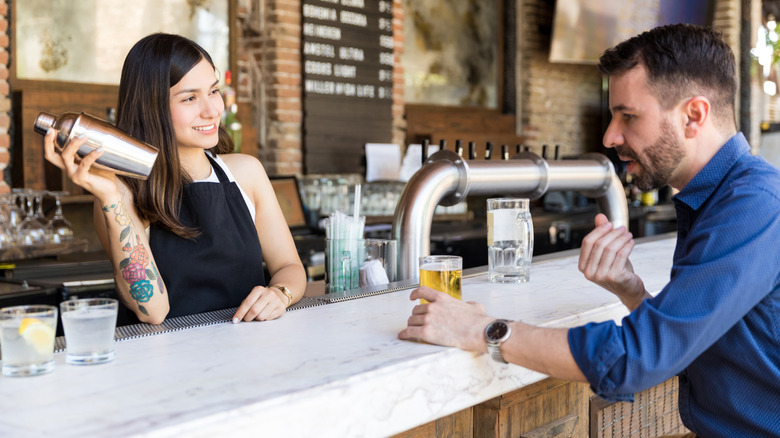
The spirit doesn't have to be one of the reference points you give the bartender, by the way. If you know you love gin or rum, lead with that; but if you're not sure what spirits are your favorites, there's so much more to a drink.
"Spirit, flavor profile, strength, sweetness, acidity, bitterness, temperature, dilution, and texture are all part of the equation," Lavenue explains. "Someone may say they love whiskey, but what they really love might be cold, boozy, stirred drinks with a little sweetness and bitterness." Don't be afraid to ask for the flavor experience you want, define other characteristics like carbonated versus not, and be open to different spirits.
If you do want to know the best way to find the right spirit for you, Lavenue says there are certain entry-point cocktails to explore.
"I would not always start with the most aggressive showcase cocktail," he says. "A martini is a great way to understand gin, but it can also feel like the final exam if someone is new to the category. A simple sour is often the easiest gateway: a daiquiri for rum, a margarita for tequila, a whiskey sour for bourbon or rye, a gimlet or southside for gin." In any of these, you still get the taste of the spirit, but it's supported and balanced by citrus, sugar, and proper dilution. "The goal is to choose a cocktail that neatly frames the spirit, not one that puts it in witness protection," explains Lavenue.