

The Vintage Kitchen Tool Home Cooks Are Using Again
We may receive a commission on purchases made from links.
Modernization often leads to replacing old kitchen tools, but they're not always gone forever. Vintage kitchen items can suddenly become trendy again as people re-discover them and embrace why they were once so beloved. One of the gems from the past that has recently been getting a big revival is the manual bread slicer.
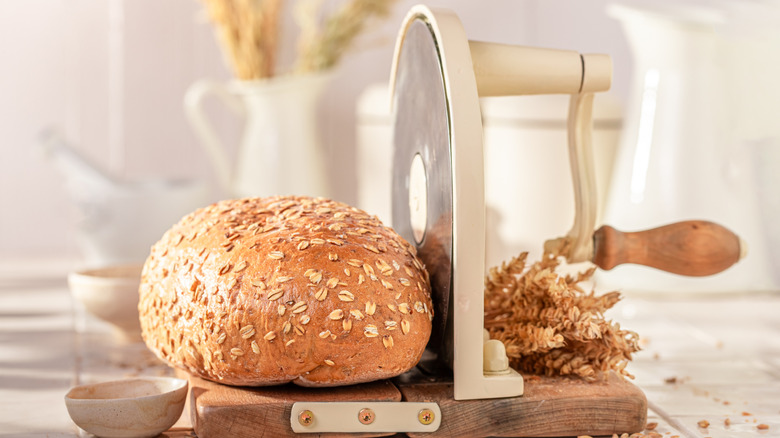
Manual bread slicers were very popular in European homes throughout the early-20th century. They looked a lot like mini guillotines, equipped with a single sharp stainless steel blade that you pushed downwards to slice the loaf. Three popular brands of the time, which began manufacturing the bread slicers between 1890 and 1904, were Raadvad, Alexanderwerk, and Zassenhaus.
However, in the United States, the manual slicers didn't really catch on with the same fervor as overseas, but they were still present — many of them are now listed for sale on reselling sites, generally costing between $60 and $150. While Europeans kept slicing their own bread, America would soon champion commercially sliced bread instead. In 1928, Otto Rohwedder invented the first commercial slicing machine, and the rest is sliced-bread history.
Sourdough bread revived the vintage slicer
As consumers became used to buying pre-sliced bread, the convenience of it pushed home baking aside and manual bread slicers eventually became redundant. Some people have kept bread slicers as an antique piece in their home or, as mentioned earlier, have tried to resell it. But as fresh-baked sourdough bread surged in popularity in recent years, the need for bread slicers came back around.
Sourdough has a hard, crispy crust, which can be difficult to cut with a regular bread knife, especially if it's not regularly sharpened. Home bakers also find that controlling the thickness of the bread slices isn't easy, even more so if you prefer thinner pieces. Needless to say, a good bread slicer eliminates those problems.
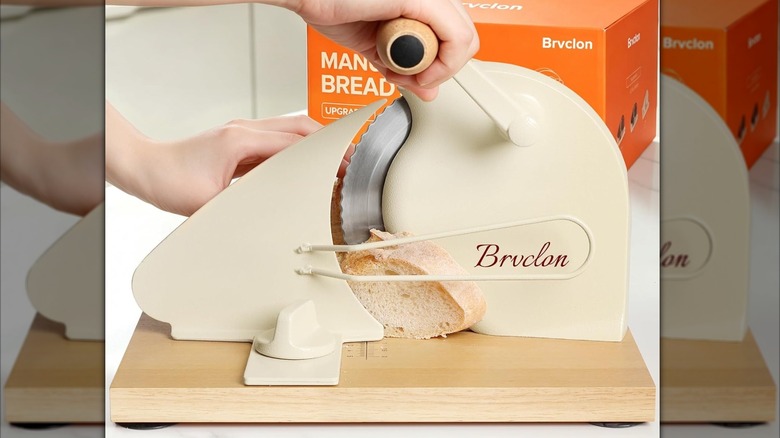
The modern iteration of the manual bread slicer is an improved version of its vintage predecessor. It comes with a nifty handle that protects your fingers, a holder that catches the bread slices, and even a measurement guide that allows you to control the thickness of each slice. While the old bread slicers relied on their weight to stay in place, the modern versions are lighter and come with suction cups. On Amazon, these gadgets range from $50 on the cheaper end, like the Brvclon slicer, to $200 on the pricier end, if you want to go for the German Zassenhaus slicer.
Home bakers say the manual bread slicer is totally worth the initial investment
Even some dedicated sourdough bakers initially doubted the vintage bread slicer. It takes up valuable space on the kitchen counter, can only perform one function, and honestly, it's not the cheapest. So, what gives?
"I couldn't believe I was spending $50 on a bread slicer but now I have no regrets," shared one home baker on Reddit. "It truly just makes it so much easier & I'm not carving the bread with a knife & smooshing it," they wrote. Another person reported a similar experience, saying, "I can't believe I've been baking sourdough for 5 years and only bought this now. After nearly slicing off my finger and having wildly inconsistent slice thicknesses no matter what knife I use, I finally bit the bullet and brought a bread slicer from Amazon. I'M OBSESSED."
Someone also pointed out that, although the bread slicer is definitely not a necessity, it's still nice to have, especially after working so hard on your sourdough loaf. "I thought it would be a waste of money but after slicing a loaf I am sold. I figured I spend so many hours making beautiful bread, it should be beautiful when I slice it too!" they wrote. The wisdom of a bygone era created a gadget that simply makes sense in households that bake a lot of fresh bread, even in the modern day.