

The Ultra-Rare CorningWare Pattern You Should've Collected In The '50s And '60s
We may receive a commission on purchases made from links.
When you purchase a mass-produced dinnerware or cookware set, you're probably not imagining that it will become a collectable at a later stage. That was likely the same attitude shared by shoppers buying CorningWare in the 1950s and '60s. After all, this is a brand that has now sold hundreds of millions of pieces.
For those blessed with the foresight (or sheer luck) to hold onto any of CorningWare's early releases, the ones really worth keeping would have been the ones with a Black Starburst design. The original Platinum Starburst pattern was introduced in 1959, making it one of the company's first. It features a four-pointed, silver star on a plain background with decorative details. The Black Starburst was released in 1961 and sold in Canada. Although the starburst design was in production for a number of years, Black Starburst pieces are now rare, valuable vintage CorningWare. This is partly because the pattern was only printed on percolators, so there is no cookware or bakeware that has it.
Compounding the scarcity is that CorningWare was forced to recall millions of percolators between 1976 and 1979 due to a manufacturing issue. Although the Black Starburst line was not considered one of the faulty models, it's possible that some were returned as part of this recall. If you happen to find a Black Starburst percolator in the back of a cupboard or at a thrift store, it's not going to make you rich, but you can expect it to sell for up to $100, making it a vintage brand worth hunting for.
What to know about collecting vintage CorningWare
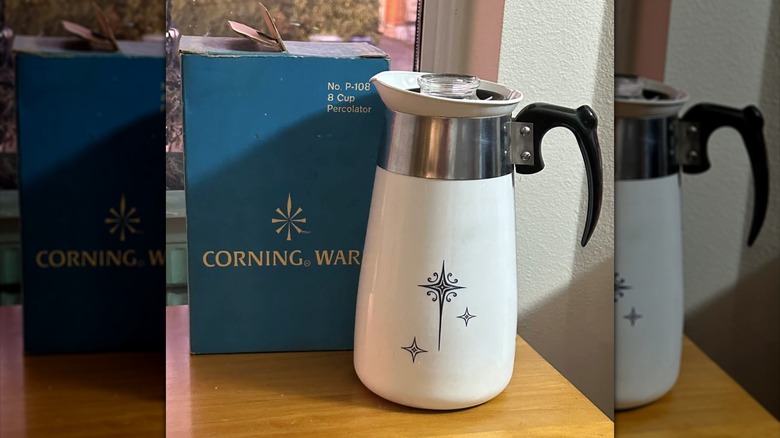
Along with Pyrex and Le Creuset, CorningWare is one of the most collectable retro cookware brands, thanks in part to the long list of designs produced, each of which had a limited run. The company still exists, making stoneware dishes rather than Pyroceram (the oven-safe glass that led to the invention of CorningWare). Today, collectors need to rely on old catalogues and digital forums to get information about CorningWare's vintage patterns. For example, Black Starburst is often confused with what's known as the Black Star or Atomic Star pattern. This is also fairly rare but distinct, with a simplified, eight-point star shape that was featured on casserole dishes, saucepans, percolators, and carafes. Knowing which products feature which patterns can help you narrow down the value of what you have found.
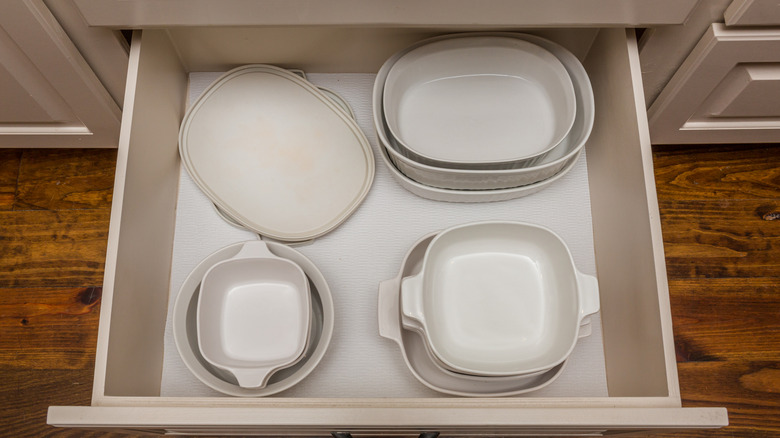
Beyond the pattern, individual product design and the year of release can give you clues about identification and valuation. Vintage CorningWare (as opposed to modern reproductions like this French White casserole dish) made prior to 1972 will have an embossed cornflower or starburst logo on the base, and the brand name written as two separate words. An alphanumeric code will identify the specific product shape. For example, Black Starburst was only printed on the P-108, P-116, and P-119 percolators. You should also keep in mind that the prices these pieces can fetch don't reflect any intrinsic value — it's simply what people are willing to pay. Collectors always pay more for rare items, but the value of CorningWare in general can rise and fall dramatically based on trends.