

If Your Grandma Collected Cookie Jars, Take A Closer Look — Some Could Be Worth Hundreds
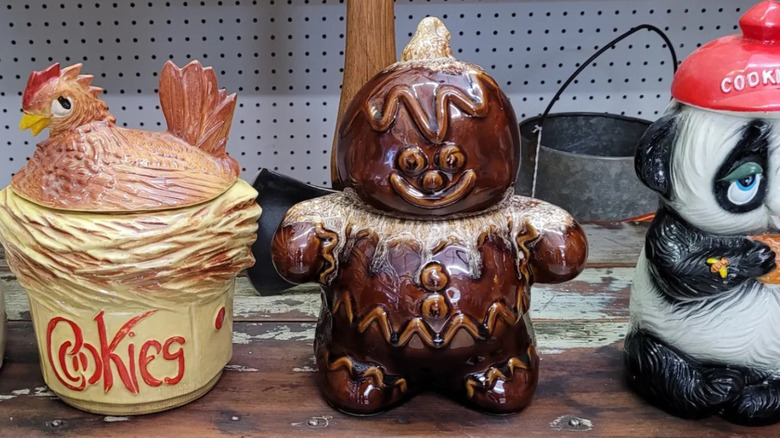
If you still have some of grandma's heirlooms up in the attic, blow the dust off any boxes labeled "Kitchen" and check for cookie jars. You might find a couple from Sears' Merry Mushroom collection, but do you see any colorfully glazed, lidded pieces shaped like animals, fruits, or faces? How about a covered wagon, an old-timey stove, or astronauts partaking in the Space Race? Check the bottom for a clear "McCoy" or "USA" stamp in the clay — if you find a rare design in good condition (and are willing to part with it), you may be in for a payday.
McCoy is a coveted name in the cookie jar market. These hand-decorated pieces date back to the early 20th century, and the Ohio-based manufacturer, originally known as the Nelson McCoy Sanitary Stoneware Company, produced them until about 1990. Identifying features include the aforementioned labels, smooth glazing in bright colors, crisp, intricate molding, and a weighty composition. A passionate fanbase has formed around this pottery line thanks to its production quality, collectability, and whimsically nostalgic designs. Collectors even congregate in Zanesville, Ohio, every summer to display and bid on noteworthy pieces.
Most McCoy cookie jars sold online are priced in the double digits (think $30 to $75), though rare mint-condition pieces can easily go for hundreds, if not more. According to antiques valuation platform WorthPoint, collectors paid between $699 and $1,200 for select jars in 2025. In May 2026, a rare 1974 "Freddie the Gleep" jar sold for $4,999. Back in 2018, a '40s-era Hillbilly Bear cookie jar set a record when it sold for $25,000.
Not all of these cookie jars are the real McCoy
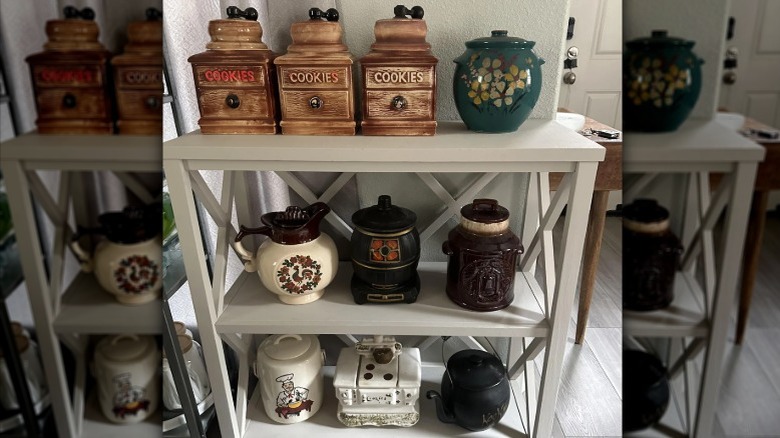
As is often true in collectors' markets, McCoy fakes and reproductions abound. Common indicators of counterfeit cookie jars include dull, cloudy, or uneven glazing, imprecise molding, and the absence or smudging of those bottom etchings. Look for multiple hints before you cry "forgery," though, as some jars may predate the company's stamping practice. Also, exercise caution when purchasing online — the McCoy Pottery Collector's Society warns against eBay listings attempting to pass off inauthentic pieces as the genuine article.
One notable fake is the Little Red Riding Hood jar, which McCoy never actually produced. Other common pieces, like the ubiquitous (i.e., pretty affordable) 1970s Happy Face cookie jar, were McCoy designs, but not all listings are necessarily the real deal. Before you drop a few hundred dollars on a purported McCoy, check it against one of the company's reference books, such as "McCoy Pottery: a field guide." Collectors say that if the jar's longest dimension is at least 6% smaller than the reference point, you're likely looking at a reproduction.
Want to scope out valuable McCoy pieces while hunting for other thrift store treasures, like decades-old goose kitchenware and vintage Lenox Village cookie jars? Early Brush-McCoy pottery — produced between 1911 and 1925 — is particularly sought after and will feature "Brush" stamped into the bottom. The cream of the crop, however, might be the elusive Betsy Baker cookie jar; rare molds feature either a rounded hat or flat, two-tiered cap.