

The Underrated Summer Berry You Should Be Eating More Of
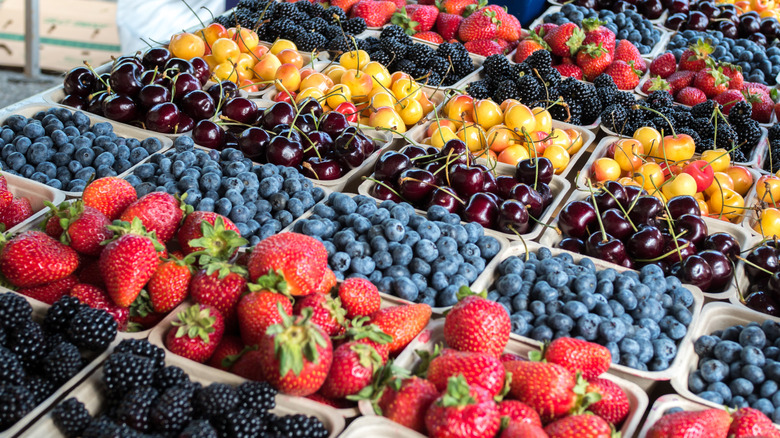
If you're a fruit lover, nothing beats the summer harvest. From watermelon to plums to peaches, there's a bounty of fruit, but perhaps best of all is the abundance of summer berries, which are always worth buying at a farmers market. You may be able to get raspberries, blueberries, and strawberries year round from greenhouses or imported from afar, but the fresh, local berries you can find in the summertime are next level. It's not just freshness that summer brings to the table, but variety. There are plenty of lesser-known berries worth trying if you can find them, and one of them is the honeyberry.
Also known as haskap or blue honeysuckle fruit, honeyberries have three times the antioxidants of wild blueberries. Visually, they also resemble elongated blueberries with that same mottled blue-and-purple-tinged flesh. The taste of haskap has been described as very similar to blueberry or a cross between blueberry and raspberry. The fruit is sometimes used to make juice, preserves, and baked goods. Tasting Table spoke to Linda Ziedrich, the blogger behind A Gardener's Table, and the author of "First Fruits" and "The Curious Kitchen Gardener," who recommends honeyberry as an underrated summer berry that deserves more attention.
"The berries ripen even earlier than strawberries, and they usually hold well on the plant for a good while," she shares in our exclusive chat. "They have very high levels of ascorbic acid and antioxidants, their seeds are so small they're hardly noticeable, and the fruits have a better texture than blueberries for jams."
Haskap berries have it all
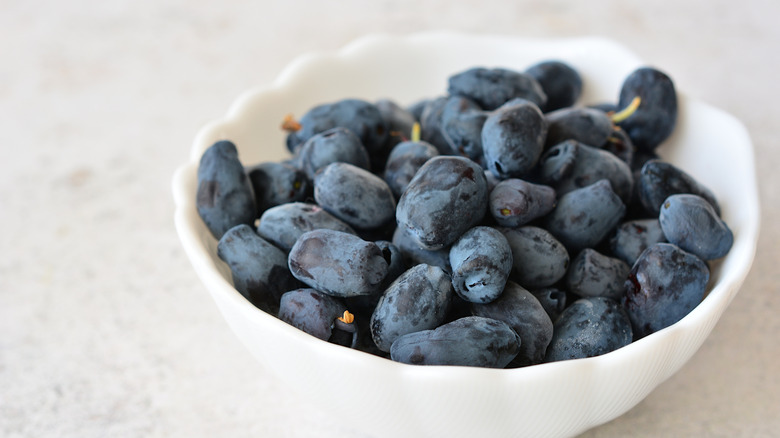
Linda Ziedrich tells Tasting Table exclusively that she uses haskap berries "to make an outstanding chutney." While the berries are great in jams or syrups used in sweet applications, haskap berry chutney pairs so perfectly with savory flavors as well. The berries can be more tart than a traditional blueberry, and that allows them to provide a bright contrast to the richness of pork, duck, or lamb.
If you're interested in growing the berries yourself, they can bring more to your garden than just delicious fruit. Haskap berries grow on bushes similar to blueberries, and they are some of the edible shrubs known to attract hummingbirds. The shrubs can also produce fruit for a long time — as much as 30 years. Once it's established, a single haskap shrub can produce several pounds of berries per year. A fully grown plant can produce as much as 10 pounds in a year, and the harvest begins in June, which is earlier than most fruit crops.
Different cultivars of haskap have distinct flavor profiles, making them a little more complex than simply "blueberry meets raspberry." For example, the flavor can include notes of blackberry, nectarine, rhubarb, currants, and plums. While the tart variety works great for chutneys, there are sweeter varieties that lend themselves well to desserts and syrups. The inside of a haskap resembles a grape, and the fruit is even used to produce wine that has been described as tasting like a Malbec, Cabernet Sauvignon, or other full-bodied reds, making this one versatile summer berry.