

How Chefs Expertly Crack Eggs With One Hand
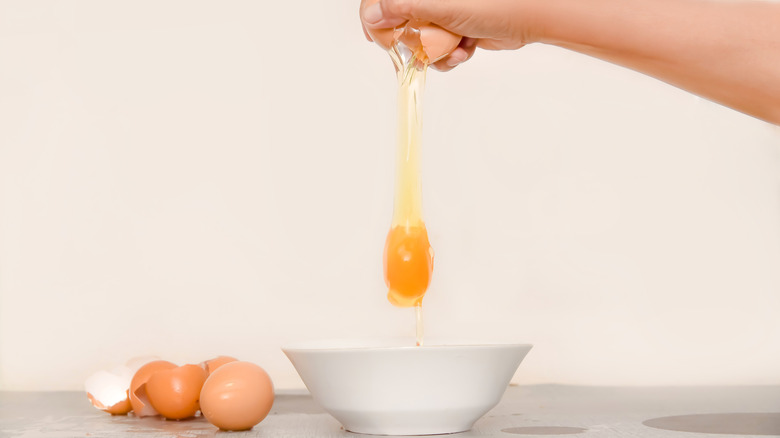
Cracking eggs can be difficult for some people. Whether they're too heavy-handed with the initial crack and shatter the shell into tiny shards or they are so hesitant about the initial thwack that they don't even break the shell, many people lack the confidence to properly crack an egg without making a mess. While most people strive to be competent at cracking an egg with both hands, what really separates most professional bakers from home cooks and novice bakers is the ability to crack an egg with just one hand. This single-handed cracking technique allows you to use both hands simultaneously to crack two eggs at a time, and even former Vice President Kamala Harris has her own technique.
When I do this at home, it's more out of fun and personal challenge rather than out of necessity. I recommend always cracking eggs on your counter, against a flat countertop, rather than against the lip of the bowl, as that could lead to a more fragmented shell — I do have one chef friend who smacks two eggs together to crack one of them, but I've never mastered this technique. Once the shell has broken, I use the ring and pinky fingers of my hand to gently press one half of the shell back and away from the other half, and I use my thumb and forefinger to try and push the other half of the shell in the opposite direction, which lets the egg drop out of its shell and fall into the bowl waiting below.
This skill takes time to perfect
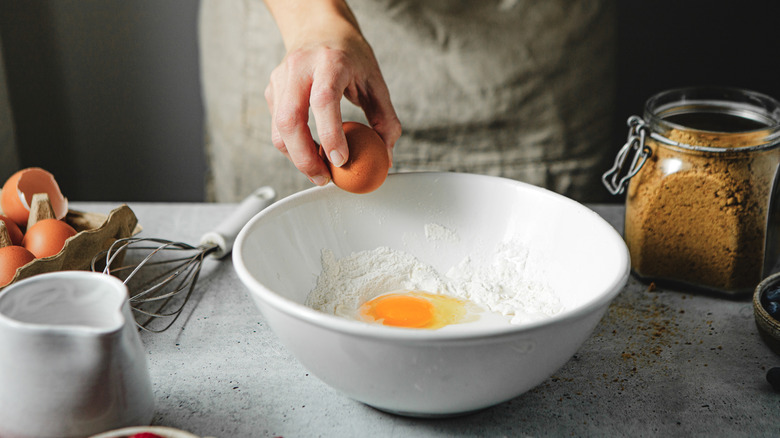
While most home cooks won't need to deal with such large quantities of eggs for culinary endeavors, pastry professionals need to blast through a flat of 30 eggs in as little time as possible. Many culinary pros can use both hands to crack two eggs simultaneously. Whether you crack one or two eggs at a time, this technique is best reserved for uses when you'll be whisking up or scrambling the eggs. For fried or poached eggs, or any instance where you need to keep the eggs whole and intact, it's best to stick with using a two-handed approach to ensure the yolk doesn't burst.
Keep in mind that not all eggs will be exactly the same, even in the same carton, as they are natural products, so some variation is to be expected. Some eggs will crack easily due to thin shells or inner membranes, while others might be much tougher to break through a thicker shell. While thinner-shelled eggs will crack more easily, they are more likely to shatter into smaller pieces with a firm smack on the countertop and may shed smaller shards of shell as the egg falls out. Conversely, a thicker shell might be harder to split initially, but the thick shell is less likely to shatter, making it easier to separate the halves cleanly. No matter what, though, always be sure to carefully use Jamie Oliver's foolproof trick to removing tricky eggshell pieces from your dish: use an empty half shell to pluck out any shell fragments that have made their way into the bowl of eggs, as you're bound to wind up with a few in there.