

These 7 Peanut Butters Are The Unhealthiest Ones On Store Shelves
Peanut butter — it's not exactly what it sounds like. For starters, dairy is nowhere to be found in this pantry staple. Nor is it always a simple spread made of peanuts. In fact, there's frequently much more to peanut butter than peanuts, or even just peanuts and salt. As a certified nutrition coach, I'm always advocating that folks read nutrition labels more carefully before purchasing items. Of course, this holds true when it comes to peanut butter as well.
Several of the most popular peanut butter brands sell products containing ingredients like hydrogenated vegetable oils, excessive added sugar, and mono and diglycerides. These ingredients are fine to consume from time to time — even I won't say no to Jif peanut butter at a hotel breakfast bar. However, if you slather your sandwiches with peanut butter every day, it's definitely worth trying to find a more nourishing product. For instance, I'm far from alone in my love for Kirkland Signature's organic creamy peanut butter, and I learned several years ago how to make perfect nut butter in a Vitamix without ruining its motor.
If you're perusing for peanut butter and are conscious about what's in it, I've rounded up several of the unhealthiest ones on store shelves that you should avoid. Whether you're hoping to better regulate your blood sugar or keep your cholesterol levels in check, avoiding these peanut butters will help you achieve your goals. Remember: Even a peanut butter branded as "natural" or "organic" can still contain harmful ingredients.
Reese's creamy peanut butter spread
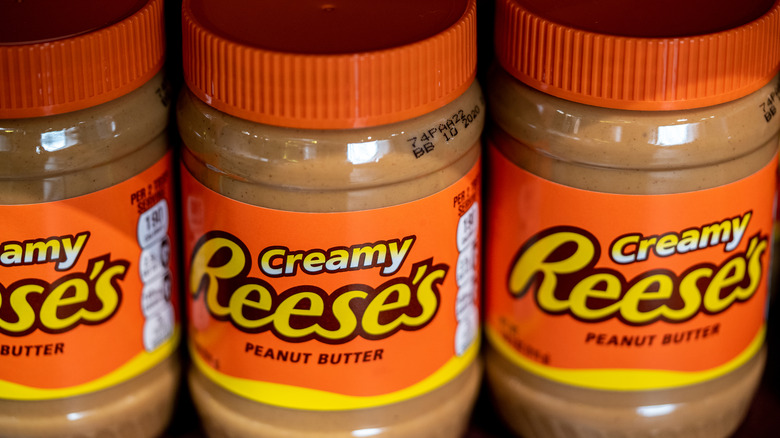
Is anyone surprised that a peanut butter product sold by Reese's made this list? To Reese's credit, however, eating a spoonful of this peanut butter is not like eating the inside of a Reese's cup. There's not a speck of powdered sugar in the jar, though molasses and sugar still yield 2 grams of added sugar per 2-tablespoon serving.
That's not altogether unusual for commercial peanut butter, but a few other factors compounded my reasons for including Reese's creamy peanut butter spread on this list. For example, this product contains hydrogenated vegetable oil from rapeseed, cottonseed, and soybeans. Hydrogenated vegetable oils help stabilize and make peanut butter spreadable. Fully hydrogenated oils are much better than partially hydrogenated oils (artificial trans fats), which are no longer allowed in American products. Nevertheless, hydrogenated oils are still processed, and I'd rather all the fat come from peanuts alone, even if it means having to stir and keep the jar in the refrigerator to slow rancidity.
This product also contains monoglycerides. Mono and diglycerides are emulsifiers that may contain marginal amounts of trans fat that don't have to be listed, but can nevertheless add up. There's an inkling that they may also be linked to cardiovascular disease.
Peanut Butter & Co Dark Chocolatey Dreams and White Chocolatey Wonderful peanut butter spreads
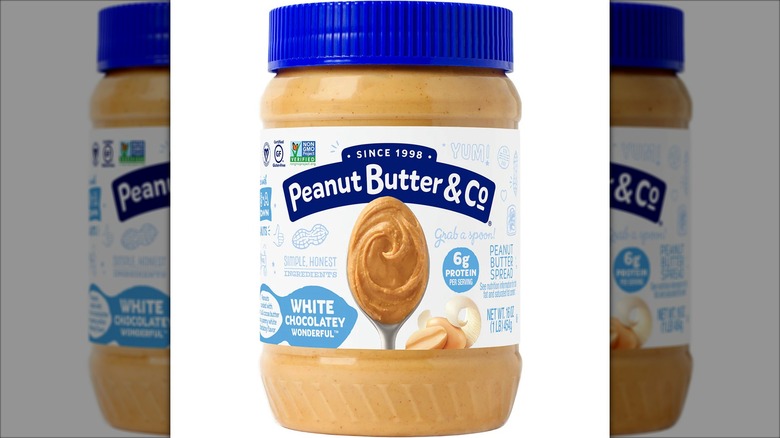
If you want to treat yourself once a year or so, I won't stop you. Go ahead and buy a jar of Peanut Butter & Co's Dark Chocolatey Dreams or White Chocolatey Wonderful peanut butter spreads. At the very least, there aren't any mono or diglycerides in these products, nor are there hydrogenated oils. They are also relatively low in sodium.
But don't think either one of these products is super healthy, either. Both contain slightly less protein than other peanut butters on this list, and they're moderately high in sugar, with 6 grams of added sugar per serving. Furthermore, even though there aren't any hydrogenated oils in these products, palm oil is listed for both. Palm oil has quite a bit of saturated fat and comes with environmental concerns to boot.
If you love the chocolate and peanut butter combo, try mixing cocoa powder into a high-quality peanut butter instead. By making it at home, you have control over the sweetness levels and can bypass any unnecessary ingredients.
Skippy reduced fat peanut butter
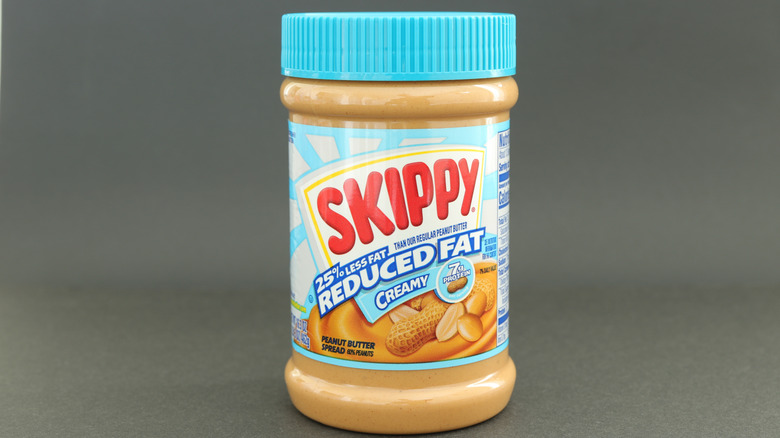
Even the standard creamy Skippy peanut butter could merit a place on this list; it contains hydrogenated vegetable oil and 2 grams of added sugar per serving. Meanwhile, the natural creamy variety is only marginally better; though it has the same amount of sugar, it contains palm oil instead of hydrogenated vegetable oil.
But it's the reduced fat version of Skippy peanut butter that I chose to feature because it contains mono and diglycerides, as well as 2 extra grams of added sugar per serving. That's a total of 4 grams of added sugar for every 2 tablespoons. Some of this sugar comes from corn syrup solids, an ingredient that is exactly what it sounds like: Dehydrated corn syrup. Its binding and thickening properties are useful in a reduced-fat product like Skippy peanut butter, but you're still getting additional sugar without any nutritional benefits as a side effect.
This is not necessarily worth the tradeoff for 4 grams less fat per serving and only 1 gram less saturated fat compared to the standard creamy variety. The reduced fat version of Skippy peanut butter even has 1 gram less fiber and slightly more sodium.
Finally, there are a number of added vitamins and minerals in this product. I'm not opposed to that, but the addition is not clearly advertised. If you're eating a lot of enriched products like this one in addition to taking supplements, you should keep an eye on whether you're maxing out your quotas.
Jif reduced fat peanut butter
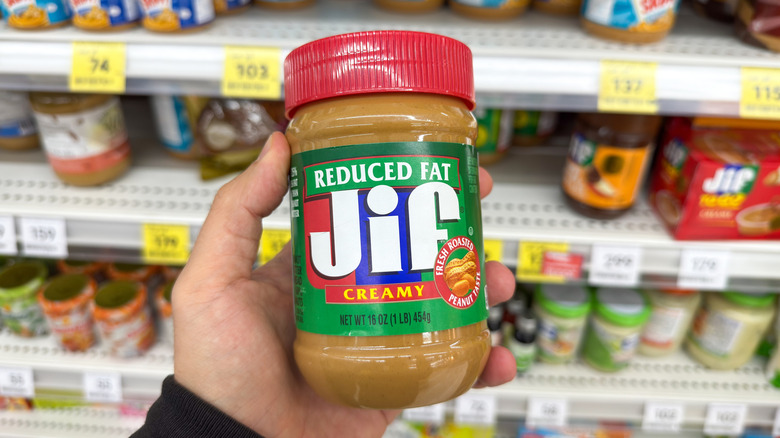
Jif reduced fat peanut butter runs into several of the same issues as its Skippy counterpart. You've got the fully hydrogenated vegetable oils (here, they're derived from rapeseed and soybeans), plus 3 grams of added sugar per serving. Furthermore, this product includes mono and diglycerides, corn syrup solids, and extra vitamins and minerals that aren't clearly advertised.
Compared to the standard Jif creamy peanut butter, the reduced fat version has an extra 1 gram of added sugar (and therefore more carbohydrates), as well as more sodium. If you ask me, it's not a tradeoff worth making. After all, reduced fat Jif can't even be labeled as peanut butter because of its contrived composition.
If you absolutely must have Jif, try the natural creamy version instead. It still has a bit of sugar and molasses, but opts for palm oil instead of hydrogenated vegetable oils, and it doesn't contain any mono or diglycerides.
Jif peanut butter and chocolate flavored spread
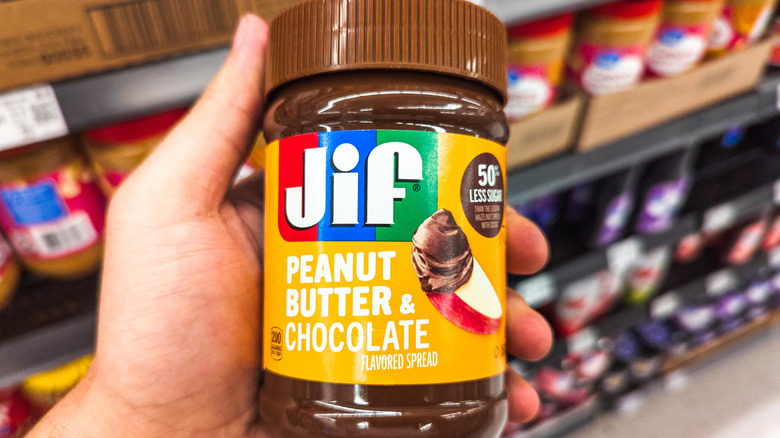
The Jif peanut butter and chocolate flavored spread is about as healthy as it sounds. And I'll be the first to say that it's also as delicious as it sounds. However, it's not a product I would buy myself. That's because it contains all the usual suspects that I've previously described: Sugar, fully hydrogenated vegetable oils (again, rapeseed and soybean), and mono and diglycerides.
But while some of the products on this list only contain a few grams of added sugar per serving, this one contains an astounding 8 grams of added sugar for every 2 tablespoons. Some of that is from molasses, though it's impossible to tell how much. Besides, even though molasses may contain more nutrients than refined sugar, the difference may be negligible in such small amounts. Not to mention, molasses still causes blood sugar to spike. Indeed, there are well over a dozen types of widely recognized sugars, all of which are, at the end of the day, sugar.
It's also worth mentioning that this product contains vanillin instead of vanilla. That's not necessarily unhealthy, but purists may prefer natural sources of vanilla over those that have been produced in a lab. After all, vanillin can be produced from several materials, including crude oil.
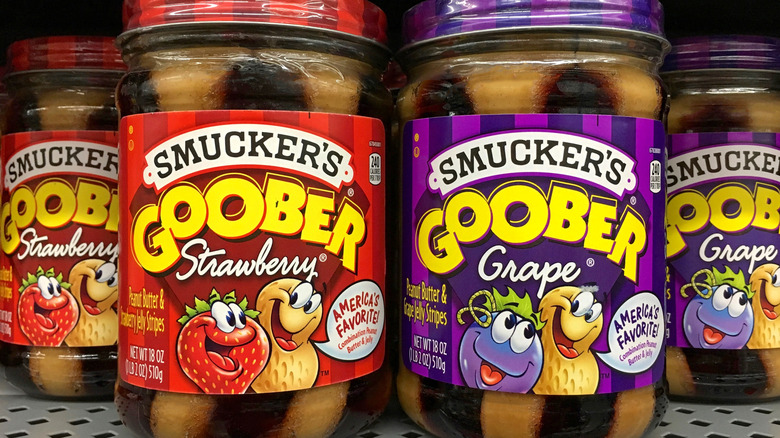
Smucker's Goober
Surprisingly, all of Smucker's organic and natural peanut butters are solid choices. I expected the iconic fruit spread brand to sell sugary peanut butters, but both the organic and natural products contain nothing more than peanuts and salt. The organic line even offers relatively low sodium and saturated fat levels.
That said, you have to watch out when it comes to the Goober line, which combines peanut butter with jelly and honey spreads. Both the strawberry and grape flavors include corn syrup, high fructose corn syrup, dextrose, and monoglycerides. The honey variety is only slightly better; it contains no high fructose corn syrup.
I've explained most of these ingredients, but have yet to touch on dextrose. This simple sugar has a high glycemic index and digests quickly, which can negatively impact blood sugar regulation. Eating added sugars like dextrose regularly can also contribute to weight gain.
Without even looking at the ingredients, however, the numbers alone should be enough to turn you away from these products. The strawberry and honey flavors contain a massive 20 grams of added sugar per serving, while the grape measures in at 18 grams. All that sugar is why using a Goober jar is one of the biggest mistakes you could make when preparing a PB&J sandwich.
Of course, making space for jelly means that you lose out on some of the protein power of peanut butter, too; each serving only contains 5 grams of protein, as opposed to 8 grams in the natural and organic products.
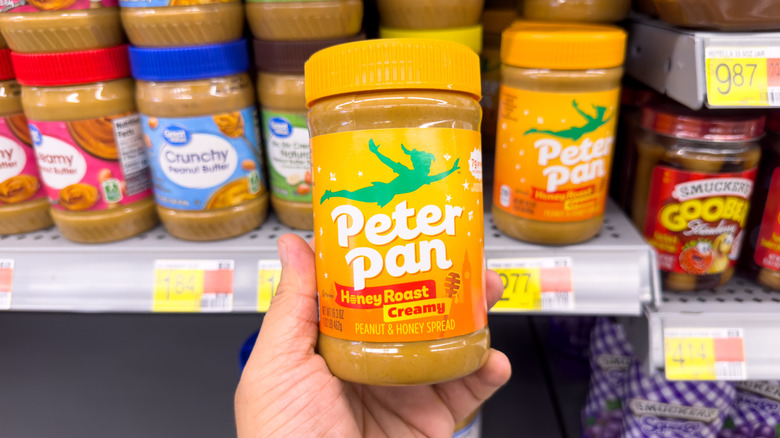
Peter Pan creamy honey roast peanut butter
I was raised on Peter Pan peanut butter. Indeed, the 6-pound containers of Peter Pan creamy peanut butter from Sam's Club were so large that nobody would ever notice if I ate a spoonful or two straight from the canister. But when my parents wised up to the hydrogenated vegetable oils and sugars in this famous brand, we suddenly stopped buying it.
It's true that the brand's creamy peanut butter contains hydrogenated rapeseed and cottonseed oils, along with 2 grams of added sugar per serving. But I'd eat that before the creamy honey roast peanut butter — not only does the latter product contain the same hydrogenated oils, but it also packs in a whopping 7 grams of added sugar per serving. The crunchy version of the honey roast peanut butter is nearly as sugary, with 6 grams of added sugar per serving. There's no way to know how much of this is actually honey and how much of it is regular sugar.
If you truly must eat Peter Pan peanut butter, go for the natural version. It substitutes palm oil for the hydrogenated oils and only contains 1 gram of added sugar per serving. Then add a drizzle of honey to elevate your PB&J instead of submitting yourself to the quantity pre-determined by Peter Pan.