

The Differences Between Jack Daniel's Black And Green Labels
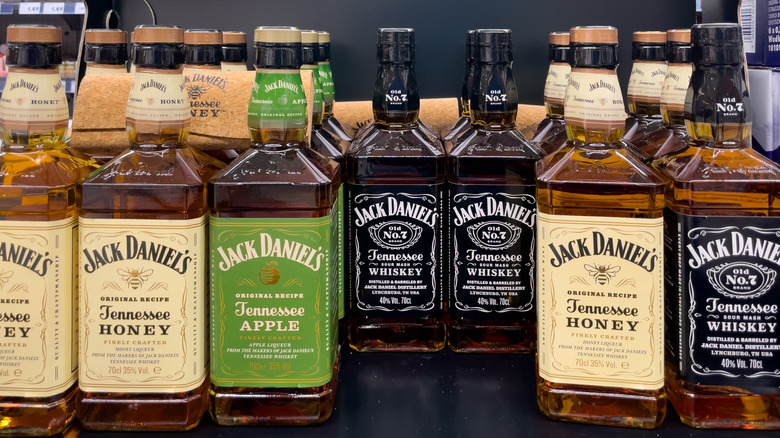
While a trusty liter of Jack Daniel's Old No. 7 "black label" can be found for a little over $20, its green-labeled sibling sometimes fetches as much as $249 for a bottle of the same size. The ingredients are identical, using the classic No. 7 ratios of 80% corn, 12% malted barley, and 8% rye, with the same charcoal filtration. What is so different about these two whiskeys to create a miles-wide price gap? The biggest distinctions between Jack Daniel's black and green labels involve two factors: a tweak in the Green Label's barrel selection, resulting in a subtler, lighter flavor, and the dwindling availability of this whiskey, which has become a collector's item.
Jack Daniel's uses large rickhouses, or warehouses, to store barrels of distilled spirit on various levels. Upper levels fluctuate in temperature, causing the liquid to expand and contract inside the charred oak, pressing in and out like tides. This gives American whiskeys like the black label a profound oak-driven richness, intensifying flavors of caramel, vanilla, and baking spices.
Green Label, on the other hand, is made exclusively from whiskey aged on the lower sections, which stays cooler and more consistent, slowing maturation. This results in a whiskey with less intensity and char. Even though both whiskeys are made from the same ingredients, spend at least four years maturing, and receive the same Lincoln County process of sugar maple charcoal filtration — the step that makes Tennessee whiskey different from bourbon – they taste very different.
Subtle deviations make notable differences
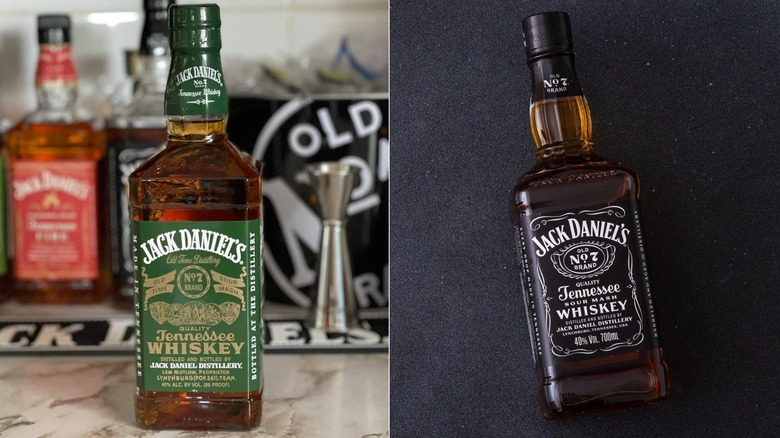
The color difference between Jack Daniel's No. 7 black label and Green Label is also visible in the whiskey itself. The Green Label is a paler amber than black label, despite the key grain-derived characteristics of caramel, corn, baking spices, and a hint of banana being present in both whiskeys. Due to Green Label's more climate-controlled position in the warehouse, it tastes younger, too, with a less robust oak profile. One Jack Daniel's fact you may not know is that the Green Label was introduced after Prohibition, when then-owner Lem Motlow needed to market a whiskey while his barrels aged. He released a one-year-old version with a green label to differentiate it.
Rumors started circling over 20 years ago about the Green Label being quietly discontinued, and the gradual evaporation of bottles has proven them true. Over the last 14 years or so, reports have shifted from the whiskey being available in roughly half of U.S. states to only five: Tennessee, New York, New Jersey, Texas, and Pennsylvania. Green Label is still available online, but its rarity invites a hefty price tag, making it more of a collector's item than a casual addition to the home whiskey shelf.
Today, a 375-milliliter half-bottle of Green Label from 2005 goes for $149.99. That's a drastic difference from 375 milliliters of black label, which sells for closer to $15. Certainly, Green Label is one of the discontinued Jack Daniel's bottles that deserves a comeback, albeit at a more affordable price.