

Costco's New Sourdough Loaf Has Shoppers Questioning The Ingredients
Generally, any new product that hits the bakery shelves at Costco is cause for celebration. The warehouse chain has a fervent fan base that is dedicated to its line of private label products. The newest arrival, however, seems unlikely to make the list of Costco's most beloved products. Instead, the ingredient list on the new Kirkland Signature Olive and Rosemary Sourdough Bread is stirring up controversy.
The sourdough in question is a fairly standard batard-shaped loaf, studded with two types of olives — green and kalamata — and infused with aromatic rosemary. While all of that is wonderful, and customers even admit that the bread tastes good, the number of ingredients listed on the label has them concerned that it isn't real sourdough. "Yeah with a thousand ingredients in it. No thanks," commented one disgruntled customer on Instagram.
The predominant concern among such keyboard warriors is that, if it were true sourdough, the Kirkland Signature Olive and Rosemary Sourdough Bread would be made with just a few simple things: flour, water, salt, and starter. In their eyes, the number of ingredients in this bread must mean that it's not true sourdough. As one Instagram commenter put it: "Please stop pushing this as sourdough. It is not!"
There is such a thing in the world as "sourfaux" bread, as it is so cleverly called. These are breads that mimic sourdough through the use of extra ingredients, rather than the traditional sourdough fermentation process. For purists, spotting fake sourdough bread can seem as simple as seeing more than four ingredients on the label — and Costco's new loaf runs up to nearly 30. But while the length of the list can be an indicator of legitimacy, you can't be sure until you actually read it.
Is Costco's new sourdough legit?
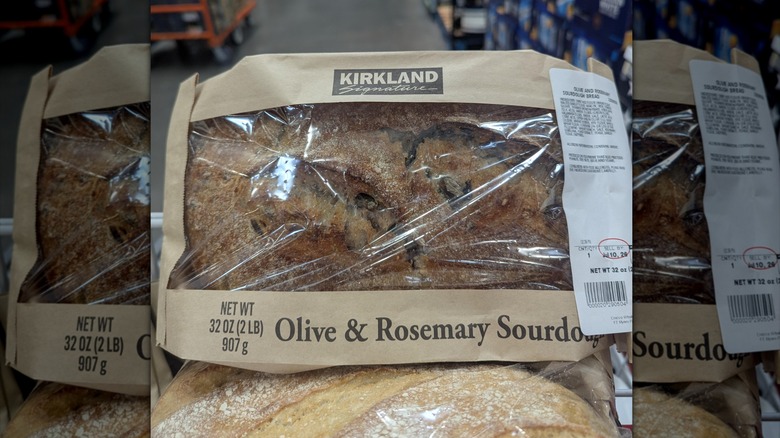
The Kirkland Signature Olive and Rosemary Sourdough Bread's list of ingredients includes: enriched flour (wheat flour, malted barley, niacin, iron, ferrous sulfate, thiamin mononitrate, riboflavin, folic acid), water, olives (green olives, kalamata olives, water, salt, lactic acid, citric acid, extra virgin olive oil), sour culture, wheat berries, rye flour, whole wheat flour. Additionally, it contains less than 2% of wheat starch, salt, rosemary, semolina, yeast extract, yeast, barley flour, and enzymes.
As you can see, Costco's new sourdough bread is made of much more than just flour, water, salt, and starter. When you parse it apart, though, 15 of those are just the constituent parts of the olives and enriched flour — and anyone using enriched flour at home should read the label, as it likely contains more or less of the same fortifications. Notably, the list does not include dough conditioners or other industrial additives that make grocery store bread taste different from bakery bread.
There are three items on this list that indicate the bread's true nature: yeast extract, yeast, and sour culture. As one Redditor pointed out, "Yeast Extract is a flavoring, not a raising agent." The yeast is also a concern, however, as true sourdough is risen entirely with starter. That said, it is common practice for commercial bakeries to speed up the leavening process by adding yeast to the mix. As for the sour culture, it's a controlled collection of bacteria and yeast that is often used in commercial baking to produce a reliable sourdough loaf.
So, is Costco's new Kirkland Signature Olive and Rosemary loaf a true sourdough? For stickler home bakers, no. But producing sourdough on a commercial scale with exclusively wild yeast is not so simple, and this hybrid sourdough isn't far off.