

It Was Everywhere In The '60s, Now It's Rare Dishware On Thrift Store Shelves
You likely know vintage Pyrex is in demand these days, but have you heard of Cathrineholm enamel dishware? No, it's not an obscure designer's name, but rather the name of an enamelware factory in the Land of the Midnight Sun. These Norwegian-made bowls and plates were staples in stylish kitchens in the 1960s, but these days, they're far more likely to be sold in antique stores rather than displayed in a groovy kitchen.
The Lotus line was designed in the early 1960s by Norwegian designer Arne Clausen, an award-winning and multi-talented artist who worked as an in-house decorator for the company. Funnily enough, his boss, renowned designer Grete Prytz Kittelsen, hated the print. Nevertheless, even without her approval, it was produced by the Cathrineholm factory in Halden, Norway.
The dishware's clean lines, primary colors, and minimalist motif soon became a fixture of the Scandinavian modernism movement. The simple lotus leaf design encircling the enamel surface became an icon of mid-century design, appearing on mixing bowls, fondue pots, kettles, and other kitchenware. After Cathrineholm closed in the early 1970s, production ceased, making original pieces instantly collectible. The pieces were produced in vintage shades like avocado green, turquoise, burnt orange, and cobalt blue. It was the perfect color scheme for the optimistic, modern style of the 1960s, when retro kitchen designs ruled. The bowls were durable yet surprisingly lightweight, considering they were enamel-coated steel cookware.
What to look for when sourcing Catherineholm pieces
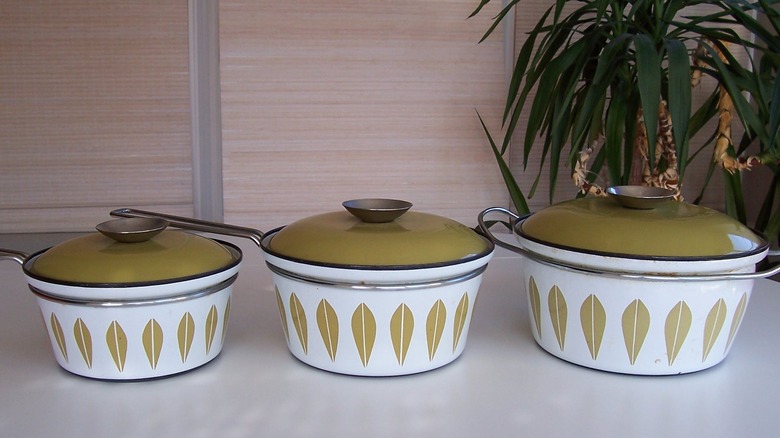
Despite their widespread popularity at the time, authentic Cathrineholm Lotus bowls are hard to find. Because enamel can chip if dropped or handled roughly, pristine examples are even less common. Even small chips on the rim can affect pricing because exposed steel is susceptible to corrosion. That kind of scarcity just throws more gas on the fiery frenzy of collectors. Complete nesting bowls have sold for $500 to over $1,000, especially if it's in harder-to-find colors. Who knew so many vintage mixing bowls would be worth a fortune today?
When you're on the hunt, you may find a mark of authenticity stamped on the bottom of bowls: Cathrineholm of Norway. Not to worry if it doesn't have one, as many pieces came with only a paper tag. Another sign to look for is the shape of the lotus. It should be wider on top and taper down to a point, much like a petal. The colors are numerous, including every color in the rainbow except purple. Listings for many pieces show up among the usual suspects: eBay, Etsy, and Facebook Marketplace.
If you hate the hunt, a Danish design studio actually licensed the lotus style and worked with Arne Clausen's family to produce new pieces for sale in 2012. The new bowls come in subtler, more organic colors, like sage green and dark rusted red. Notably, the bowls are ceramic, which is a trendy texture popping up in kitchen designs.