

This Is How Long To Bake Sweet Potatoes For Ultra-Tender Results
We may receive a commission on purchases made from links.
In theory, a sweet potato should be one of the easiest things to bake. As a hearty root vegetable that comes encased in its own natural packaging, you'd think preparing one would be as simple as throwing it in the oven for a while. But in practice, a perfectly baked sweet potato is the product of many variables, particularly time and temperature, that must come together. We spoke with Adrianne Calvo, whose new "Maximum Flavor at Home" cookbook will debut in November 2026, about how to bake sweet potatoes to get the most tender textures.
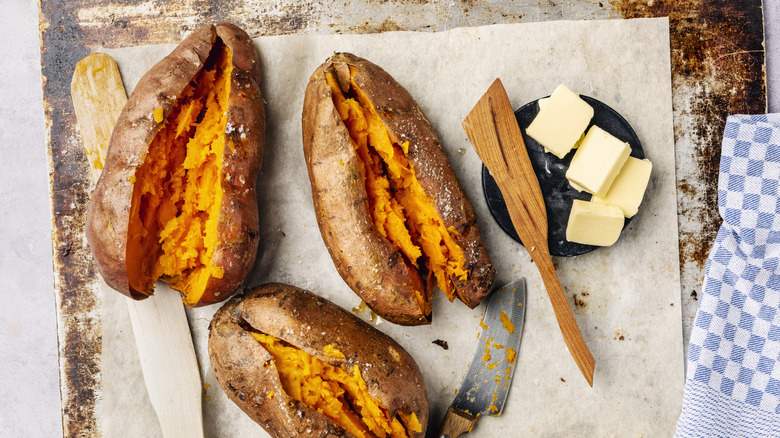
Calvo tell us, "I like to roast whole sweet potatoes at 425 degrees Fahrenheit for 50 to 70 minutes, depending on their size." As a ballpark figure, plan on roasting them for about an hour to avoid any unpleasant stringiness from overcooking or blandness from underbaking. "I know 400 degrees Fahrenheit is the standard answer," she says of her temperature choice, "but I think 425 degrees Fahrenheit creates a much better contrast." According to Calvo, this is the absolute best temperature for baking sweet potatoes because "the high heat gently caramelizes the natural sugars under the skin while allowing the interior to become incredibly creamy," which is precisely what you want when baking a whole sweet potato.
"People often describe a perfectly baked sweet potato as 'soft'. I don't," Calvo tell us. Instead, she says, "I want it to feel almost custardy when you cut into it; that's when you know you've unlocked everything that potato has to offer."
Changing the potato's form means changing up the cooking time
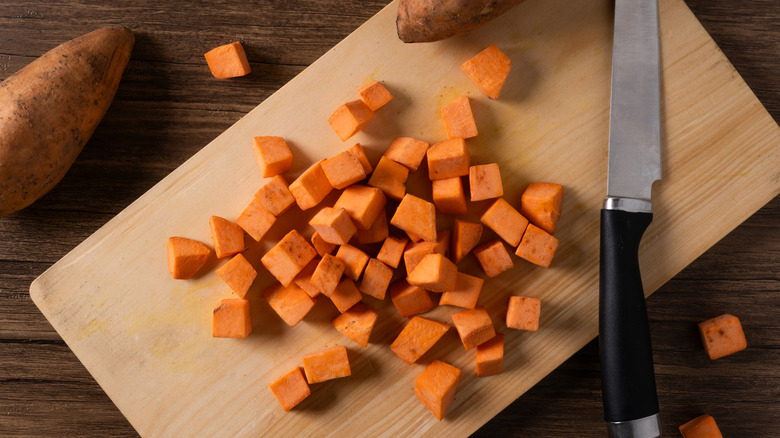
That hour-long bake time is great for a whole sweet potato, which Calvo says is all about patience, but things change once you've decided to cut up the tuber instead of roasting it whole in it's own skin. "Cubed sweet potatoes are about surface area," Calvo says. "For cubes, I roast them at 425 degrees Fahrenheit for 25 to 35 minutes, tossing them halfway through." The cooking time is much less since the oven's heat doesn't need to permeate nearly as much flesh to fully cook the centers of the smaller cubes.
Calvo also explains that "every cut edge becomes an opportunity for caramelization, and that's where the magic happens." Whether the cut edges of the sweet potato are exposed to the hot air of the oven or come into direct contact with the hot metal of a baking tray, the natural sugars in the tuberous root begin to melt and caramelize at high temperatures. When she opts to dice up a sweet potato, Calvo divulges that rather than aiming to cut uniformly-sized pieces for even cooking, she will purposefully vary the sizes. "The smaller pieces develop darker caramelized edges while the larger ones stay creamy inside," Calvo notes. "That variation creates a much more interesting bite than perfectly identical cubes."
Patience and salt are your friends
While you may be tempted to bring aluminum foil into the roasting process, Calvo vehemently advises against it. "Foil traps steam, and steam is the enemy of caramelization," she explains. Instead, Calvo recommends leaving sweet potatoes uncovered for the entirety of the cooking process.
When we asked her for any more tips on cooking sweet potatoes, Calvo's main advice isn't complicated: "Don't rush them." It's common to test for doneness by sliding a small knife into the potato, but Calvo explains that she prefers to let the potatoes keep cooking for another 5 to 10 minutes after the knife slides in easily. "Those extra minutes continue converting starches into sugars, giving you noticeably deeper flavor," she shares. Another trick Calvo loves is to roast whole sweet potatoes directly on the oven rack with a tray or foil underneath to catch any leaking liquid. "That circulating heat helps cook the potato more evenly than sitting flat on a pan," she says.
Additionally, Calvo tells us she also uses a fork to pierce the outer skin of the sweet potato before baking, as this gives the steam and pressure that builds up inside the potato as it heats a chance to escape rather than burst and split the skin. Finally, she shares, "Perhaps my favorite trick is finishing them with flaky sea salt." Instead of using maple syrup of brown sugar to further sweeten the potatoes, Calvo says that "salt is actually what makes their sweetness taste even sweeter – it's the same reason salted caramel is so addictive."