

8 Rules Every Aldi Employee Must Follow

Some might assume that working at a grocery store is an easy job. Serving customers, stocking shelves, scanning products — it's all pretty straightforward, right? Well, actually, not always. Aldi, which is growing fast in the U.S., runs a tight ship for its thousands of employees across the country. You might not see it from a quick dash around the store for your weekly groceries, but employees go through a lot behind the scenes. While it can be rewarding, the job can also be stressful, high-pressure, and physically demanding.
Need more convincing? We scanned Reddit and some of the company's policies to uncover what it's really like for employees. From strict time targets and handling difficult customers with a smile to staying tight-lipped about trade secrets, keep reading to find out some of the rules that every Aldi employee must follow.
They have to scan groceries as quickly as possible
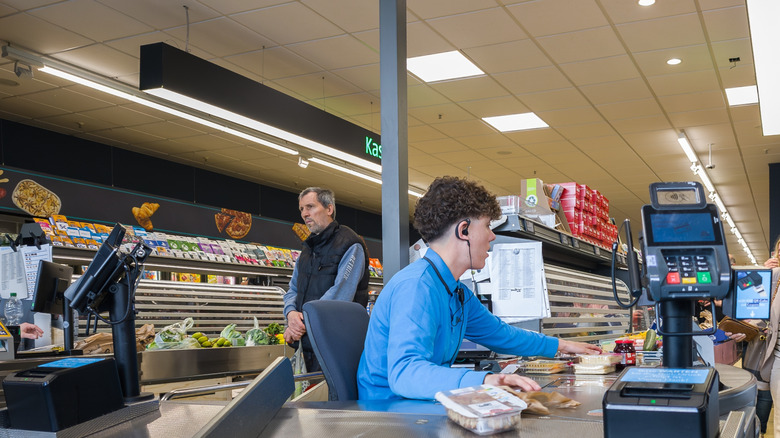
Sometimes, checking out your groceries at Aldi can feel like an extreme sport. The cashier is sliding everything through as quickly as possible, you're desperately packing the bags before the next item comes flying through, and a bead of sweat trickles down your brow; it's a lot. But rest assured, this is not a game for Aldi cashiers. They have to be super speedy when they're scanning customers' groceries, because they're being timed on the whole transaction.
Yep, according to workers, everything is recorded: from how many items they have scanned per hour to the average number of seconds it takes for them to move on to the next customer. They also have targets to reach, which can vary from store to store, but for many it involves scanning one item per second. If they don't reach targets, they might have to be retrained, or they could even be fired if they don't improve their speed. So, that explains why it feels like Aldi employees are hurling your potato chips like it's an Olympic sport.
If you want to help your Aldi cashier meet their targets, there are a few things you can do, according to workers. Using dividers to avoid confusion between groceries helps, and organizing everything properly so there are heavy items first and light items last can also be beneficial (you'll find it easier to pack, moving items off the checkout much faster).
They have to sit at the register
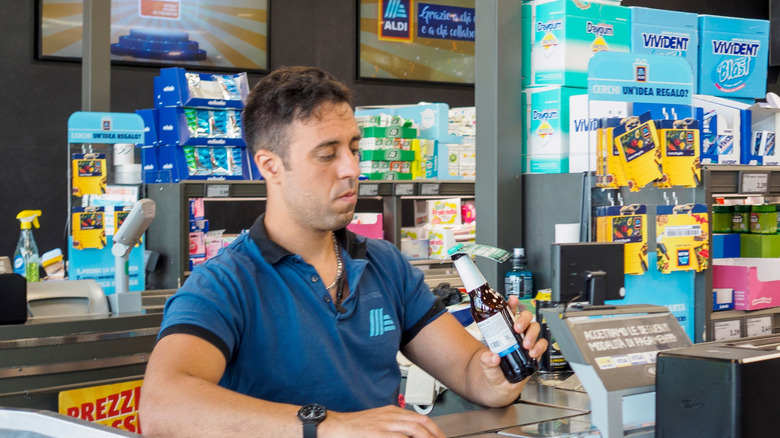
Aldi seems to understand that if you expect cashiers to be speedy and highly efficient when scanning groceries, it's essential that they're comfortable. That's why you'll always see Aldi cashiers seated at the register, instead of standing, like in most other American stores. In fact, seated cashiers are actually pretty common in European grocery stores. It means that workers are less fatigued, don't have to move as much, and can physically scan groceries a lot quicker.
When things are faster, more people move through the store, and it makes more money. The strategy is really as simple as that, and it's effective, say workers. "I've worked at conventional grocery stores where you stand as a cashier, and even fast cashiers with a bagger to assist them were only ringing 15-20 items a minute," explains one Redditor and Aldi worker on the Aldi_employees subreddit. "Working at Aldi I routinely see cashiers hitting 40-50 rings a minute, myself included."
They have time targets for unloading pallets
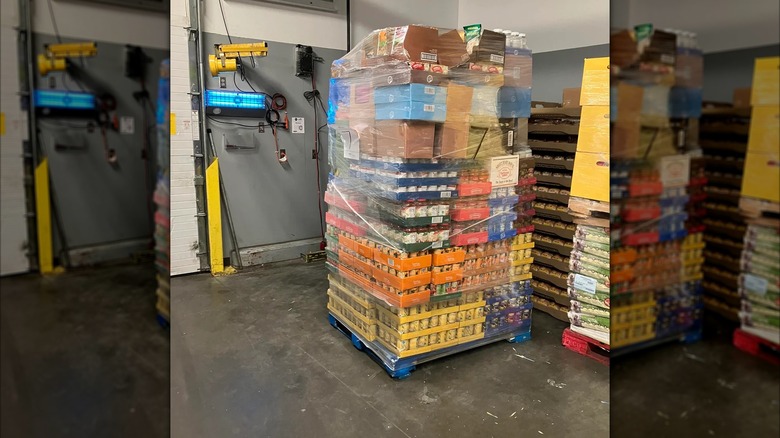
Across the store, speed is important to Aldi. It's not just the cashiers who have to be fast, but employees unloading pallets also have their own time targets. In fact, according to workers on Reddit, the time target for each pallet is around 30 minutes on average. That said, Aldi does understand that it takes time to speed up. A new employee, for example, is expected to get a chiller pallets unloaded in 45 minutes, while someone who has been there more than 18 weeks is expected to achieve the 30-minute time target every time. Some stores are even stricter and expect pallets to be completed in just 25 minutes.
Often, workers will get to the store around three hours before opening time, and then they have to get all of the stock off of the pallets and onto the shelves before the customers start arriving. If they're not fast enough, they likely won't get fired, but they could get moved to a different shift time.
For some, the pressure is simply too much. In fact, some employees feel that nothing is ever good enough for Aldi, regardless of how quick or efficient they are. "Pushing constantly for [unrealistic] times, goals, and demands on a daily basis will kill your soul," said one Redditor in the r/Aldi_employees subreddit. The main takeaway for customers? Be kind to Aldi employees; they're probably beat.
They have to be physically fit
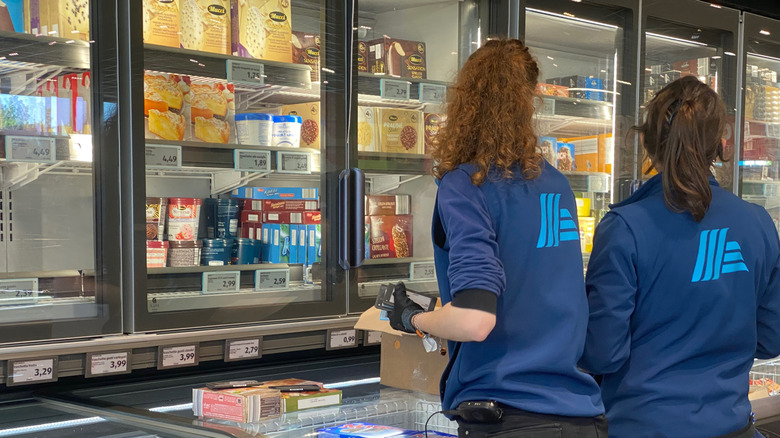
As you've probably gathered by now, Aldi employees work really, really hard. While cashiers do get to sit at the checkout, many of the tasks are physical. Unloading the pallets, for example, requires lifting stock and moving it to the correct section of the store quickly. Even just moving around the store and helping customers adds thousands of steps to a shift. In fact, some employees say that working at Aldi has helped them lose weight. "At [Aldi I] hit a MINIMUM of 10,000 steps a day," said one Redditor in the r/Aldi_employees subreddit. "But most [of] the time [it's] over that. [T]hat combined with throwing pallets is enough exercise to last me my entire life."
So, perhaps it's unsurprising that Aldi wants to check that people can handle the demands of the job before hiring. Several workers say that the store asked them to prove they could lift heavy boxes before they started the job, for example. In Australia, one person who interviewed for a position at Aldi even claimed they had to do push-ups and star jumps over Zoom. Rest assured, though, if you were hoping to apply, this doesn't seem to be an ordinary occurrence.
All customer interactions have to be handled positively
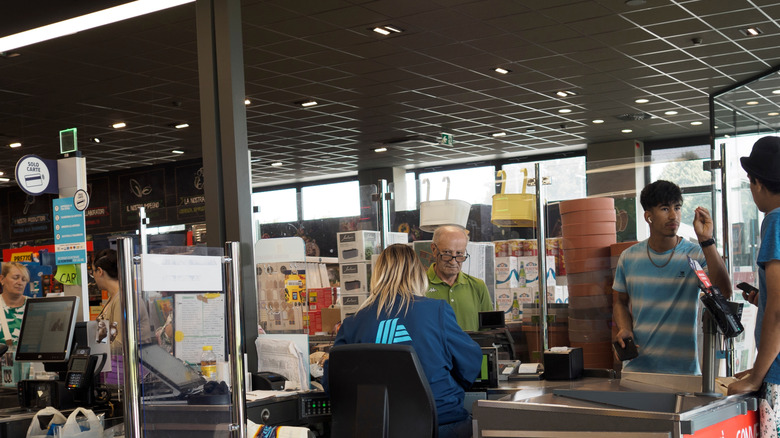
Being timed and monitored can probably feel stressful, but Aldi employees aren't supposed to let any frustration or stress show when they're interacting with customers. In fact, according to the official Aldi Code of Conduct, it's essential that all employees handle all customer questions and requests positively. Even silly ones, like eye rolls, are not allowed.
As you'd expect, Aldi employees do have to deal with plenty of ridiculous questions. Workers on Reddit say they have been asked if the store sells live birds, for example, or if they need to unload groceries from their cart onto the checkout counter. "Someone picked up a tub of butter (clearly marked 'table spread') and asked me if it was yoghurt," says one Redditor in the r/Aldi_employees thread. Sometimes, customers are downright rude, which makes staying positive incredibly challenging.
Employees on Reddit (the forum is a bit of a haven for frustrated Aldi workers) have shared tips on how to stay calm when dealing with difficult customers. Some have recommended practicing stoicism, for example, while others say that having a projecting confidence can be disarming.
They can't speak about company secrets
Sometimes, Aldi employees like to share a few tips, tricks, and secrets on social media, and for the most part, these are harmless. For example, did you know that you can always borrow a quarter from the register to unlock a cart? Or that Wednesday evenings are a quiet time to shop? But if an employee has been privy to some serious information about, say, the inner workings of the company or its strategy for expansion, they have to treat it as confidential, even if they've stopped working for Aldi. Otherwise, they might risk coming up against the budget retailer's litigious side.
In March 2019, Aldi filed a lawsuit against two former employees and Lidl U.S., accusing the employees of sharing confidential information about its plans for expansion with its biggest rival. Just like Aldi, Lidl is, of course, another German discount retailer with a very similar business model (it even has its own middle aisle). So, you can see why Aldi wouldn't want Lidl to know its trade secrets. According to the lawsuit, as well as expansion plans, the former Aldi employees, one of whom was a director of real estate for the company, also shared things like sales data and marketing strategies with Lidl.
Still, the trade secrets didn't get Lidl all that far in the U.S. At the time of writing, there are nearly 2,700 U.S. Aldi stores and around 200 Lidl locations.
They have to dress smart-casual

As you'll likely know if you've shopped at Aldi, the employees can't just turn up in their everyday clothes. They are expected to always be presentable and in keeping with the grocery chain's official smart-casual dress code. They are, however, allowed to wear jeans, as long as they are smart and free of holes or rips. They can also wear slacks, chinos, and cropped pants, as well as dress shirts, knee-length dresses, and sweaters. Most stores also provide employees with a branded polo shirt.
While it does have a dress code, Aldi seems to be pretty relaxed about letting employees express themselves and showcase their own individual style. Tattoos, piercings, and dyed hair (even if it's pink or purple or even green) are often allowed. "I've gone through every single hair color and am making my way back through," said one worker in r/Aldi_employees. "My SM and DM love it!"
They (nearly) always have to accept returns
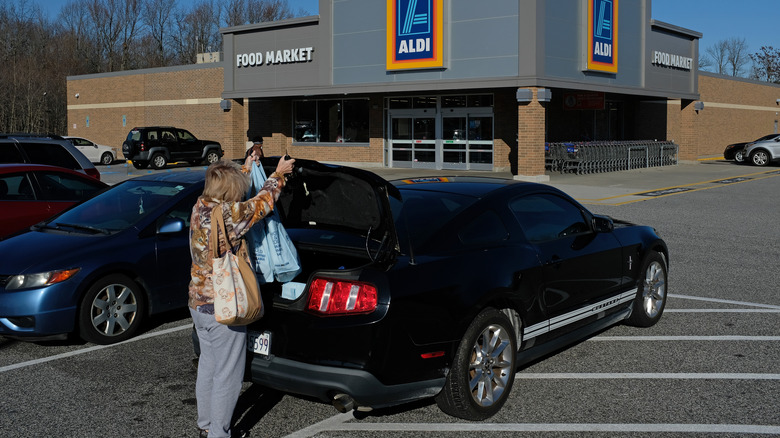
In most cases, Aldi employees have to accept your returned items — but there are some rules. The item has to be returned within 60 days, for example, and be in good enough condition to resell, unless there's something wrong with it. It must also be in its original packaging and be returned with a valid receipt. Otherwise, anything goes. And some Aldi workers have seen some pretty odd returns in their time.
According to one employee on Reddit, a customer once returned three packets of unopened carrot salads for having too many carrots. Yes, seriously. "Had a lady return $130 of groceries because her doctor told her snacks and chips and cookies are [unhealthy]," added another Redditor in the r/Aldi_employees subreddit. "She had a gallon-size Ziploc bag full of receipts ... that was a fun day."
Still, there are some limits. Employees say they have had to turn away things like half-empty bottles of wine and months-old spoiled fruit, for example (for what we hope are obvious reasons).