

The Best Time To Wrap Pork Butt For Tender, Juicy Meat Every Time
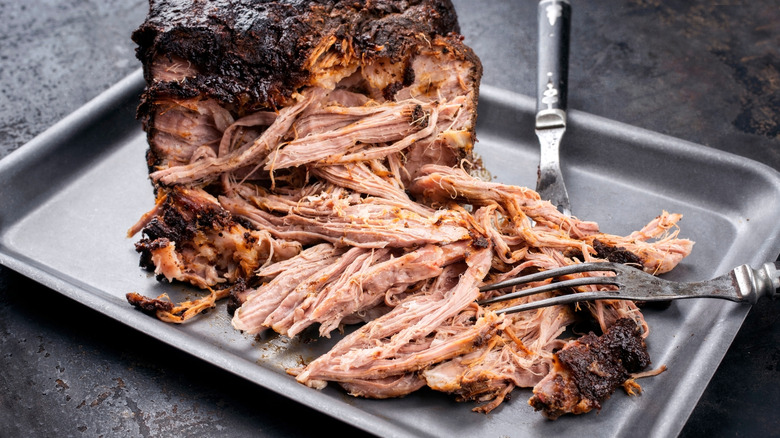
Pork butt is the culinary equivalent of hitting the jackpot: A cut of meat that is both affordable, and perfect for barbecue beginners. Smoke it on gentle heat over several hours, and you've got a melt-in-your mouth barbecue classic with a dark, crispy crust and deliciously tender meat.
Like with most cuts, the trick is in cooking it just right. And while one part of it is how long you cook the pork butt for, there's an important step towards the end of the process that you just cannot skip: wrapping it to prevent the meat from drying out. We asked Dennis Littley, chef and culinary expert at Ask Chef Dennis, for the best time was to wrap the pork butt for tender, juicy meat every time. "When you smoke or low-and-slow your pork butt, you'll likely find yourself wrapping at some point after the meat reaches the 'stall,' normally in the range of 160-170 degrees Fahrenheit," he says. "At that time, the exterior should have formed an extremely dark brown crust or bark."
In case you're wondering what the "stall" is, it's a stage you hit when cooking meat low-and-slow where the internal temperature, which has been rising over a few hours, plateaus. "It will also be clear when the inside of the meat begins to cool due to evaporation of moisture," Littley said, adding that the bark forming and the internal temperature stalling were both "very good signs to indicate it's time for you to begin wrapping."
How does wrapping the pork butt in foil help?
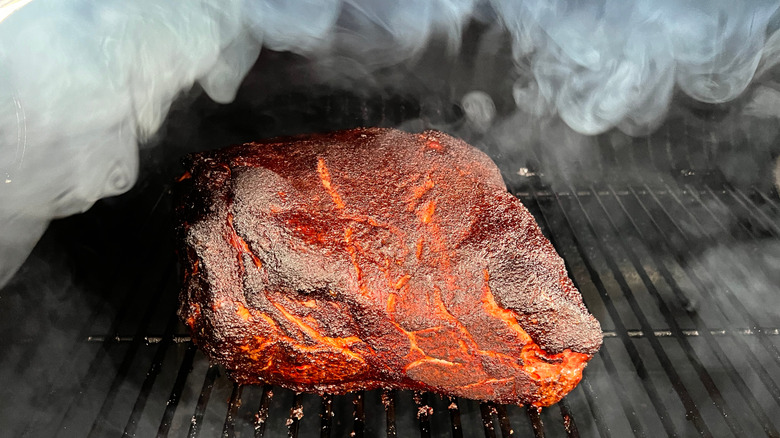
Once you've wrapped your pork butt in foil, you need to put it back in the smoker and keep cooking it low-and-slow until the internal temperature hits 185 degrees Fahrenheit if you plan on slicing the roast. If you're looking to make pulled pork, you can leave the meat on the smoker, covered in foil, until it reaches an internal temperature of 207 degrees Fahrenheit. "By creating an enclosure over the meat with aluminum foil, you're creating a barrier to retain heat and moisture," Littley explains. "As such, less moisture will leave the meat during the remaining cooking process."
Covering the meat in foil creates the conditions for it to get past the stall, and it also ensures that the retained heat continues to break the connective tissue down into tender gelatin. "What results is pork that's moist and tender, easy to pull apart," he notes. Littley also had one final trick up his sleeve — instead of aluminum foil, cover the pork butt in butcher paper. "Butcher paper is excellent if you want a harder bark on your barbecue pork," he adds. "The paper retains most of the bark while still evenly cooking the meat."
One final point: All the time you've spent, and all of your attention to detail, will go to waste if you don't let the meat rest once it's off the fire. Resting meat is not optional when it comes to pulled pork, because this is what allows all the juices to evenly distribute through the meat.