

Are Grocery Stores Really Tracking Your Car And License Plate?
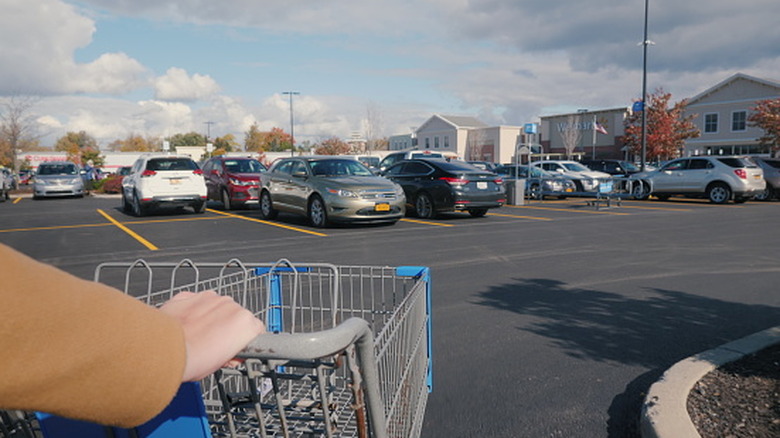
Before grocery shoppers even set foot inside stores, the company may already know they're on their way — as well as the make, model, and color of the car they drive. Major grocery store chains use technology to track the license plates of cars in the parking lot. Automated License Plate Readers (ALPR) collect information about passing vehicles, registering where they went and when they arrived and left. That information is then uploaded to a centralized database that can be accessed by law enforcement agencies.
Beyond plate numbers, these AI-powered vehicle profiling systems can gather specific vehicle details — from bumper stickers to bike racks and dents in the bumper. Grocery chains like Costco, Target, Meijer, and Walmart claim they use or may use this technology. Beyond the grocery sphere, Home Depot and Lowe's have also admitted to using ALPR cameras. In fact, American surveillance technology company and one of the most prominent ALPR manufacturers, Flock, reported on the idea as early as 2024.
Flock claimed that license plate reader technology could help reduce theft by identifying repeat offenders. With more searchable, concrete data than video camera footage alone can provide, ALPRs could help build a case for law enforcement to prosecute crimes from shoplifting to armed robbery. For customers, repeat theft issues can drive up prices for local shoppers. So, not only can ALPR cameras help keep you safe while grocery shopping, but they may also be keeping prices low.
Customers weigh the pros and cons of Automated License Plate Reader technology
Of course, many consumers have concerns about the use of Automated License Plate Readers (ALPR). Most center around a lack of transparency about how the data can or will be used and who can access it. According to the Walmart ALPR Privacy Notice, store associates must be officially authorized to access data, and they must undergo ethics training for data privacy. However, collecting and storing plate-reader information has the potential to be used for more than just theft investigations. The city of Dayton, Ohio, for instance, suspended 72 Flock cameras after the data was assessed to enforce immigration-related searches.
Looking forward, the importance of implementing adequate safeguards around ALPRs seems to be at the forefront of public conversation. More than a few consumers have raised concerns about how the use of ALPR, facial recognition, and other Artificial Intelligence technologies affects their privacy. In a Reddit thread, one commenter wrote, "And also facial recognition every time you step inside [the store]. And you don't know what they do with that data." Another expounded, "In store cameras don't record your license plate, and with that license plate number, access all your personal data that is stored in Motor Vehicles' record bank (DOB, SS, home address, perhaps cc details as well)."
On the other hand, some seem to feel protected by such developments. As a Facebook commenter noted, "I would think it's a great plus in case someone tries to break into a vehicle or someone gets mugged. It will only help catch the perpetrator."