

The Jack In The Box E. Coli Incident That Changed Fast Food Forever
Many of the food safety laws to protect consumers have historically been preceded by scandals or outbreaks of illness that grimly demonstrated the necessity of those actions. The 1973 discovery of botulism spores in canned mushrooms led to the first major recall in U.S. history and the public outcry from Upton Sinclair's "The Jungle," a fictionalized account of the American meat-packing industry, prompted the passage of the Food and Drugs Act. In recent history, there are few more dramatic proofs of this than the massive E. coli outbreak that afflicted Jack in the Box customers in 1993, an incident that changed fast food forever.
Escherichia coli, aka E. coli, are bacteria often found in the intestines of humans and animals, but certain strains can be problematic, like O157-H7, which can cause serious illness. Cows are among the primary hosts of E. coli O157-H7, but it can be found anywhere, and cross-contamination can occur when the cattle are slaughtered and processed. This is why ground beef is recalled so often. This danger was realized when hamburgers containing E. coli O157-H7 served by Jack in the Box led to over 700 illnesses and the deaths of four children.
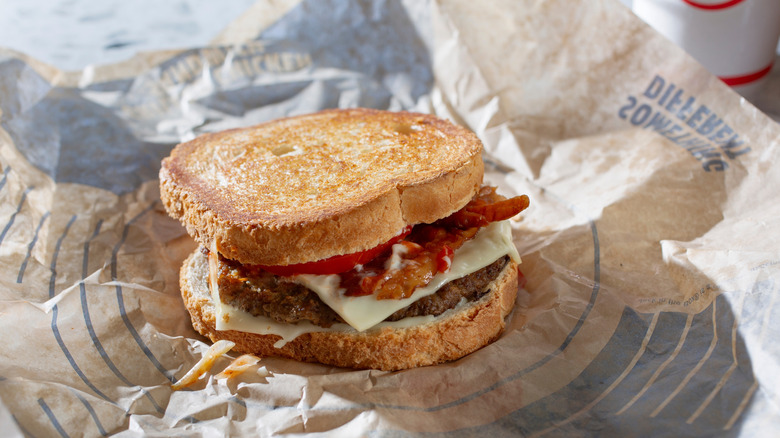
At the time, Jack in the Box was promoting its "Monster Burger," which an investigation later linked to the outbreak. Though Jack in the Box sued its suppliers, it was discovered the chain had knowingly failed to follow state regulations that required burgers to be cooked to an internal temperature of 155 degrees Fahrenheit. Per the Spokesman-Review, Health Department's lead investigator Bert Bartleson commented, "If they followed the standards ... no one would have gotten sick."
E. coli still haunts the fast food industry
The biggest E. coli outbreak in American history was matched by the scandal that erupted in its wake. On January 18, 1993 — 13 days after the outbreak began in Seattle, Washington — Jack in the Box ceased to sell hamburgers in Washington state, replaced 28,000 pounds of meat, and began cooking its burgers to proper temp. As a result, in February, President Bill Clinton promised action would be taken. Soon thereafter, the USDA's Food Safety and Inspection Service implemented new federal inspections of every meat and poultry slaughterhouse and processing plant in the country.
The Jack in the Box outbreak may have been the biggest, but it was not the first time the fast food industry was struck with E. coli — in fact, fast food is how the bacteria were first identified. In 1982, 47 customers at McDonald's restaurants were sickened by E. coli in two separate outbreaks in Oregon and Michigan. According to the Lange Law Firm, McDonald's then-vice chairman Edward Schmitt stated the illnesses were "isolated incidents." Nevertheless, McDonald's put into force new cook times and temperatures to make sure any potential trace of E. coli was killed off during the cooking process. That same year, E. coli was officially recognized as a pathogen for the first time.
Despite the food safety reforms brought about by the Jack in the Box outbreak, E. coli remains a significant danger to the fast food industry. In 2024, an E. coli outbreak traced to onions used in McDonald's quarter-pounders sickened 104 people and caused McDonald's competitors to pull onions from menus.