

Sailor Jerry Spiced Rum: The Ultimate Bottle Guide
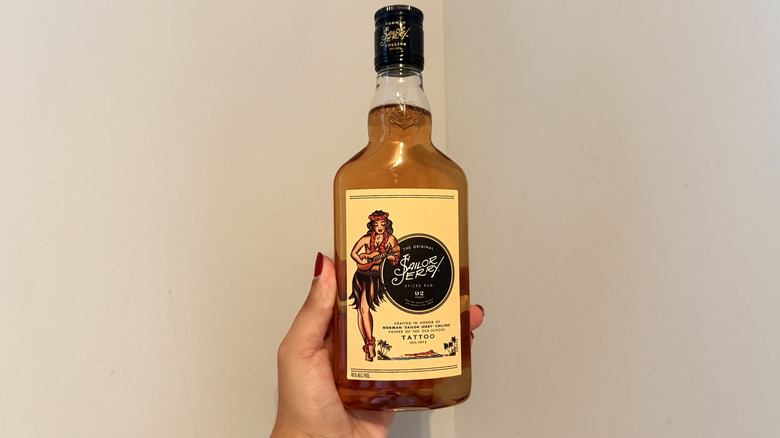
Sailor Jerry is a rum that's popular in the United Kingdom and throughout the United States. It is a spiced rum that's not only known for its bold flavor from all-natural spices, but also for the intricate history behind the real-life Sailor Jerry himself. Sailor Jerry the rum is named after Norman Collins, whose nickname — as you may have guessed — was Sailor Jerry. He's considered one of the fathers of old-school tattooing. The rum is not only inspired by Collins' U.S. Navy career and his iconic work as a tattoo artist, but it's also said to be deeply rooted in research into maritime rums.
Indeed, the complex history behind this Caribbean-inspired spirit, which is sold at 80 proof in the U.K. and 92 proof in the U.S., is littered with interesting stories. Here's a breakdown of everything you need to know about Sailor Jerry — both the rum and the person — before the next time you decide to take a sip.
History of Sailor Jerry
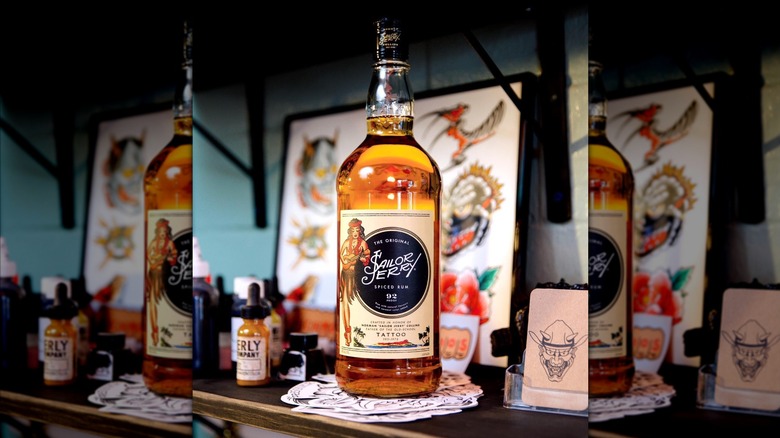
Sailor Jerry is inspired by the history of sailors, which is especially evident in the fact that this has been considered a Navy rum in the U.S. since its official launch in the 1990s. In addition to its high proof, the recipe is also said to be based on how sailors would upgrade the flavor of their rum rations in the 1800s. The brand chooses to blend the rum in spices, because this is how most sailors did it (as opposed to aging the rum in wooden casks).
The man the brand was named after, Norman "Sailor Jerry" Collins, was a jack of all trades, though he is most known for his work in the tattooing community. As he was starting out as a tattoo artist, Collins joined the Navy in the hopes of traveling and finding adventure. Through this work, he fell in love with ships and the ocean, earning his nickname of Sailor Jerry.
Later, when Collins passed 1973, he left his tattoo work and legacy in the hands of Ed Hardy and Mike Malone, two of his protégés. The pair started Sailor Jerry as a clothing company featuring Collins' tattoo artwork, alongside Steven Grasse. When Grasse discovered a gap in the rum industry, he partnered with the William Grant & Sons distillery to create and distribute Sailor Jerry Spiced Rum.
What does Sailor Jerry taste like?
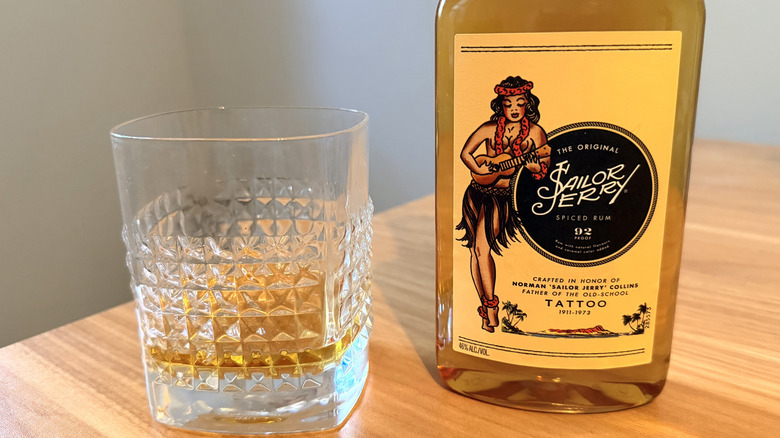
Before you even drink Sailor Jerry, its aroma gives off the sweet and nutty scent of almond and oak. There is a slight smokiness to the scent that leans toward cinnamon. Out of the bottle, the rum smells syrupy in an appealing way; once poured into a glass and aerated, the sweet-spicy element of the clove comes through prominently.
On the tongue, the fact that the U.S. version of Sailor Jerry is 92 proof is obvious. There is a slight burn on the back end of the sip, so this rum is not necessarily the smoothest on the way down, but after a few sips, the sweetness registers to calm the initial sting. Sailor Jerry is nothing if not intense, and that is a quality you would expect a sailor's rum to contain. This rum has character and is made for true lovers of strong spirits. Sailor Jerry is made based on the idea that sailors wanted to maintain the quality of their favorite beverage, and it fulfills this prophecy.
How is Sailor Jerry Spiced Rum made?
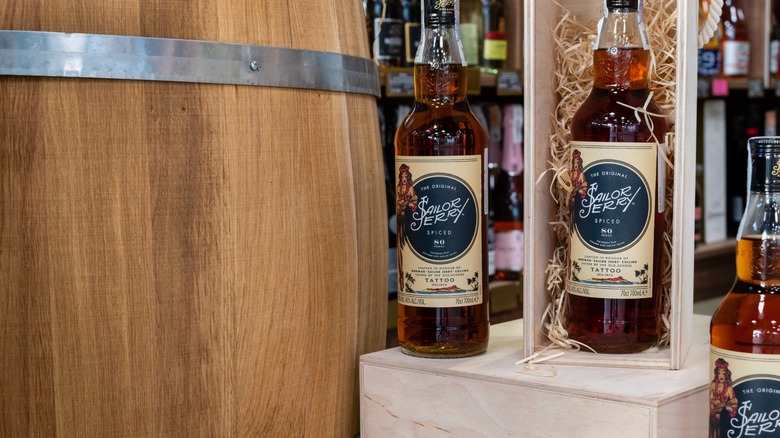
Sailor Jerry Spiced Rum is distilled by William Grant & Sons in the U.S. Virgin Islands. As previously mentioned, the real-life Sailor Jerry himself was an actual sailor, so the eponymous rum is made in the tradition of sailors with influences from the Caribbean. Blending warming spices like cinnamon into the rum is a way for the Sailor Jerry brand to soften it enough to make it enjoyable.
Beyond the mix of natural spices, Sailor Jerry is made up a mix of rums, as well. While the brand is admittedly vague when it comes to the specifics, it does state that it aims to find a variety of rums that are distilled in the Caribbean. Once chosen, the selected rums are mixed together, and the spices are blended in.
In 2010, the exterior of the bottle was rebranded. Previously, the bottle had a huge label with the name "Sailor Jerry" largely stated. After the rebranding, the bottle was given its chic, smaller label with the name "Sailor Jerry" in a simple font. In both labels, the hula girl has been present, a clear way for the brand to uphold Norman Collins' tattooing legacy.
How to drink Sailor Jerry
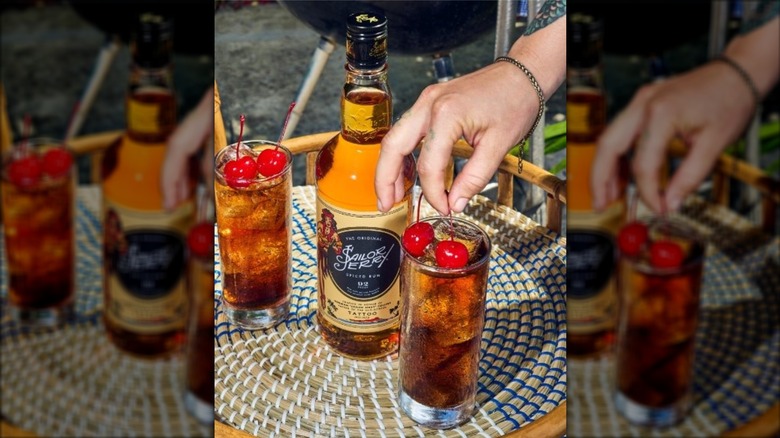
Because of Sailor Jerry's intensity, rum devotees would certainly enjoy drinking it neat or on the rocks. For the average rum drinker, though, Sailor Jerry might work better in a rum-based cocktail. The rum's boldness would be unmistakable in any drink, but its hints of vanilla and oak would blend well with other classic cocktail ingredients, like a cranberry daiquiri, which you can make using Sailor Jerry rum, water, sugar, cranberries, orange zest, and cinnamon, or an iconic rum punch, which mixes in ginger beer, apple cider, cranberry juice, fruits, honey, and warming spices.
There are also Sailor Jerry specific cocktails that you can make to be on brand with the rum you are drinking. Take the Cup O' Jerry, for example, which mixes the spirit with coffee, heavy cream, and brown sugar for a Sailor Jerry twist on an Irish coffee. Another option is the Stormin' Sailor, a mix of rum, lemon-lime soda, cranberry juice, and if you are feeling festive, black food gel to really get into a sailor character. There are myriad ways to drink Sailor Jerry.
Sailor Jerry vs. Captain Morgan Original Spiced Rum
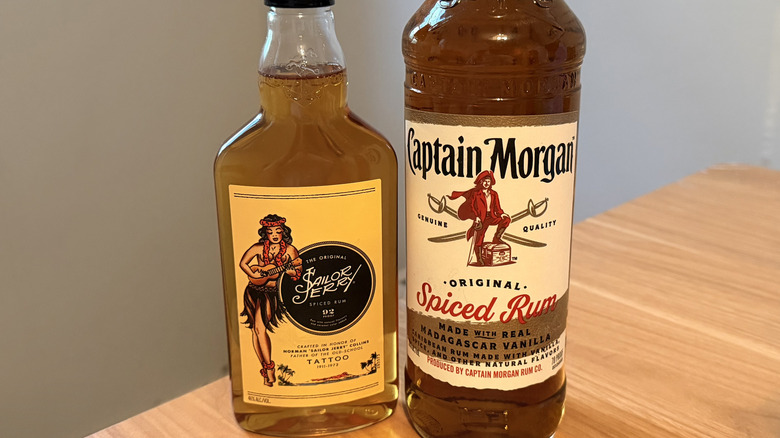
When most people think of spiced rums, they likely think of Captain Morgan. The brand's Original Spiced Rum was launched in the United States in 1984 and has been a household name in the rum industry ever since. Captain Morgan is 70 proof compared to Sailor Jerry's 92 proof, and it's dark amber in color compared to Sailor Jerry's lighter amber. Both rums have that syrupy smell, though Captain Morgan leans more sweet in its aroma, with prominent notes of vanilla that provide a super appealing scent.
That sweet scent bleeds into the taste, and Captain Morgan goes down smoother than Sailor Jerry. The vanilla flavor is also more prominent in Captain Morgan — though it is present in Sailor Jerry, as well — and both rums would work well in cocktails that bring out their natural flavors. The lack of burn on the back end of the sip speaks to a level of approachability that Captain Morgan has compared to Sailor Jerry. It makes sense that Captain Morgan is a more mainstream rum brand, because it's a spirit that seems suitable for more entry-level rum drinkers, whereas Sailor Jerry seems best for more seasoned rum fanatics.
The real-life Sailor Jerry was an iconic tattoo artist
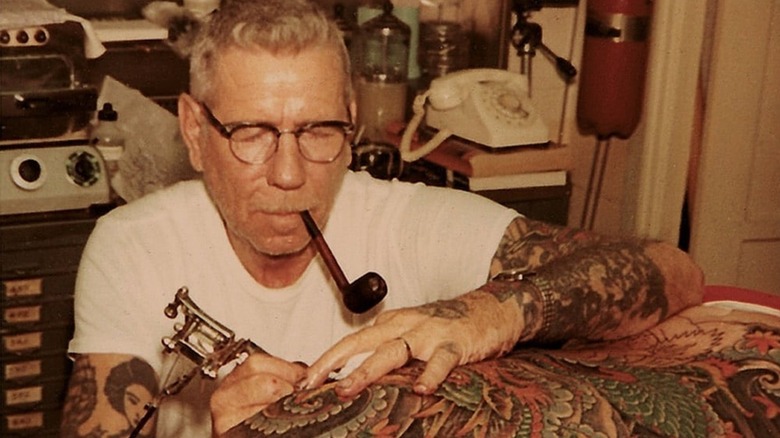
Norman "Sailor Jerry" Collins is widely considered the father of traditional American tattooing, as previously mentioned. This old-school style of tattooing stems from the maritime exploration era, when it initially became synonymous with sailors. With symbolism rooted in freedom, identity, and rebellion, Sailor Jerry's tattoo style was reminiscent of his own life.
Prior to joining the Navy, Collins left his home to travel by hopping freight trains alongside other Americans chasing the American Dream. At this time, Collins started by working only with a needle and black ink in a stick-and-poke tattoo style. Eventually, Collins met Gib Thomas, a well-known tattoo artist, and Thomas taught him to use a tattoo machine. After Collins' Navy career, he began crafting tattoo designs that represented the lives sailors were experiencing around the time of World War II, and he had a significant influence while working on Honolulu's Hotel Street (more on this below).
Impressively, the real-life Sailor Jerry also created purple-colored ink for tattoos. Tattoos were previously only done in black, green, red, or yellow, but Collins worked on making a carbazole violet color that would become the first purple ink to be used in tattoos — but only for people he thought really deserved it. Beyond the ink, though, Collins' legacy has lived on for years via the Sailor Jerry Festival, an event approved by his family that's held to celebrate his impact on the tattooing community, featuring live music, food, and art. The location of his old shop, now called Old Ironside Tattoo, also still stands at 1033 Smith Street in Honolulu.
Norman Collins took inspiration from WWII and Hawaii
After World War II reached its peak and Japan bombed Pearl Harbor — just west of Honolulu on the island of O'ahu — a significant number of military members would find themselves in this Hawaiian city while on leave from service. This made Honolulu's Hotel Street a hub for men returning from war who were looking for fun to decompress, and for some, this included getting tattoos.
For his part, the real-life Sailor Jerry ended up living in Honolulu around this time once he had completed his time in the Navy, and Hotel Street is where he began to establish his legacy as an old-school tattoo artist. This, of course, would later lead to the Sailor Jerry brand and rum being created in homage to Norman Collins and his tattooing work.
The American soldiers' desires became a major theme in Sailor Jerry's tattoo work, as is evident in his Man's Ruin tattoo, for example. This famous tattoo features a seductive woman lounging in a cocktail glass while images of cards, dice, and symbols of money surround her. Furthermore, his skull tattoos were a motif representing many of the values he held throughout his life, namely adventure and the importance of fighting for what one believes in. Collins also did a few military tattoos, ones that represented fallen soldiers. There were even pin-up girl tattoos, which some sailors got as a reminder of the women waiting for them at home once they returned from sea. Collins' designs were as straightforward and bold as the rum that now honors him.
There is hidden art on the inside of the Sailor Jerry label
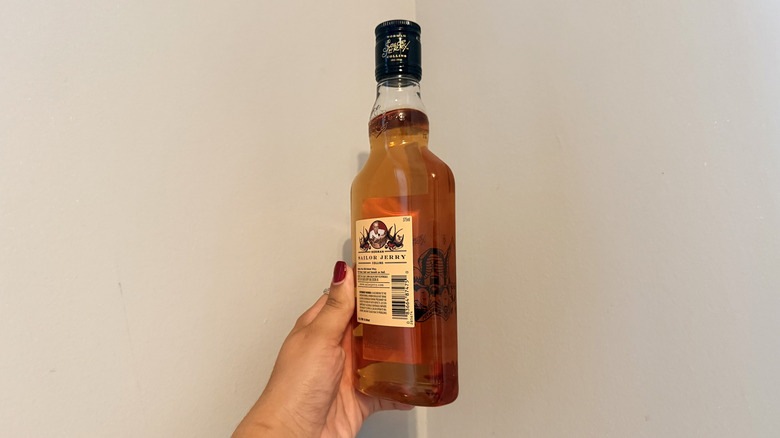
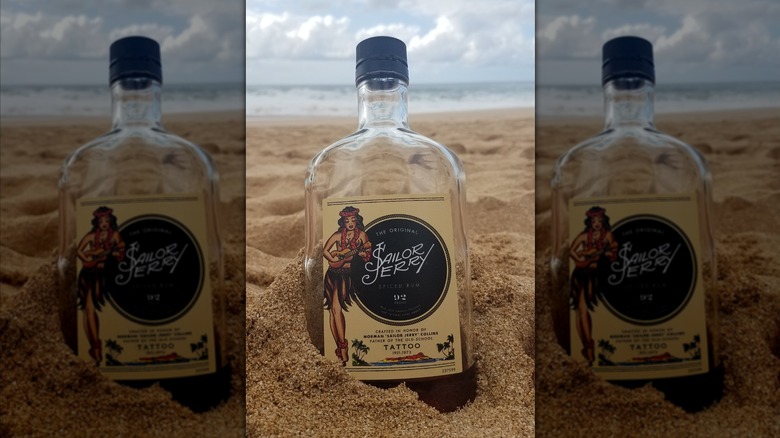
Since Norman Collins was an artist, it seems only right that the Sailor Jerry rum bottle has an artistic quality to it. The bottle design itself is classy, with a simple black top that has the Sailor Jerry brand logo embossed on it and a label that features one of Collins' famed hula girl drawings. The hula girl is accompanied by some palm trees and a picture of an ocean, which should transport drinkers to Collins' homefront of Honolulu.
More interestingly, though, if you get far enough into a bottle of Sailor Jerry rum, you will notice more of Collins' hula girl designs appear on the back of the front label. In fact, if you are lucky, you can carefully peel the label off and discover that the additional design is actually a sticker featuring Collins' very own designs. Besides the classic hula girl image, one of the designs features a pin-up girl sitting in a martini glass with her legs and head hanging off its edges.
The real-life Sailor Jerry wasn't much of a drinker
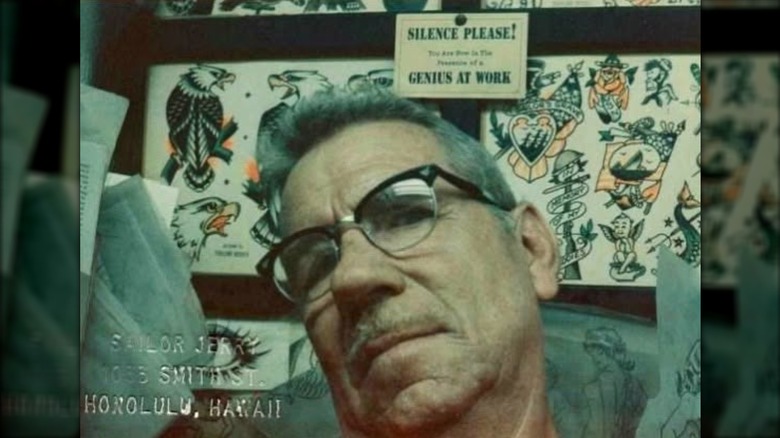
Despite the existence of a rum that uses his nickname, it turns out that Norman "Sailor Jerry" Collins wasn't much of a drinker. His widow, Louise Collins, and their children made this publicly known in a 2019 lawsuit while seeking compensation from William Grant & Sons, the distillery behind Sailor Jerry.
Calling the real-life Sailor Jerry "a true patriot," attorney Bill Meyer told Hawaii News Now, "He really had no time for hippies and hooligans. He didn't like rock 'n roll." In addition to claiming that "neither Sailor Jerry nor Mrs. Collins consumed alcoholic beverages during the course of their relationship," per Honolulu Civil Beat, the family alleged in the suit that the distillery never got their permission to use Norman's name and artwork to sell its liquor. They claimed it was an offensive misappropriation of his persona, which Norman wouldn't have appreciated, either. The lawsuit was settled in 2020, and while details about the terms were not made available to the public, the Collins family have continued to honor Sailor Jerry's memory.
In a PBS Hawai'i short documentary called "My Dad, Sailor Jerry," daughter Meriel Collins explained how Norman separated his work life and family life. "I knew his work, I saw his work, but only here in the shop. At home, he was a typical father," she said. Calling him both an artist and a family man, Meriel added, "I'm proud of the fact that his legacy and his artwork is being continued. It's still out there. ... His life was tattooing and his life was design, expressing himself — not to be famous, but because he was good at it, and it made him happy to do that."