

Should You Visit A Restaurant With A B Health Inspection Grade?
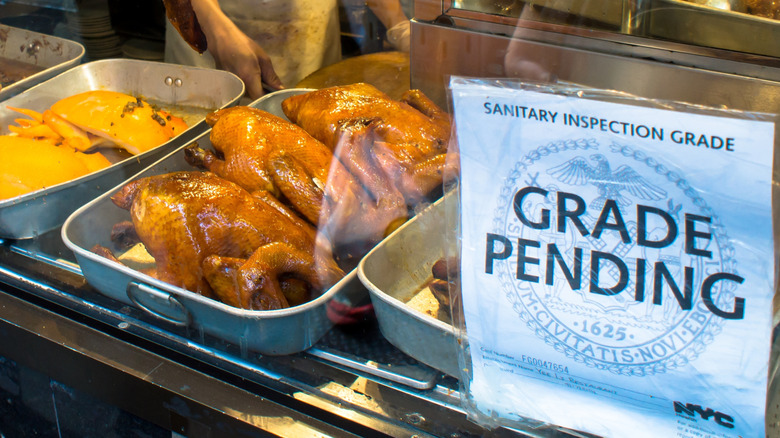
On most report cards, a B grade is pretty alright. It could be better, but the majority of folks look at it as representing a respectable effort and a degree of success. When it comes to the health inspector grades that sit in the front windows of restaurants, however, public opinion can be quite different. For those, anything but an A can cause prospective diners significant concern. As it turns out, however, this may be an overreaction. To help understand exactly what these grades mean, as well as whether or not a B should give you pause, we sat down with Brian Labus, associate professor of epidemiology and biostatistics at the UNLV School of Public Health.
"An inspection grade of B doesn't mean that you shouldn't eat there," Labus says in simple terms. "If the inspector thought there was a serious food safety issue that put diners at risk of illness, the restaurant would be closed." In truth, that B grade in the window does show up much like it would on any other report card. The goal is to have all restaurants at an A, meaning that they're keeping up with food safety best practices, but one notch lower is still far from failing. "B grades generally indicate that there [are] some issues that need to be addressed by the restaurant, but they don't pose an imminent threat to diners," Labus says. These problems could be things like failing equipment or mislabeled food, so the health inspector cannot give the restaurant full marks, but it is still considered plenty safe.
What it means for a restaurant to have a B or C health inspection grade

It can be hard to decipher what health inspection grades at restaurants really mean, though, so we'll break it down a bit further. Depending on where you are, the grading may be different, but A-B-C systems are pretty common. Within these systems, the grade is determined by the number of demerits received, each of which detracts points from the score. Notably, restaurants don't get F grades, or at least not on a placard to display in the window. Anything below a C is considered failing, and the restaurant must immediately close up shop until the safety concerns are adequately addressed.
Not all food safety issues are created equal, however, and the grading system takes this into account. "Inspection systems typically have two broad categories of violations," Labus says. "Major violations are serious issues, like improper cooking, cooling, or storage. Minor violations are less serious issues, like a hand sink without soap or equipment issues." The bigger issues detract a correspondingly larger number of points from the restaurant's score, so you can trust that a good grade means a safe kitchen.
"A restaurant can earn a B grade with a couple of major issues or several minor issues," Labus explains, "but a C grade typically requires a number of major issues." With a C, the restaurant is still considered safe enough to operate, but it has enough health inspector red flags to be on the brink of closure. That said, health inspections exist to ensure that restaurants are operating within food safety parameters. Even if the placard in the window doesn't have an A on it, if the doors are open, the restaurant has gotten a pass and is considered safe.