

The Cheese American Shoppers Love Most Is A Classic For A Reason
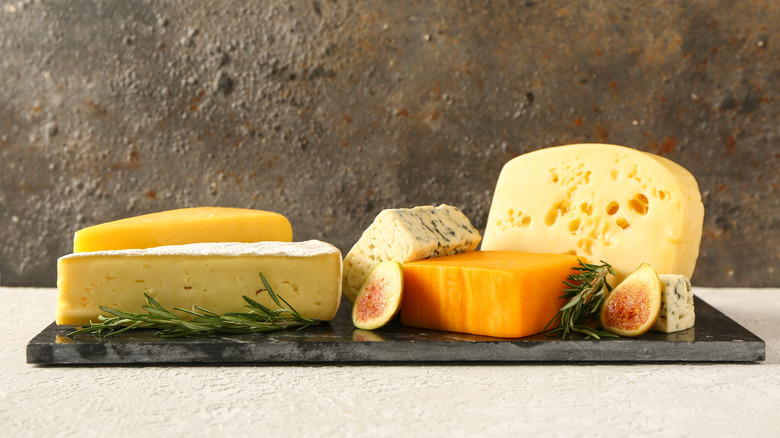
Somewhat ironically, the most loved American cheese isn't American cheese or even, technically, a cheese from America. Talker Research recently conducted a survey of 5,000 U.S. citizens that "explored how Americans consume cheese, their favorite types, and the role it plays in their diets," and found cheddar narrowly pulling ahead of mozzarella as the country's favorite. It's orangey-yellow, protein dense and calcium rich, it melts, it snacks — what's not to love?
Most Americans probably could have guessed it intuitively, but the mathematically quantified result raises an interesting question: Why cheddar? Of the thousands of varieties around the world, how did a humble English farmhouse cheese become the ubiquitous, veritable default found in so many American refrigerators and recipes?
Cheddar stretches across the entire middle of the cheese spectrum. Even in its mildest form, it has a discernible personality; with a pH between 5.1 and 5.3, it's more acidic than some other cheeses. With that tangy undertone, it holds a gentle balance of salty richness. Young, mild cheddar melts like a dream into sauces and classic grilled cheese sandwiches, adding enough depth to stave off blandness without dominating the dish with funk or chunk. Older cheddar, which doesn't melt as creamily, loses its moisture as it ages and becomes firmer and sharper (sometimes crumbly), with salty little protein crystals scattered throughout the block. White, yellow, young, and aged cheddars all slice clean or shred easily, and when heat is applied, they crisp and caramelize beautifully. Cheddar tastes just as good eaten in thick wedges with an apple as it does melting into a casserole.
The big cheese, whey back when
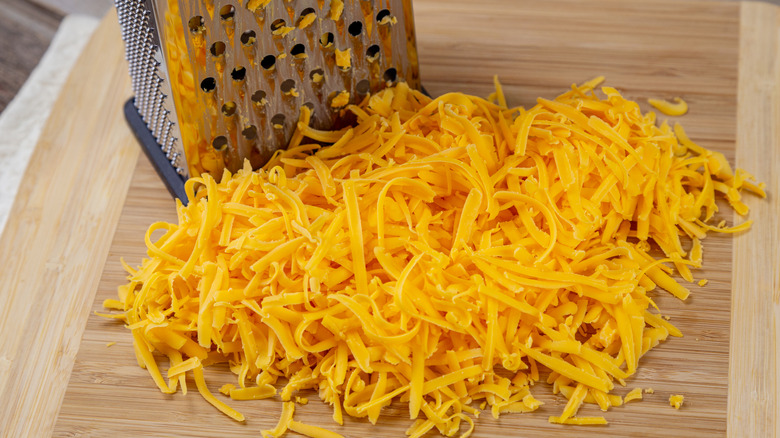
Its versatility has given cheddar an astonishing number of roles. Pizza gets mozzarella, parmesan goes on pasta, bleu on a meticulously arranged cheese board. But cheddar wanders through the rest of the American food canon with the easy confidence of somebody who received an invitation to every party. Cheeseburgers, macaroni and cheese, broccoli cheddar soup, loaded baked potatoes, bacon egg and cheese sandwiches, diner omelets, cheese fries ... the list goes on and on.
Way before creamy chip dips and nachos with creative toppings were a thing, cheese solved a practical problem: mitigating milk spoilage. Milk is one of the most perishable foods, and before refrigeration, every bucket was a race against time. Cheesemaking is one of humanity's oldest preservation technologies, predating recorded history. It concentrates dairy's tenuously suspended, but nutritionally valuable, fat and protein into a sturdier form. Cheese is capable of surviving weeks, months, or even years, and hard cheeses like cheddar have especially excellent staying power. Compared to a more delicate, pungent cheese like brie or Camembert, cheddar's low moisture content slows spoilage, and it actually gets better as it ages, becoming more complex and flavorful. A wheel of cheddar functions as food and storage, making the abundance of spring and summer milk edible during the lean winter months, when cows aren't producing as much milk.
The cheese takes its name from the village of Cheddar in Somerset, England, where it's been made since the Middle Ages. The naturally cool limestone caves of the region provided excellent conditions for aging and storing large wheels. The recipe and technique continued to evolve, and by the 1700's, cheddar production was prioritized because it could be easily transported for sale in London.
Extra (government) cheese
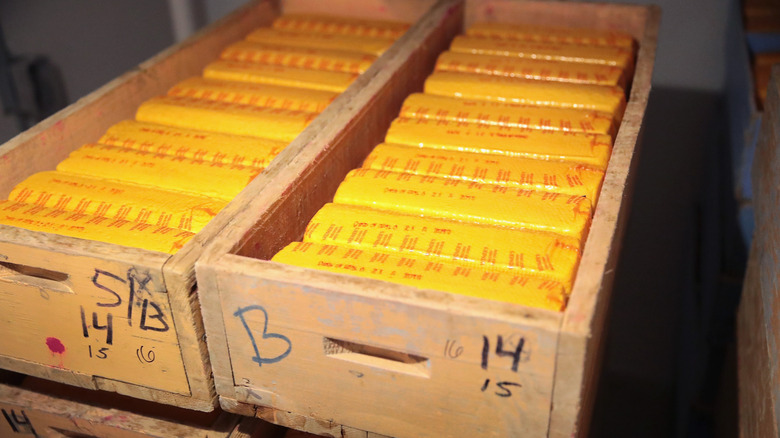
English settlers brought the cheese across the pond to America, where cheddar adapted to the culture as readily as the immigrants who brought it. In 1851, a family in upstate New York opened America's first dedicated cheddar factory, pooling milk from neighboring farms and producing an award-winning cheese at a scale that individual farmhouses couldn't. That cooperative model spread rapidly, and cheddar cheesemaking grew from a seasonal household chore into a massive specialized industry, giving growing American cities access to a steady supply of delicious, useful, and easily storable cheese.
As railroads expanded, and refrigerated transportation allowed for perishables to travel farther, cheddar became one of the defining commodities of the American culinary landscape. It was predictable to produce in bricks, which could stack and travel well, stocking grocery stores from coast to coast. American cheese (cheddar's processed facsimile) traces its lineage back to cheddar, borrowing a color and miming a flavor profile.
Cheddar's durability and wide appeal eventually produced a strange, and literally buried chapter of American food history. During the second half of the 20th century, federal dairy price-support programs encouraged a heavy flow of milk production, and surplus was often turned into a bland blend of cheddar, Colby, and Monterey Jack cheese, which stores well. The government purchased the excess, eventually accumulating over a billion pounds of surplus cheese in refrigerated warehouses and Missouri limestone caves, and much of it is still down there. "Government cheese" melted into American diets and folklore through food assistance programs, school lunches, rap songs and late-night comedians, but the stockpiles do prove cheddar's defining characteristic. Nearly a thousand years after it first emerged as a distinct food in southwest England, we still keep it, because it keeps well.