

Where Does Sam's Club Get Its Beef?
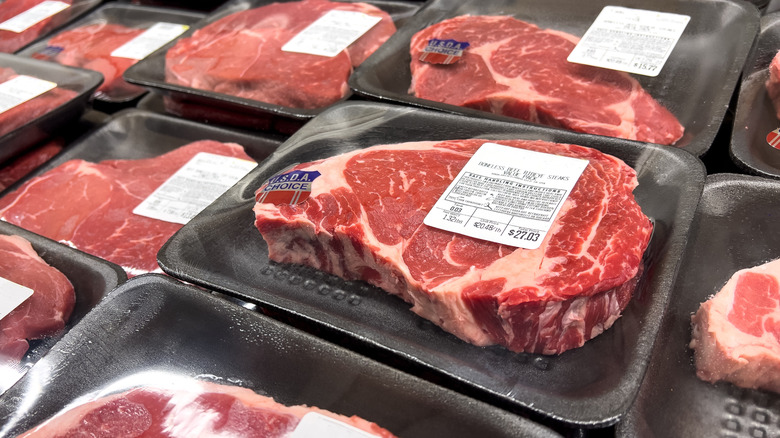
For plenty of Sam's Club members, the meat department alone is worth the annual fee. Thick ribeyes, bulky ground beef chubs, trimmed roasts: all of it priced well below what you'd pay at a conventional grocery store, in quantities that let you stock a chest freezer in a single run, with butchers on hand to help you break down larger cuts to order (something Costco won't do for you).
That value traces back to not only Sam's Club's bulk-oriented model and its clout as a Walmart subsidiary, but also to a beef sourcing network that stretches across the country. Which raises a fair question: where exactly is all that beef coming from?
The short answer is that nobody really knows — not fully, anyway. Sam's Club sources its beef from many different processors across the U.S. There's a reason for this: sourcing across many vendors gives the chain room to negotiate prices and keep supply steady. It also means that a problem at one facility doesn't empty the meat cases at all of its 607 locations overnight (unfortunately, as we'll later learn, Sam's Club is no stranger to recalls).
The big names behind Sam's Club's meat counter
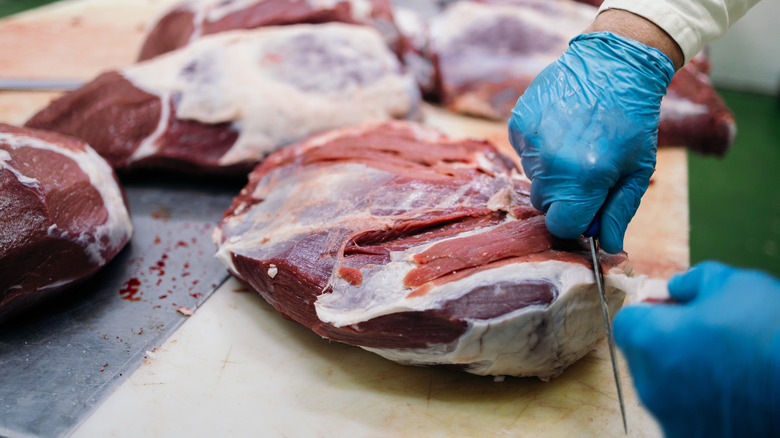
Product recalls — not exactly the glamorous side of the business — have a way of pulling back the curtain. In 2018, there were two separate beef recalls on the news that surfaced two familiar names. After Salmonella contamination, 6.5 million pounds of beef distributed by JBS Tolleson, Inc. were pulled from Sam's Club locations across 26 states (via NBC News). Cargill Meat Solutions followed with a smaller but still significant recall of roughly 132,000 pounds of ground beef sold at Sam's Club stores nationwide, this time over E. coli (via Pritzker Law).
Both incidents confirmed what industry watchers had long assumed: that Sam's Club leans heavily on a handful of the country's largest commercial meat processors. JBS is the world's biggest beef company by volume, and Cargill is one of the top producers in the U.S., so it would be strange if Sam's Club weren't working with them in some capacity.
Besides the capacity to supply beef at scale, Sam's Club also has strict sourcing standards for its suppliers that cover everything from animal welfare and antibiotic use to environmental practices, and suppliers must test for E. coli and meet Global Food Safety Initiative certification. They are also held to the livestock industry's "Five Freedoms" framework. For members, that means the ground beef in their cart has cleared a fairly rigorous set of checkpoints before it reaches the sales floor. You may not know the exact farm or facility, but the supply chain behind that Member's Mark label is more scrutinized than the price tag might suggest.