

This Hard-Boiled Egg Peeling Style Will Leave You With A Total Disaster
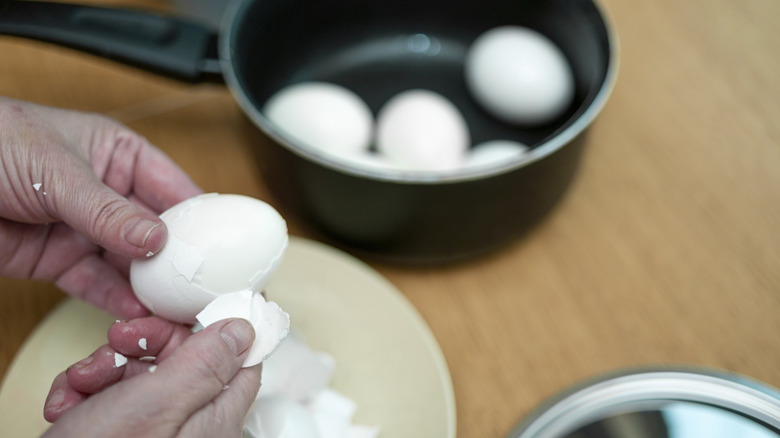
Everyone who's ever been knee-deep in a scroll hole has swiped by myriad supposedly life-changing, "one weird trick" hard-boiled egg hacks, applied to every step, from prep to cooking to peeling. Shockingly, not everything you see about peeling eggs on the internet is true — or a good idea. We put ourselves through the wringer with five methods, and we're here to tell you, some of them are great! Others, however, are absolutely not. The most egregious tactic was an actual, total disaster. Okay, maybe that's a little hyperbolic, but it certainly wasn't effective. Suffice to say, a messy and extremely irritating attempt was made by us, so you don't have to.
If you're wondering which was the worst, the culprit was the "crack-and-roll" method. After hard-boiling the egg, simply make an initial crack in the shall against the counter. Then, gently roll the egg across it, applying light pressure with your palm until (supposedly) the shell develops a network of tiny fractures. The idea is that if the shell is cracked everywhere, it should peel away everywhere. Satisfyingly tactile, almost meditative, it's exactly the kind of kitchen hack that looks shiny and convincing in a 15-second video. Unfortunately, in real life, eggs don't always cooperate.
A non-viable egg method
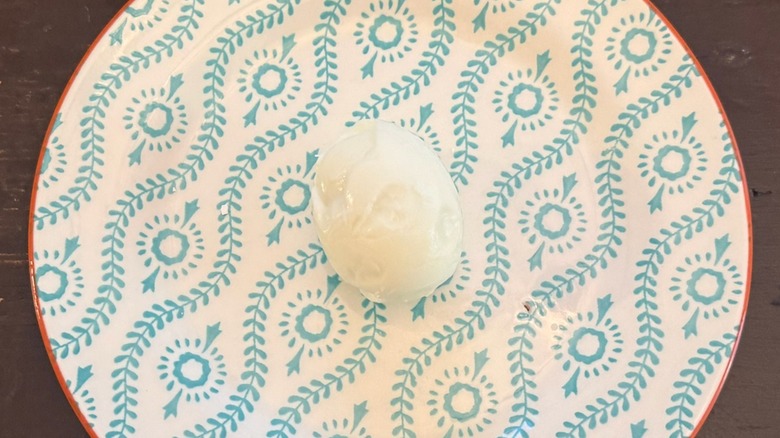
When utilizing the crack-and-roll method, the tiny fractures become a spiderwebbing constellation full of dozens of sticky (and tiny) shell fragments, each a new opportunity for the shell to cling stubbornly to the membrane beneath. During our testing, the shell did not, in fact, pull away in a few elegant sheets, but had to be picked off bit by bit. In the process, the shell fought back, and the egg ended up battle-scarred. We were weary of the task before even finishing the first egg. We absolutely cannot recommend this method, especially not for a big, hard-boiled egg-based project like a multi-dozen batch of gourmet deviled eggs.
The problem comes down to the anatomy of the egg. Between the shell and the egg white sits a translucent but surprisingly tenacious membrane. The shell, mostly comprised of calcium carbonate, is brittle and shatters easily, while the membrane is flexible enough to remain attached. So, while the shell cannot withstand the impact of the crack-and-roll, the membrane isn't impressed, sticking to the egg white as long as it wants to. When that happens, the result is a multiplication of the number of tiny pieces. Instead of flying through the task and getting to the fun part (eating), you'll probably end up wanting to just fully smash the egg against the darn counter and walk away.
Don't crack up when peeling hard-boiled eggs

This is why the more successful peeling methods focus less on breaking the shell and more on coaxing the membrane to loosen. Our favorite, the "crack-and-submerge" method, involves cracking the hard-boiled egg in a bowl of cool water so that the pressure can work its way under the membrane, which genuinely does hasten the peeling once you get going. You also end up with the shell detritus collected in the bowl for easy disposal, and the peeled egg gets rinsed off in the process, so it's cleaner and more efficient all around. No wonder Gordon Ramsey uses this technique.
Like many viral TikTok food hacks, the crack-and-roll method mistakes the entertainment value of doing too much for actual effectivity. More cracks don't necessarily produce a cleaner peel just like more stirring doesn't inherently improve a sauce. Sometimes less is more, and the easiest solution is the simplest one. Instead of technique trickery that turns your egg into a cratered and geological excavation, pick a strategy that lets the shell let go in large pieces and allows your sanity to stay intact, too.