

Why Is Corona Always Sold In Clear Bottles?
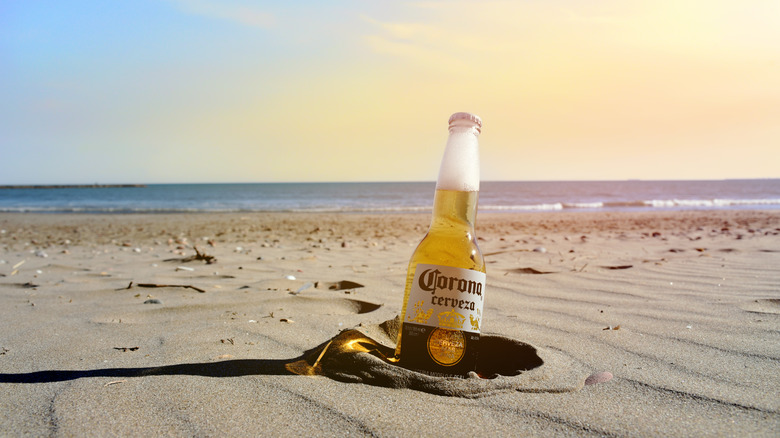
Corona seemed to be on to something a century ago when it committed to selling its beer in clear bottles. From the beginning, Corona was building a relaxed, beachy beer brand, which meant customers needed to see that golden pilsner sunshine through clear glass.
Despite Corona's successful clear-bottle branding strategy, lots of other beer manufacturers have opted for tinted glass bottles instead. But why? Beer needs protection from light. Even grocery store fluorescents or liquor store LEDs can decompose the alpha acids that make up a beer's flavor and produce prenylthiol (the same stuff that's found in skunk spray). It's called being "light-struck" or "skunked" (for the musty taste as well as smell), and is one of the reasons that beer comes in brown bottles. The opaque glass blocks the UV rays that cause the "skunking" chemical reaction.
The science behind "skunking" can make Corona's strategy to use clear glass bottles seem ill-advised, but the beer industry only caught on to that science as recently as the 1960s. Corona had long been logging clear-bottle branding hours by that point. A 1930s advertising campaign, for example, claimed that Corona's translucent consistency was indicative of the beer's purity, which gave then relative newcomer Corona a competitive edge over an established local favorite — a murky, milky, fermented drink called pulque. You need clear glass bottles to make that marketing strategy work.
Here's how to keep your Corona tasting fresh
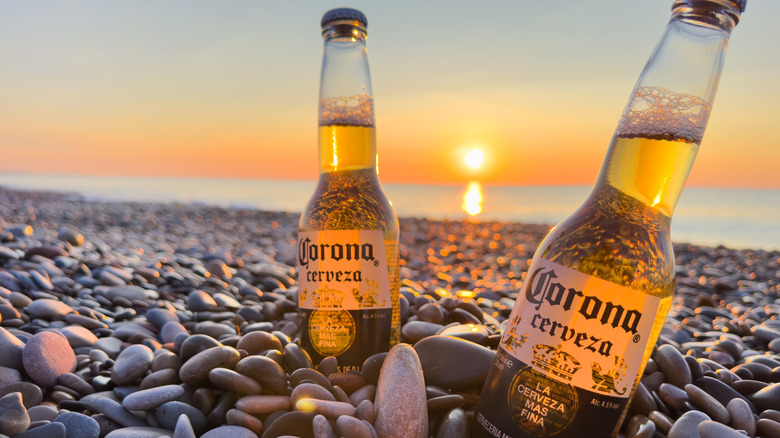
If the threat of "skunking" is tempting you to avoid beer in clear bottles, take heart. There are a few tricks to experiencing a Corona that tastes fresh, like chilling it until it is ice cold, and drinking it right away when you pull it out of the cooler. That chill is good for the beer's carbonation, plus beer just tastes better cold.
Another way to capture Corona's freshest flavor involves its now signature sidekick: the lime wedge. Adding a lime wedge to the bottleneck of a Corona has become widely recognized as having the full Corona experience. While popular legend has it that a bartender once added a lime wedge simply in hopes of setting a trend, another theory is that the lime helps cover up any unwanted skunky tang.
The lime is great for Corona's flavor profile in any case. When brewmaster Adolph Henry Schmedtje came up with the Corona recipe in 1925, he used Mexico City's local grain – maize – a starch that made Corona, with its added lime, perfect for certain food pairings.
Other tips for experiencing a fresh Corona taste include drinking it by the "best by" dates (printed on the neck of the bottle), and whatever you do, avoid subjecting Corona to harsh temperature changes. This is not the beer to forget in your car on a hot summer day.