

Say Goodbye To Stubborn Hard-Boiled Eggs And Peel Them Like This
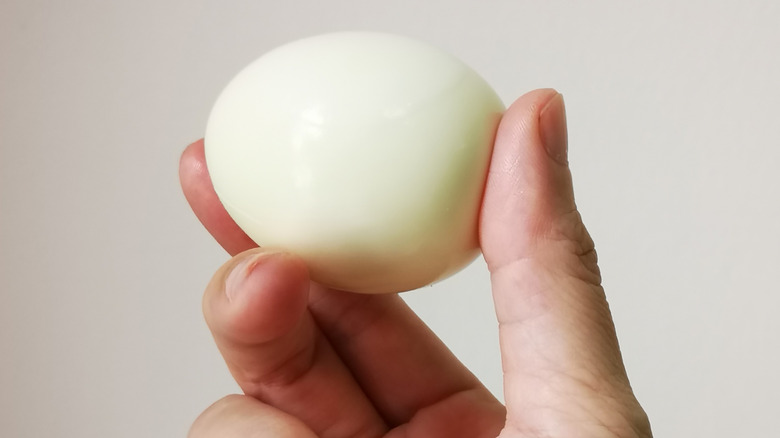
There's more than one way to crack an egg, but there are few kitchen tasks that generate more discourse than how to peel a hard-boiled one. Mention the topic in a room full of eggheads, and you'll hear passionate arguments all manner of kitchen chemistry "solutions", from flash-cooling ice baths to splashes of vinegar (or pinches of baking soda), using older eggs, fresh eggs, rolling them, shaking batches in a container, steaming, or starting with cold or boiling water — the list truly does go on and on. Altitude may also be a major factor, requiring even more patience. The sheer number of possibilities, and competing theories, explains why egg peeling is of such persistent debate.
Tasting Table staff put several popular peeling methods to the test and found a clear, and thankfully simple, winner: cracking the cooked egg under cool water. The shell just shrugs off, frankly relieved to get going. We're calling it the "crack-and-submerge method," and it requires little more than a bowl of cool water, and of course, a hardboiled egg. And a pair of hands. Once the egg is cooked, place it under the water, gently crack one end against the bottom of the bowl, and start peeling while keeping the egg submerged. In our comparative experiment, the shell slipped off in just a few satisfying shrugs, leaving behind remarkably clean egg, without the usual pockmarks of missing egg white that can happen when peeling goes wrong.
As for the science behind this hack, it's actually not about the shell itself, but the membrane clinging to the egg beneath it. When the shell is cracked underwater, the pressure of the water pushes in, finds the fissures, and slips through them under that membrane, thereby separating the shell from the white.
Shell yeah!
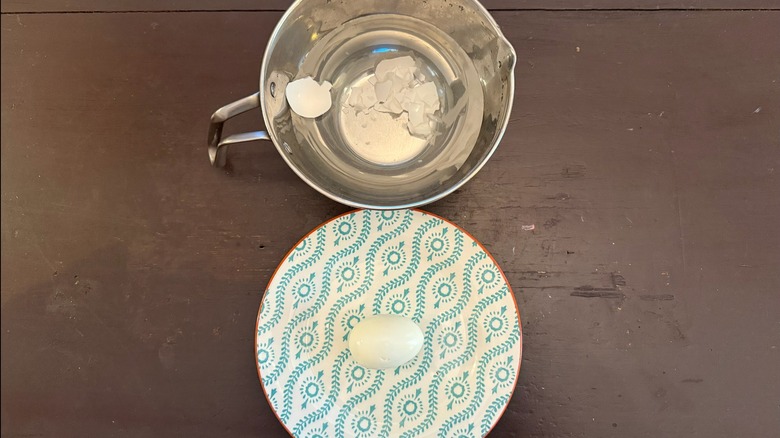
For those of us who have spent many infuriating minutes of our lives excavating a hard-boiled egg shell one tiny piece at a time, this strategy provides a compelling advantage, and can make big projects, like crafting batches of different deviled egg recipes, more "a-peeling." Rather than picking away dozens of shards of stubborn, sticky fragments, you're creating the circumstances for the shell to release fully and easily.
The method isn't exactly a revelation. Similar advice appears all over cooking forums and social media, where home cooks frequently bemoan the tedious task, and trade various tips and tricks. Several commenters, while discussing egg-peeling techniques, pointed to the same principal that make our favorite method so effective: somehow getting water underneath, between the shell and the membrane. Some suggest cracking the egg under running water, some say submerge it, and then go one step further by letting it sit briefly before peeling, which would give the water a little more time to work its way between the shell and the egg white.
The best news is that our crack-and-submerge technique doesn't require any extra ingredients, wacky as-seen-on-TV equipment, or much planning ahead. Whether you carefully time your boiling, start with room-temperature eggs, or boil them while standing on one foot and rubbing your tummy, our recommended approach can be employed right before peeling. You should still pack your patience, but it's a pretty easy one to remember next time a stubborn egg puts up a fight.