

This Pantry Staple Can Cause An Explosion If You Don't Handle It Right
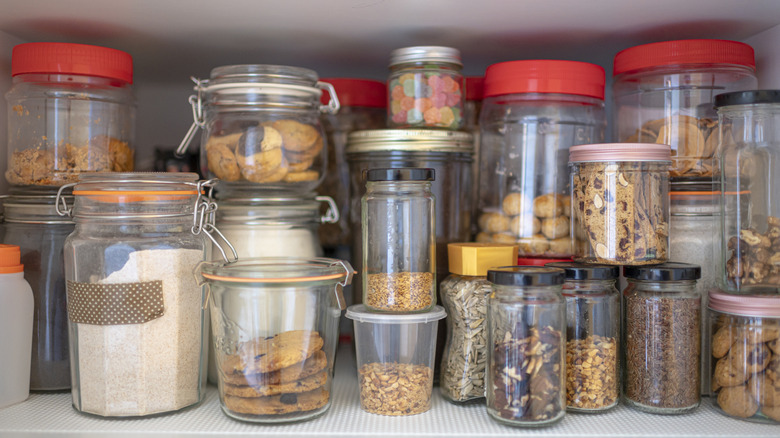
The kitchen can be a perilous place, with all sorts of hot, sharp, slippery, and electrified hazards. What's more, even something as commonplace as sugar can present an unexpected danger. While sugar isn't highly flammable, it is combustible. This means that under specific conditions, clouds of fine sugar particles can ignite when exposed to a spark, flame, or other ignition source.(Don't worry: If sugar were highly flammable, you wouldn't be able to use a butane torch to make crème brûlée without creating a boom.)
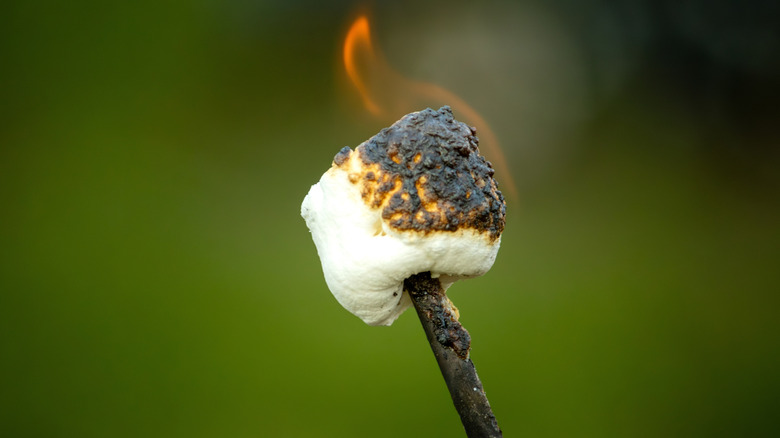
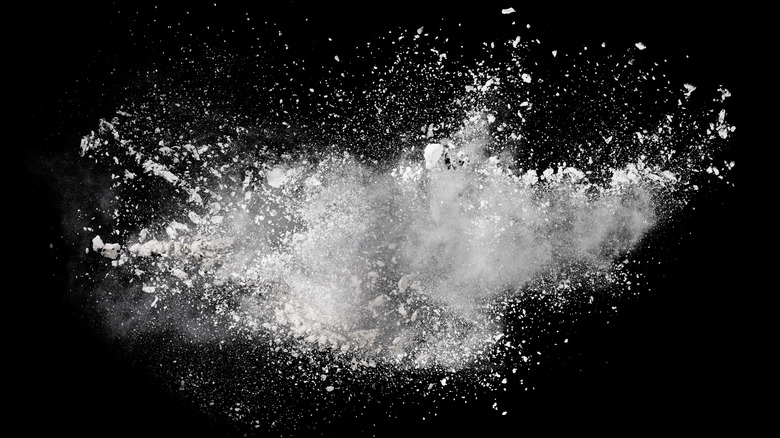
Sugar is a carbohydrate made up of hydrogen, oxygen, and carbon. When heated enough, it can react with oxygen and burn. Marshmallows and cotton candy are combustible for the same reason. It sounds alarming, but sugar does not pose a significant fire risk in everyday use. For sugar to burn rapidly enough to create a hazard, it generally must be suspended in the air as a fine dust cloud. That means the greatest concern is very fine sugar dust or powdered sugar. Fine particles have a larger surface area relative to their size, allowing them to react with oxygen more quickly. And when exposed to high heat, they can become like microscopic flying, flammable dominoes, setting off a chain reaction of ignition and combustion. Creating a cloud of sugar dust too close to an open flame, such as a stovetop, could start this process. Even blowing icing sugar off your counter toward a candle, for example, could be all it takes.
How to handle sugar safely at home
One of the best-known examples of the hazard occurred in 2008 at the Imperial Sugar Refinery in Georgia, where accumulated sugar dust ignited, fueling a catastrophic explosion as the refinery itself became the vessel for a massive sugar dust fire.
In the home, sugar dust is unlikely to accumulate in quantities large enough to create an industrial-style explosion, yet combustible sugar dust is a real hazard to be aware of. Avoid handling sugar containers around open flames or extremely hot surfaces, as any sugar particles that form a cloud and come into contact with the heat source may ignite. This is especially true when you're handling fine caster sugar or icing sugar. It's also a good idea to clean up sugar dust that collects near heat sources or electrical equipment.
If you've got fine sugar dust accumulating at the bottom of your sugar jar, it might be best to throw it out and refill the container with fresh granules. One popular way to make your own powdered sugar for baking is to blend it in a food processor with cornstarch, but do so with extreme caution. Do not attempt this near any source of open flame, high heat, or electricity, as it's sure to create clouds of sugar dust and possibly even heat from the blender itself. Any organic powder can burn (baking flour is another pantry item that can explode in the same way), so the cornstarch can also be combustible.
Sugar is only volatile at higher temperatures
The good news is that sugar is also very good at melting or caramelizing when heated. This means that your normal granulated sugar is more likely to simply burn or caramelize than to explode. Granulated sugar melts around 320 degrees Fahrenheit and caramelizes between 320 and 375 degrees Fahrenheit. Within that range, starting around 350 degrees Fahrenheit, fine sugar particles can ignite, but they require immediate exposure to high heat, such as an open flame.
The other condition required for a real explosion is confinement. In the home, sugar dust likely won't make an explosion in the conventional sense — there won't be a boom — because the suspended powder is usually not contained. Flammable material explodes when ignition reactions cause rapid expansion within a container, so when the container bursts, it does so with a bang. For example, some slow cookers have caused kitchen explosions when the latch that's intended to hold the lid in place for travel is used during cooking and traps built-up steam. With nowhere to go, the accumulated pressure results in an explosion.
That said, an open cloud of sugar dust can still be severely dangerous in confined spaces, no matter how big or small. A puff of sugar dust can quickly become a cloud of flame in a second, igniting other, more flammable materials and burning people and objects.