

When Buying Grocery Store Bakery Items With Whipped Cream May Be A Mistake
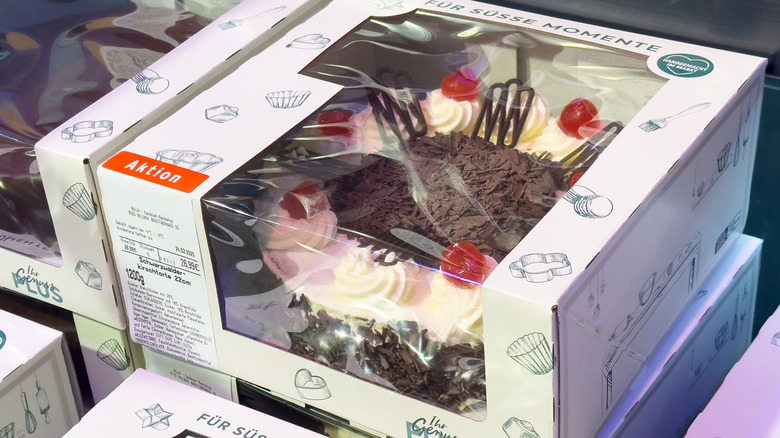
While a whipped cream topping or filling is as visually appealing as it is to our tastebuds, it might be a mistake to pick up a whipped cream-laden baked good from the grocery store bakery. We spoke with Kantha Shelke, PhD, certified food scientist, founder of food science and research firm Corvus Blue LLC, and a senior lecturer on food safety regulations for Johns Hopkins University, about why you might want to avoid whipped cream pastries from a grocery store bakery if there's no way to tell when they've been made.
Whipped cream is a dairy product that is added fresh to baked goods, from cookies to cakes. According to Dr. Shelke, "when real dairy cream is added, however, these low-acid food products become moisture-rich and nutrient-rich — and therefore, an inviting medium for microbes." Whipped cream can quickly develop harmful bacteria, causing food-born illnesses. Furthermore, says Shelke, "most pathogenic (harmful) bacteria do not change how food looks, smells, or tastes, but can make people sick. Listeria, a pathogenic organism prevalent in dairy, thrives at refrigerator temperatures without giving off any telltale sour note."
Ideally, the pastry has a best-by and made-by date to know what the window of safety is for eating it. "The made-by date tells you that you have only a couple of days, while the best-by or best-before tells you by when you should consume it," says Shelke. "These dates paired with a cold refrigerator storage case are your most reliable signal of freshness and safety." If there are no dates listed, here's what to look for upon further inspection.
Signs of freshness and spoilage

If you're trying to tell whether a whipped-cream based baked good is fresh enough to buy without seeing a best-by date, Dr. Shelke breaks down the signs you should watch out for. Even before picking the item in question up to inspect it, says Shelke, "your first clue is not the dessert, but the case where it is stored or displayed. It should be cold to the touch. The dessert should be stored/displayed in a true refrigerated display and not on shelf at room temperature, and ideally at a store with brisk turnover." The more desserts fly off the shelf, the more bakeries have to replace them with fresh, made-that-day goods. Don't make the mistake of not asking the bakery staff when the pastry in question was made, either.
Upon visual inspection of the whipped cream, Shelke says that "fresh whipped cream is bright white and glossy and holds its shape cleanly with defined peaks or swirls." Furthermore, the pastry, itself, should look moist and bouncy with no residual liquid at the bottom of the carton. When a pastry is passed its prime, the signs are more glaring. According to Shelke, Whipped cream will appear "slumped, shapeless, deflated, or melting; a watery layer weeping out or collecting underneath; a dull, yellowed, or dried "skin" on the surface... browned or leaking fruit toppings and a soggy or stale sponge are giveaways too." Of course, fuzzy mold is the most obvious sign of spoilage, and if you've brought something home you're not sure about, always follow the old adage: When in doubt, throw it out.