

Yes, Bone-In Filet Mignon Exists — How It's Cut And Why It's So Rarely Seen
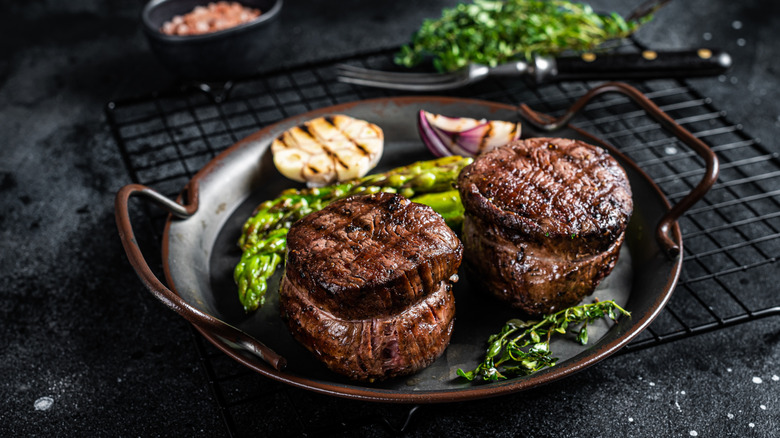
For anniversaries and expense-account dinners at a steakhouse, a filet mignon can't be beat. Bourgeois name that rolls off the tongue aside, this prized cut of steak is special and widely beloved (and fetches a premium price) for its tenderness that borders on creamy. Whether you're eating regular filet mignon, or a fancy version like blue cheese crusted filet mignon, it satisfies. Almost always, though, a filet mignon will arrive on your plate boneless. The key word is "almost" — because as it turns out, there is a bone-in version.
Unlike the trimmed, clean medallion most people picture, the bone-in filet mignon comes from the center rather than the meaty tapered end of the tenderloin. A cut from this area will come with a rib bone attached, which is kept for a bone-in filet mignon. Not only does this result in a bigger, bolder-looking cut of steak, but the bone contributes to the cooking process by acting as an insulator, slowing down heat transfer so that the meat closest to the bone doesn't overcook. The goodness inside of the marrow and cartilage near the bone is rendered down on the heat, too, and as they work their way into the beef, you'll taste a unique richness on your tongue that you don't get from the boneless cut. The easiest way to think of it is as the filet you already love (even though not every chef believes filet mignon is worth the hype), just with a lot more going on!
Why bone-in filet mignon is rare and how to find one
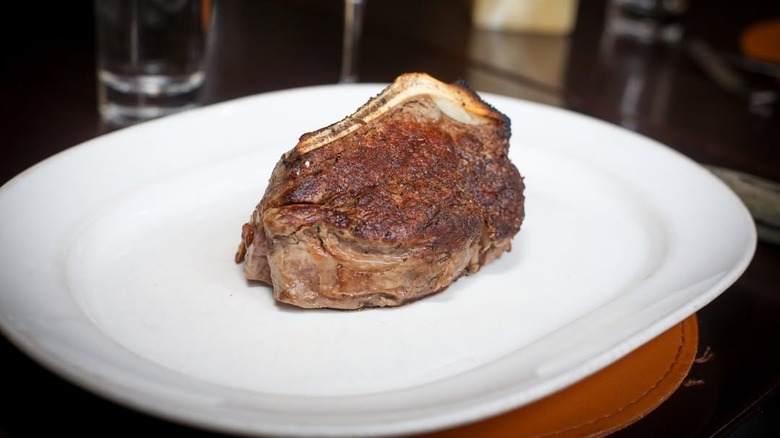
So why doesn't every steakhouse serve bone-in filet mignon? The short answer is yield. The tenderloin is already one of the smallest muscles on the animal, making up only around 2% of the total carcass. With each cow having only two of them, people have to make the most of each one. Since diners always have an appetite for filet mignon, the most economical choice is taking them and breaking them all down into medallions (plus, their small sizes make them easy to portion, ship, and sell, too). Leaving the bone intact takes specialized butchery and results in fewer usable cuts per animal — not a trade-off most suppliers are willing to make at scale.
That means tracking one down takes a little effort, but it's definitely not impossible. The most reliable way to find them is online. Look for specialty butchers like Snake River Farms, Lobel's of New York, and Texas de Brazil's — all of these names carry them, usually in the 12-to-16-ounce (1-pound) range. Price-wise, because you also have to factor in the weight of the bone, it's typically more expensive ounce-for-ounce than boneless. Snake River Farms, for instance, sells a 2-inch, 16-ounce bone-in filet mignon for $85 at the time of writing ($5.31 an ounce). A Choice-grade, 10-ounce boneless cut, on the other hand, goes for $41, or $4.10 an ounce. That's almost a dollar difference per ounce — you'll find this pattern repeating at other stores, too.
So between the two, boneless is still the more economical choice, but considering how it gives you a far more novel eating experience and more flavor, why not give bone-in a try at least once? Bet no one in your friend's list has ever tried it before.