

What Kind Of Beer You'd Have Found In An Old West Saloon
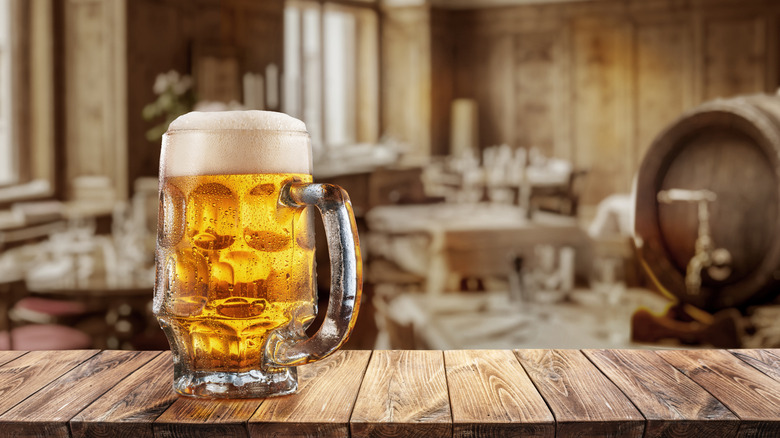
It's a familiar scene, a dusty saloon with swinging doors and glasses of beer being slid across the bar to thirsty cowboys. But the beer in the glass — was it really a cold, sudsy, refreshing beer? In reality, it likely wasn't, until immigrants, infrastructure, and innovations improved the ability to brew and transport beer that was closer to what we enjoy today.
In the early saloon days of settlements pushing further west, before railroads could transport goods quickly across long distances, most beer was brewed in-house. In the early 1800s, hops weren't as readily available, if at all, meaning that the beer produced lacked the refreshing bitterness we now enjoy. In fact, the function of hops in beer is also to act as a preservative, so these early beers would often go sour and cloudy, accelerated by the heat without a source of refrigeration. While sour beers have gained popularity among contemporary beer nerds, these spoiled brews fermented unpredictably by wild yeast would likely curl modern nose hairs. The grain base for these early brews was also not ideal, often a mash made up of whatever grains didn't make the cut for bread or to take to market.
Small outpost towns even had bars serving beer that was actually a mix of anything that could ferment. This included cactus pulp, molasses, or cornmeal, affectionately referred to by such appetizing names as "pop skull" or "rotgut beer."
A new era for beer in the Old West
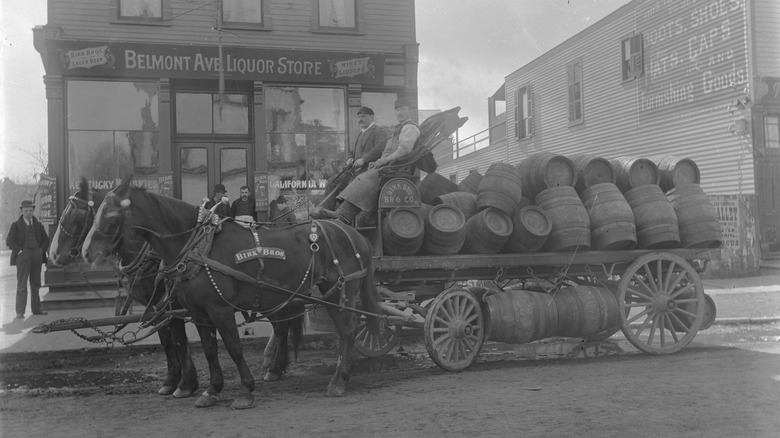
As German and Czech immigrants traveled further west with lager brewing recipes and expertise, better techniques were employed, refining the beer that saloons could serve. Although lager requires lower temperatures to brew and condition than ale needs, early German-American brewers were able to use underground, brick-lined cellars to maintain cooler temperatures.
It's all fine to brew and store cool beer underground, but as industries, infrastructure, and settlements developed, breweries became better equipped to transport their cold beer to saloons. In 1870, New York brewery Liebmann's Sons Brewing Company became the first to use industrial refrigeration to cold ferment and ship beer. Notably, Eberhard Anheuser and his son-in-law, Adolphus Busch, who together created Anheuser-Busch in the 1860s (today known as AB-InBev, ranked the country's biggest beer company in terms of volume and producer of Budweiser) embraced refrigeration and pasteurization, allowing them to preserve and transport their beer west from St. Louis.
The first Transcontinental Railroad was completed in 1869, and by the 1870s, innovations like ice-chilled railcars were primed to send beer west, keeping them cool and fresh in transit. Other rapidly-growing German-heritage breweries like Schlitz, Pabst, and Miller, could now ship beer west. Lagers like Schaefer's that had boomed in popularity in eastern states like its home of New York could now make it across the country. The 1870s also saw more beer being bottled, rather than being shipped in kegs, meaning carbonation wasn't reliant on the bar keeping it pressurized, so offering a more uniform sip.