

Why Your Homemade Pizza Dough Doesn't Taste Like It's From A Pizzeria
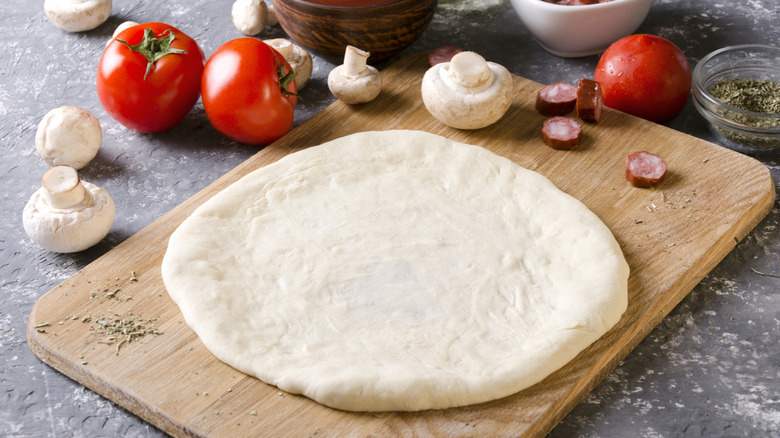
As someone who worked in a pizzeria and considers themselves to be a pretty prolific home baker, I can say that making homemade pizza — and more specifically, pizza dough — is a character-building experience, especially if you don't make it on the regular. This is simply a dough that is usually better off left to the pros, whether that means buying store-bought pizza crusts or getting yours from a pizzeria. At the joint I worked at, we offered our raw sourdough pizza dough to customers for charitable donation. I can't tell you how many folks came in at the last minute to grab a couple of containers of dough because something catastrophic happened with their homemade batch or it just "didn't taste like you guys." But why is there such a difference between the taste of pizzeria dough and homemade dough?
The truth is, it comes down to an array of factors. Professional kitchens and pizzerias have a leg up on home bakers from a quality-control standpoint, as they prep in bulk, measure everything, and have worked it all down to a science, meaning the dough is replicable. These disparities may also differ by pizzeria. Ours, for example, was made with a well-matured sourdough starter, giving it a tangy and unique flavor specific to our yeast culture (and by proxy, our restaurant). Our crust also underwent a cold ferment — a maturation that occurs over the course of several days and improves the overall flavor of the dough, makes it easier to handle, and produces that golden, crisp yet chewy crust — which is not something that many home bakers satisfying an immediate craving for homemade pizza can make happen.
Tips for making tastier pizza dough
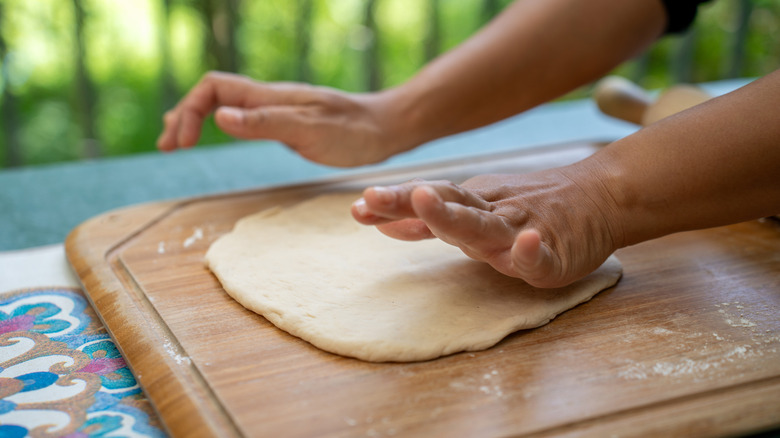
If you can't get quality dough from a great pizza restaurant or trusted source, I do have some helpful tidbits of advice for you when making pizzeria-quality dough at home. Use a trusted recipe, for one, and make sure to measure out all of your components by weight rather than cups. Baking with a scale will give you more accurate measurements, and it also makes your crust recipe more easily replicable in the future. Don't skimp on the salt either, as this will add dimension to your otherwise flavorless dough.
Although cumbersome, I also do recommend doing a cold ferment on your dough to slowly develop the gluten and the flavors. It may take upwards of three days, but the crust that you get from doing it will be leaps and bounds better than the one you bring together in a matter of hours. One of the most common mistakes people make with pizza dough, and the reason why it often won't stretch, is because the gluten becomes overdeveloped. The cold ferment will help preserve the dough's elasticity and will make it easier to handle. Of course if you can't wait that long (or don't plan in advance), head to a nearby pizzeria to see if you can score some of their dough.