

Why Chianti Bottles Come In Little Baskets
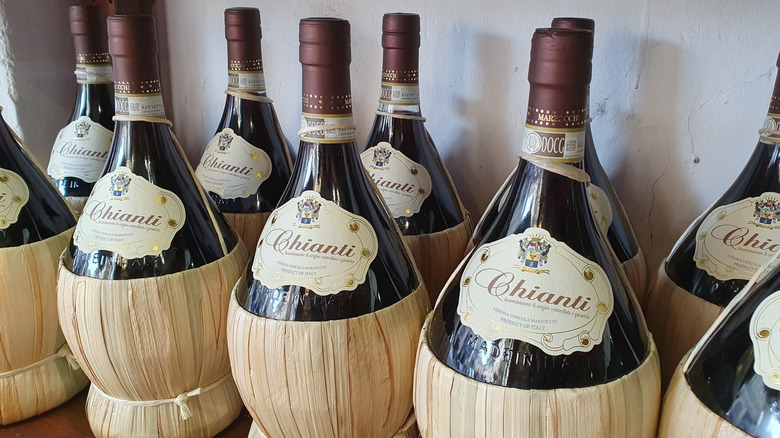
A fairly universal experience among those who frequent mom-and-pop Italian trattorias is spotting a teardrop-shaped wine bottle wrapped in a straw basket, usually reappropriated as a candlestick. This bottle is the iconic fiasco – an Italian word that originally just meant flask – chosen by restaurants because it looks as if it might have been found in the basement of a Tuscan villa. These are the recognizable bottles that helped popularize the approachable red wine led by the sangiovese grape, Chianti, especially in markets outside of Italy.
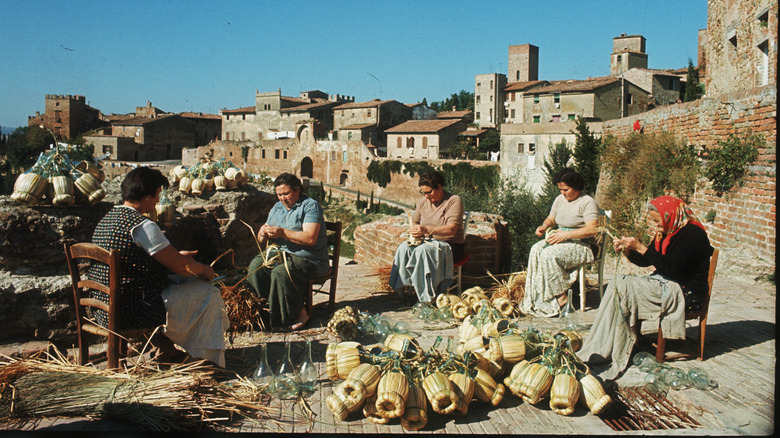
Chianti is a region in Tuscany, and the name of the wines that come from it, but like most Italian wines you'll encounter, this means following strict regulations. Long before control was as explicitly asserted on the production of wine across Italy, fiaschi (that's plural for fiasco) were used to bottle a range of liquids, including olive oil, as early as the 1500s. The glass bottles were made as bottom-heavy bulbous shapes, easier for glassblowers of the era, and by the time they held wine were larger than we know today, usually holding around two liters. Craftswomen called fiascaie would then weave swamp weeds from nearby marshlands to surround the glass bottles, getting paid for every fiasco wrapped. Because of the rounded glasses, the basket casing helped the bottles stand up and also protect them from breakage. These bottles weren't for single-use shipments as they are today, but could be refilled for years. Before the invention of corks, wine was sealed with a floating layer of olive oil.
Ironically, something called a fiasco kept things intact

In 1860, the form of fiaschi was tweaked by a man named Adolfo Laborel Melini, creating a tempered glass iteration that was strong enough for shipping and could have a cork mechanically inserted. The straw protected the glass bottles in transit, as well as allowing upside-down bottles to be stacked on top of right-side-up ones, making them even more efficient to ship. The ability to supply met the new international demand driven by the influx of Italian immigrants to the U.S. in the 1900s. For Italians and non-Italians alike, Chianti fiaschi became both an accessible supply of — and symbol of — classic Italian wine.
This boom in popularity ultimately undermined the quality of Chianti, and discerning wine enthusiasts know that nowadays if the wine is poured from a fiasco, it's likely not very good. Over time, Chianti's increased demand led to a rush to export the wine in its iconic bottles, which led to some diversion from the original structure of the blend, allowing higher additions of Italian white grapes like trebbiano. Mechanical methods of weaving the straw baskets, as well as corner-cutting by using synthetic straw, further cheapened the image of the fiasco as a modern gimmick.
The future of the fiasco
In 1996, the Consorzio Vino Chianti Classico, Chianti's local wine production controlling body, designated a new legal denomination of wine, "Chianti Classico," to separate a higher quality product of around 350 producers from the broader Chianti denomination, comprising around 3,000 producers. Like most Italian wines, Chianti and Chianti Classico are controlled by DOCG (Denominazione di Origine Controllata e Garantita) denominations, which strictly regulate the geography, varietals, and processes for producing wines labeled with their tag. Chianti Classico also includes the labels Riserva and Gran Selezione, two newer, even higher tiers of demarcation.
To differentiate themselves from the image of gimmicky yet substandard wine, superior Chianti Classico wines are rarely bottled in fiaschi, although a handful of producers might occasionally do so to represent the history of the region. Most modern Chianti Classico producers release their wines in more standard, narrow, Bordeaux-style bottles, preferring to let the DOCG denomination sell the wine. Reputable producer Monte Bernardi even released a modern one-liter bottle of Chianti Classico playfully called "Fiasco!" although it is not itself bottled in one. If the straw-wrapped bottle is something you can do without, the best red wine at Olive Garden will surely scratch the Chianti Classico itch, fiasco or no.