

The World's Favorite Airplane Cookie Dates Back To The 17th Century
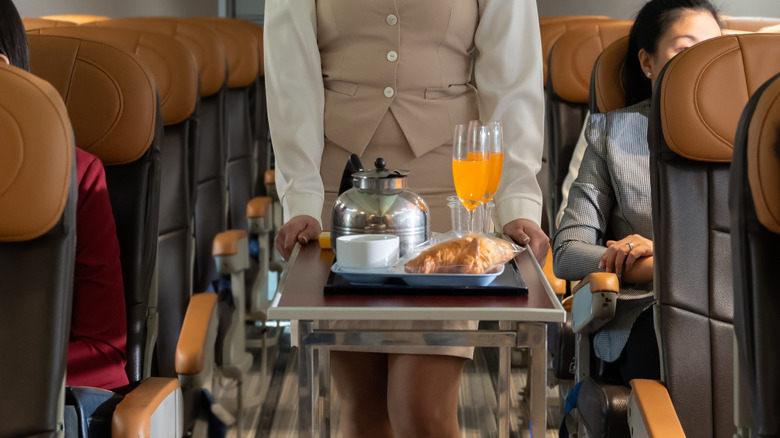
Even if you're hopping on a quick flight without an elevated airline menu, chances are your in-flight experience will still include a packet of cookies. Chances are even better that those cookies will be Biscoff. This near-ubiquitous darling of the fold-down tray table has origins that reach back to the 17th century and remains one of the most popular airplane cookies in the sky.
Speculoos is a longstanding staple of Belgian cuisine, a spiced biscuit made with toasty, caramelized sugar. Its story begins in the 1600s, when the Dutch East India Company introduced imported spices to Europe. In fact, the name "speculoos" itself is a nod to the speculaas spice blend first used to make the cookies: cinnamon, nutmeg, cardamom, cloves, and ginger. At least, the Dutch version of speculaas was made this way. Belgium's unique take on speculoos foregoes much of the spice bouquet – which would have been costly imports in the 17th century – and instead leans into caramelized brown sugar, cinnamon, butter, and kandij syrup for its distinctive toasty, toffee-like flavor and comparatively softer texture than its ultra-hard Dutch counterpart.
An alternative origin story posits that the speculoos name derives from the Latin "speculum," meaning "mirror." Early versions of the cookies were made in decorative molds shaped to look like Santa Claus. The resulting cookie would have been the mirror image of the mold. Other intricate designs, including windmills and ships, were also common. Traditionally, speculoos cookies were eaten on the feast day of St. Nicholas, celebrated on December 6. According to custom, children would place their shoes beside the fireplace overnight and wake to find them filled with speculoos biscuits and oranges — a nocturnal delivery from Sinterklaas.
Speculoos is a longstanding pillar of Belgian culinary heritage
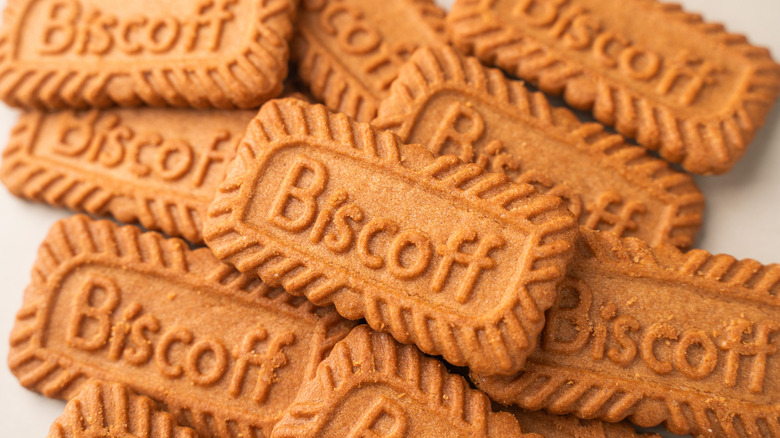
Over 400 years later, speculoos cookies are enjoyed year-round and all around the globe — especially on airplanes. Yet the treat's rich cultural and historical significance remains strong in Belgium. An important distinction: Biscoff and speculoos are not necessarily the same thing. Biscoff is one specific brand of speculoos cookie. Regardless of the name, the distinctive brown sugar and cinnamon cookies are commonly served alongside coffee in Belgian cafes. In fact, "Biscoff" is a portmanteau of "biscuit" and "coffee," a nod to the complementary pairing.
The cookie's place in Belgian culture was underscored in October 2020, when Lotus Bakeries CEO Jan Boone, grandson of the company's founder, announced plans to remove the word "speculoos" from Biscoff packaging. The proposal sparked public backlash from consumers who saw the move as distancing the product from its Belgian roots. Fans made protest memes. The controversy even culminated in the word being added to the official Inventory of Intangible Cultural Heritage in Brussels.
That same year, United Airlines faced Biscoff-related backlash for pulling the beloved treat from its in-flight experience. The replacement — Oreo Thins — proved unpopular with many passengers. Shortly after, United reinstated Biscoff and tweeted, "Internet, we won't go baking your heart. We have an ongoing rotation of snacks... so here's how the cookie crumbles for this round: OREO Thins = on board March 1. Biscoff = comes back May 1."
Biscoff speculoos cookies have dominated the skies since the 1980s
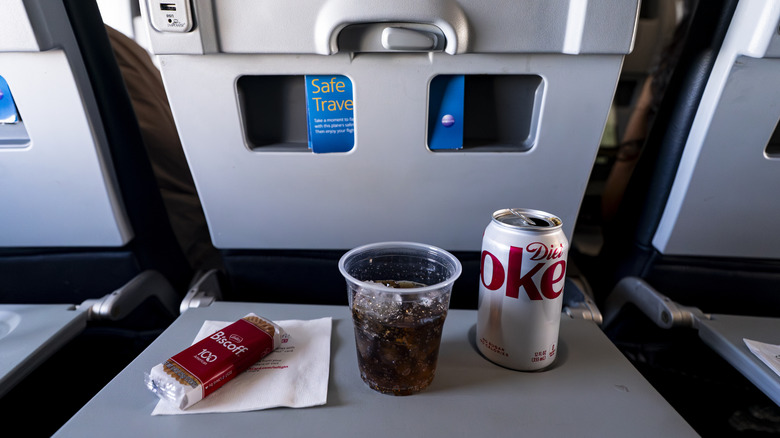
For fans abroad, speculoos remains one of Belgium's best-known culinary exports. Lotus Bakeries, maker of the red-and-white-packaged Biscoff brand, has been around since 1932, while Brussels institution Maison Dandoy has been making speculoos cookies since 1828. Some historians credit Maison Dandoy with being the first to use the French-influenced "speculoos" over "speculaas."
Lotus found a quick fanbase among foodies in Belgium and the Netherlands, and was the first company to sell the cookies in individually wrapped packets marketed toward the hospitality industry. The rest is history. Biscoff went global in the mid-1980s, expanding to Asia, and by the 1990s, Biscoff had a major presence on U.S. airlines. Nowadays, the company, which is still family-run and based in its hometown of Lembeke, produces roughly 7 billion cookies annually for fans in over 70 countries. Delta Air Lines alone serves an estimated 80 to 85 million Biscoff cookies each year.
Rectangular Biscoff cookies have emerged as such a popular in-flight snack not only for their flavor but for their compact size, long shelf life, low crumb (no mess), and sweet-spiced tasting profile, which can still be registered even when air passengers' sense of taste becomes dulled. In-flight anxiety? Crunch into a mildly spiced Biscoff and fuhgeddaboutit. Beyond airlines, Biscoff cookies have inspired spinoff desserts from Crumbl, and Trader Joe's even sells its own version of speculoos cookie butter. Here at Tasting Table, we're stirring this sweet-spiced ingredient into our espresso martinis. Those crispy Biscoff cookies are sold online and in many grocery stores – both an airline emblem and a pantry staple for foodies from pole to pole.